Discourses From the East


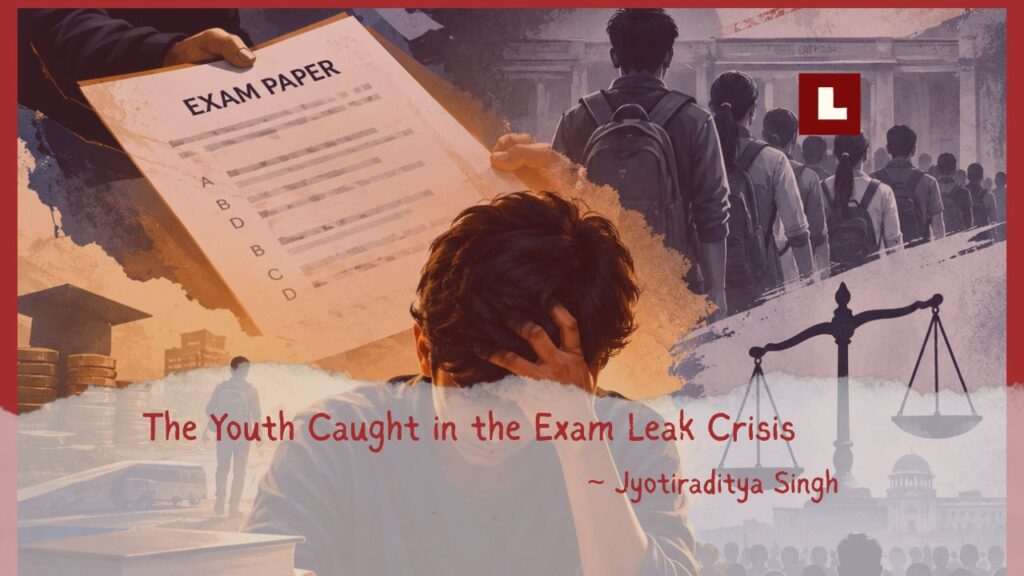
The late morning announcement on May 12, 2026, that the National Eligibility cum Entrance Test (NEET-UG 2026) stood cancelled exposed the fragile foundations of India’s centralised examination system, while devastating nearly 23 lakh aspirants and their families. It is profoundly cruel to disregard the thousands of hours that students devote to preparing for such an intensely competitive examination — hours filled with relentless hard work, sleepless nights, the pressure of coaching classes, endless mock tests, and constant uncertainty. The process takes a severe toll on the mental health of adolescents, who are forced to live under continuous anxiety and fear of failure. The burden becomes even harsher for students from economically disadvantaged backgrounds who cannot afford expensive coaching classes and yet are compelled to compete within the same unequal system. The history of controversies and alleged leaks surrounding the National Eligibility cum Entrance Test (NEET) and earlier medical entrance examinations in India reflects long-standing concerns about examination security, commercialisation, and systemic failures. In this piece, we will try to look at briefly the structural changes that the Indian education system has embraced over the years, culminating in the NEP 2020, which has led to this phase of coaching capitalism and ultimately paper leak
The crisis surrounding the NEET paper leaks cannot be understood merely as a failure of examination security or policing. It must instead be located within the long-term structural transformation of the Indian education system — a transformation that gradually shifted education from a public and social good into a competitive market governed by privatisation, centralisation, and high-stakes testing. The emergence of coaching capitalism and the recurring phenomenon of paper leaks are products of this deeper historical process.
In the decades immediately after independence, Indian educational thinking was strongly influenced by ideas of equality, nation-building, and social justice. Commissions such as the Kothari Commission advocated the Common School System, emphasising neighbourhood schooling, equal educational opportunity, and the reduction of social disparities. Education was viewed as a democratic public responsibility rather than a private commodity.
However, beginning especially in the late 1980s and accelerating after the economic liberalisation of 1991, this orientation began to change. The state increasingly withdrew from its welfare commitments and encouraged privatisation, self-financing institutions, cost-sharing mechanisms, and public-private partnerships, linking it to the market logic. Simultaneously, the engineering, medical, and management degrees became the pathways for economic mobility and a measure of educational success.
With decreasing employment opportunities and an increase in unemployment among educated youths, competitive examinations have acquired enormous social importance. Examinations such as IIT-JEE, NEET, CAT, and various state recruitment tests became almost gateways to survival, dignity, and middle-class aspiration itself, especially among those fortunate to have commensurate school education.
It was within this environment that coaching centres emerged as parallel education systems. Cities such as Kota, Hyderabad, Delhi, Patna, Sikar, and Latur became specialised coaching hubs where students spent years preparing for standardised examinations. Schools increasingly lost their importance, while coaching institutes became the real sites of academic preparation. A major structural shift was that a set of “dummy schools” appeared, where most of these students remain formally enrolled but devote their entire time to exam preparation. This helped India’s coaching industry to grow into one of the largest segments of the country’s parallel education economy. A widely cited estimate valued the industry at around ₹58,000 crore in 2024, with projections that it could grow to ₹1.3 lakh crore by 2028(“Inside India’s coaching industry and the struggle of govt job aspirants” investing.com, 10/07/2025) Market research firms estimate that the sector is growing at roughly 10–12% annually (“Coaching Industry in India 2026: Size, Growth, Challenges, Forecast” Business Base, 24/01/2026). This coaching ecosystem facilitates educational anxiety, competitive examinations, and unemployment to be converted into a massive commercial market.
Another contributing factor to this coaching market is the expansion of centralised testing. The National Testing Agency (NTA) was established by the Government of India in November 2017 under the then Ministry of Human Resource Development (now the Ministry of Education). It was created as an autonomous and self-sustaining testing organisation to conduct national-level entrance examinations. The NTA emerged within a broader policy shift toward centralisation and standardisation in Indian education. Instead of different institutions and states conducting their own admission processes, the idea was to move toward common national examinations conducted through a single centralised authority. Designed as a uniform test for admission to undergraduate medical and dental courses, NEET has replaced multiple state and institutional examinations, aiming to bring standardisation, transparency and fairness in medical education. Its vision is “the right candidates joining best institutions will give India her demographic dividend.” (nta.ac.in). But what a travesty!
This logic of centralised testing became even more prominent in the National Education Policy 2020. Although the NTA predates NEP 2020 by three years, the policy strongly reinforces and expands the same centralised testing framework. The policy proposes that the NTA conduct “high-quality common aptitude tests” and additional subject-specific examinations for universities across the country. This reflects the larger “one nation, one examination” approach that increasingly defines Indian education, which grossly undermines the regional variations in terms of educational quality and opportunities. The National Education Policy 2020 repeatedly emphasises excellence, merit, and global competitiveness, yet without adequately strengthening the public education system, such a model becomes deeply unjust. As government schools continue to deteriorate, large-scale school closures and mergers have deprived countless students — particularly those from rural, marginalised, and economically weaker backgrounds — of their rightful access to quality education and fair preparation for future competitive examinations. In effect, students from unequal educational realities are pushed into the same centralised competitive framework, even though many have been denied the institutional support necessary to compete on equal terms.
Moreover, the centralisation increases the stakes of a single examination. When millions of students depend on one national test for access to education and employment opportunities, competition becomes extraordinarily intense. Most importantly, it strengthens the coaching industry. Because the pattern, format, and structure of national examinations have become standardised, coaching institutes develop specialised systems for cracking these tests through repetitive MCQ practice, speed training, predictive modules, and exam-oriented preparation. Another systemic vulnerability is that centralisation affects the entire country when a paper leak happens, like the recent NEET case. So, this larger expanse makes the economic value of leaked papers extremely high, encouraging organised cheating networks, including interstate networks of educators and middlemen, impersonation rackets, and corruption.
The National Education Policy 2020 intensified many of these structural tendencies. Although the policy speaks of holistic and multidisciplinary education, its implementation has deepened the culture of centralised assessment, institutional autonomy linked to self-financing, privatisation, digitalisation, and market-oriented skill formation. At the same time, the policy does not adequately confront the deeper crisis of depleting educational quality, unemployment and shrinking public opportunities. In fact, NEP 2020 deepened the crisis of public education by encouraging the privatisation of education at all levels. In an economy marked by precarity and inequality, families increasingly invest their hopes, savings, and emotional futures into private education and examinations like NEET. The coaching economy thrives precisely because it converts social insecurity into commercial opportunity. Within such a system, paper leaks are not accidental; they become structural symptoms.
Thus, the NEET paper leak crisis reflects more than administrative failure. It reveals the consequences of a broader transformation in Indian education — from democratic public education toward a highly competitive marketplace of examinations, rankings, and privatised aspiration. In this system, education is increasingly reduced to mechanical performance in standardised tests, while the deeper goals of critical thinking, equality, and social transformation are steadily eroded.
Therefore, the solution to the crisis lies not simply in securing question papers but in fundamentally rethinking the structure of education and competitive examinations themselves. India requires a stronger, more equitable and inclusive public education system that reduces dependence on coaching centres and restores confidence in schools and universities. Another serious consequence of centralised testing mechanisms such as NEET is that students from states like Assam — particularly those from rural and underprivileged backgrounds — are placed at a structural disadvantage. These examinations largely privilege CBSE-oriented patterns, pedagogies, and question formats, while many students in Assam continue to study in state board schools with limited resources and unequal academic infrastructure. As a result, students from marginalised backgrounds are compelled to compete within a centralised examination system that often does not adequately reflect their educational realities, thereby deepening existing regional and social inequalities.
Competitive examinations must be decentralised, diversified, and made less exclusionary so that the future of students is not determined by performance in a single high-stakes test, to which they are not accustomed. Before the introduction of the National Eligibility cum Entrance Test, admissions to MBBS and BDS courses in Assam were conducted through a state-level examination known as the Assam Combined Entrance Examination (Assam CEE). A reintroduction of such a state-based system, with necessary reforms and safeguards to maintain transparency and broader academic standards, deserves serious consideration. Such a mechanism could also be suitably modified to maintain parity with national benchmarks while remaining sensitive to the educational realities of the state.
Moreover, education falls within the Concurrent List (List III) of the Indian Constitution, under which both the Union and State governments possess the authority to legislate on educational matters. In this context, the complete centralisation of admissions into state medical colleges through a single national examination raises important constitutional and federal concerns. Excessive centralisation undermines the spirit of cooperative federalism envisioned in the Constitution and weakens the ability of states to shape educational policies according to their own linguistic, social, and regional contexts.
At a broader level, meaningful reform also demands addressing the economic insecurities that intensify examination pressure. As long as education remains tied to scarcity, unemployment, and market competition, the cycle of desperation and corruption will continue. The paper leak crisis, therefore, compels us to ask a larger question: whether education should function as a democratic public good aimed at social transformation, or as a commercialised system of elimination governed by competition and fear.
This moment in the educational history of India calls for deep introspection and urgent public debate about the kind of education the country truly needs — inclusive or exclusionary; education for social transformation or merely for competitive elimination; education for whom, and in whose interests. Above all, it compels us to question whether the growing centralisation of power over education should continue, especially when such centralisation appears increasingly antithetical to India’s federal structure, linguistic diversity, and democratic polity as envisioned in the Constitution.