Discourses From the East

The Ideological Conflict
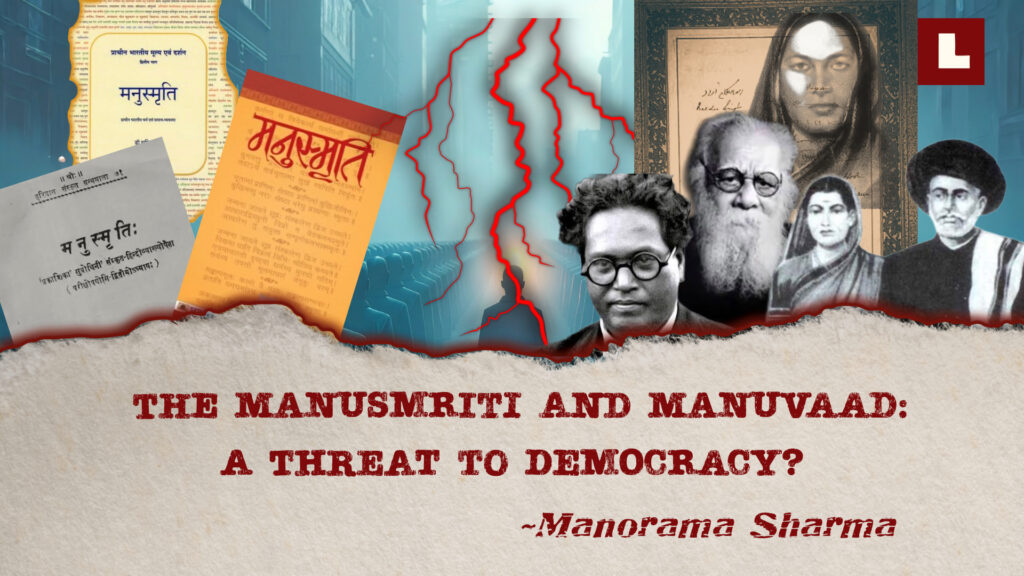
There is no doubt that today Indian democracy and the Indian Constitution are under threat because the political party in power is controlled by the ideological preferences of the RSS, which does not believe in either the values of the Indian Constitution or the principles of Democracy. In fact, an editorial of the Organiser, the mouthpiece of the RSS, dated 30th November 1949, complained that the newly drafted constitution of free India was not really necessary as India already had a constitution from ancient times as enunciated in the Manusmriti. The Organiser also published an article, “Manu Rules our Hearts” on 6th February, 1950 written by the retired High Court Judge Sankar Subba Aiyar, which reaffirmed the support of the RSS for the Manusmriti as the final law giving authority for India instead of the Constitution of India. Therefore, for the ruling party today, neither the Indian Constitution, which has secured for every citizen of the country the right to equality irrespective of religion, race, caste or sex, nor the principles of democracy are the fundamental principles for governing or building our nation. The ruling party and the RSS would rather have an India which is not a democracy but an undemocratic system which is governed by a patriarchal and misogynist mindset and the politics of caste discrimination because those are the undemocratic founding principles of the laws of the Manusmriti. It is therefore very important for us to look into the historical and socio-economic, and political realities in which Manu’s laws were founded in order to understand how dangerous it is to say that the Manusmriti should replace our democratic constitution and Manuvad to be the guiding principle of the nation.
The use of the term Manuvaad definitely leads us to the source of this term, which is the Manusmriti or the Manu Dharmasashtra, the primary Brahminical text which provides the laws of Manu. This text is said to have been composed between 200 BCE and 200 CE, almost a thousand or more years after the Vedic period. It is important to understand this time difference because this leads to certain very important questions about Indian society and culture. So those who today talk about a 5000 years old culture,civilisation and heritage of India should understand that the Manusmriti is only a very small part of it and the laws of Manu came to be articulated at a particular time of this long history according to the existing requirements of the social, economic and political realities of his times. There was also a territorial change of what was called Aryavarta, the land of the Aryas, over this period and by the time of Manu it covered northern India down to the Vindhyas, but interestingly not further south, as has been shown by Romila Thapar in her researches on ancient India. So today, when a section of people say that Manu’s laws should be followed by the whole country, history shows us that Manu did not make the laws for a society which covered the whole geographical area of what is India today. (The India of Manusmriti definitely did not include present-day Northeast India at all). Also, as Romila Thapar has pointed out very clearly, that it is not correct to view cultural heritage as something like a package that was packed many centuries ago and has been handed down from generation to generation in exactly the same form and which we today regard as our heritage. Heritage is something that each generation creates, invents, sometimes on the basis of existing realities and even fantasies. But the package of the past is opened continuously, some things taken out from it and other things added to it, and so it is a continuous process from one generation to the next. It therefore makes no historical sense to speak of heritage, in whatever form, as untouched and unchanged, constituting a tradition that goes back to five thousand years back. Those who are insisting today that we go back into the past and follow the Manusmriti are merely misusing history and trying to make our present reality fit into a reality of about 1500 years back where certain provisions were made to meet the requirements of the existing socio-political conditions of those times.
Patriarchy, Property, and Caste Stratification
Let us then have a brief look into how cultural ideas, forms and patterns of living are shaped, how they give rise to institutions which in turn shape the dominant patterns of thought that influence all sections of the society. History shows that in every society there are multiple patterns of living and therefore there are also multiple cultures. But generally, what has happened is that a culture has been defined by characteristics of the culture of the dominant, and usually powerful, sections of the society and the particular perceptions that this dominant section has of the rest of the society. So, cultures have also to be associated with inequalities of various kinds which have risen in the society. The major inequalities that have divided all societies, in the context of early India are patriarchy and caste. It is perhaps useful to begin with patriarchy because that also explains the other inequalities that exist in any society including the society in India at the time when Manu’s laws were proclaimed.
It is important to understand that patriarchy is a system which is not natural (like the biological difference between male and female) and therefore did not always exist in society. It is a historical phenomenon created by various socio-economic forces in a society and it has been created by historical factors. This is the reason why patriarchy does not exist in exactly the same form in all societies though its basic characteristics remain same which is the domination of the male over the female. But the nature and degree of freedom and unfreedom of the women vary in different strata of the society and in different parts of parts of the country and in the different stages of historical development. The studies done on the origins of patriarchy have pointed to the fact that there is a variance in the degree of the prevalence of either patriarchal or matrilineal norms in different types of societies. For instance, the hunter-gatherer societies tended to be more matrilineal while pastoral societies definitely begin to acquire patriarchal relations where control over the herds of cattle began to move into the hands of the men. As societies move to settled agriculture from this stage patriarchal norms became dominant and control over private property began the gradual process of the women losing their Mother right. (F. Engels, The Origin of the Family, Private Property and the State has a detailed discussion on this.) This evolution of gendered power relations is a process of history of societies when we try to look for the inequalities and the realities. A brief look into the emerging economic realities and the resultant social structures between the Rig Vedic, the later Vedic period and the period when Manu’s laws came into existence gives us a clearer picture of the socio-economic realities of those times.
The researches and analyses done by historians and Anthropologists have shown that, as can be understood from the terms used in the Rig Veda, land was not a form of property in the early Vedic age because that period was mainly a period of pastoralism (cattle rearing) and agriculture was hardly known. Although there were beginnings of the idea of ownership as in owning herds of cattle the concept of private property as is seen in the later periods was not there. But it can also be perhaps said that the seeds of patriarchy were sowed during the pastoral phase of human history. The Rigvedic times have also been very often identified with the origins of the fourfold division of society into castes, but it has to be understood that caste is something which is directly linked to the production and division of labour, and social stratification is something that takes generations to evolve and take shape. The early Rigvedic hymns may have provided a Brahmanical perspective for a form and structure to a caste society which would have matured in later periods. So, during this early Vedic period there were many matrilineal elements in the society which may have been remnants of the earlier tribal organisations of the society and therefore during this early Vedic period women were respected and held egalitarian positionsboth in the household and society. They had access to education equivalent to men, could study the Vedas, and were entitled to perform religious sacrifices. Women participated in philosophical debates and social gatherings, and their opinions were valued in family and community matters. Marriage was generally conducted after reaching maturity, and women could choose their husbands through Swayamvara, reflecting personal agency of women. However, when we look into the evidences and works in the later Vedic period we see a difference. (The works of historians like Romila Thapar, Suvira Jaiswal, N.N. Bhattacharyya, Kum Kum Roy and many others have provided information and analyses on these issues.)
By the later Vedic period agriculture and permanent settlements became a marked feature and thus by this time private ownership of property also became a necessary reality. Patriarchy became the major feature of power relations in the society and the division of society into castes a necessary phenomenon for the management of labour. The results of these developments can be seen in the position that women began to hold in society and their status declined in comparison with the early Vedic period. Early marriages became common, sometimes girls were married as young as 8–10 years, and daughters were increasingly deprived of formal education, dowry demands emerged, and widow remarriage was not consistently encouraged. The societal changes that came about with deepening of patriarchal relations gradually restricted women’s participation in religious and social life, leading to greater dependence on male family members. These are the historical realities that lead us to that period of developments in the social relations where there were specific necessities for streamlining labour and production relations to meet the needs of a developing agriculture and organising social norms on strict patriarchal values. Social structure became even more patriarchal as new vocations like trade and exchange began to rise and men played larger roles in these because these required travel to distant places. As a result of this, urban centres began to emerge and these centres began to reflect highly patriarchal social structures. (See Romila Thapar). These take us to a period about eight to nine centuries later than the later Vedic period when very definite laws, like the Laws of Manu or the Manusmriti were put in place to meet the specific requirements of the times. This ancient text has today become the carrier of a political philosophy named as Manuvada based on Manusmṛiti. The Manusmriti which is based also on earlier ancient texts like the Arthasashtra and the Dharmasashtra provides extensive instruction on the obligations of an individual throughout their life, and how these vary based on caste. The Manusmriti is the primary Brahminical text prescribing lifelong male control over women (verses 9.3, 9.2, 5.148) and prohibiting Shudras from accumulating wealth (verses 10.129, 8.417), with severe consequences for defiance (verses 8.270–271, 8.418). Its verses, reflect a patriarchal and hierarchical worldview aimed at maintaining social order through strict gender and caste roles. It must be kept in mind that by the late years before the Common Era (BCE) and the early years of the Common Era (CE) the economic and resultant political and social conditions had undergone immense structural changes. With the rapid growth of agriculture producing surplus and the rise of other vocations, there was a situation which now required specific norms for control over land, production and ownership. Thus, the necessity of organising labour and control over property led to formulating laws and norms which today are sought to be presented as necessary for an India in the 21st century.
The Prescriptions of Manu
There have been many translations of the Manusmriti beginning from the colonial times. Amongst some of the most reliable ones which have been used widely by historians and other scholars are those of Patrick Olivelle and George Bühler, and from their translations we get a comprehensive idea of the laws of Manu prescribed for the society at that point in time.
The text sought to consolidate Brahminical authority, but its prescriptions have been criticised for perpetuating systemic inequality. Understanding the Manusmriti requires balancing its historical context with its contested legacy, as it continues to shape debates on caste, gender, and social justice in contemporary India. Manu believes that women are like property, over which the owner alone has ultimate dominion. He unequivocally asserted that a wife cannot be freed from her husband through sale or rejection. Women were occasionally regarded in Manu’s code in the same manner as slaves or Shudras. Manu forbade women from getting divorced or getting remarried under any circumstances. Regardless of her husband’s personality and character, she was required to treat him as her God. Manu believes that a woman should never be left to fend for herself because she is, by definition, so divine and special that she must be protected and well-cared for by her father when she was young, her husband when she was married, and her son when she was old. Manu also states that the place where women are respected becomes the gods’ preferred home. This verse has been interpreted by many today (particularly by the followers in RSS) to say that Manu held women in high esteem, but if we place it against the other verses, it becomes clear that women are expected to be always controlled, and only when those controlled women are respected are the gods happy. Historians have also shown from evidence that Manu’s laws covered only the elite society of the time. Scholars like Patrick Olivelle argue that the text was primarily addressed to Brahmins and Kshatriyas, as evidenced by its extensive rules for these groups (1,034 for Brahmins, 971 for Kshatriyas) compared to minimal rules for Shudras (2) and Vaishyas (8). This focus suggests an intent to balance priestly and political power while marginalising lower castes and women.
Manuvad, the political philosophy emanating from the Manusmriti establishes a patriarchal framework where women are denied autonomy and placed under the authority of male figures throughout their lives. This reflects a broader Brahminical concern with controlling female sexuality and ensuring lineage purity within the varna/caste system. Chapter 9, which addresses the duties of husbands and wives, contains the most explicit statements, but related prescriptions appear elsewhere in the text.
The Manusmriti also enforces a rigid caste hierarchy and utmost inequality in the society, with Shudras at the lowest rung, primarily with the task of serving the “twice-born” castes (Brahmins, Kshatriyas, Vaishyas). The text explicitly prohibits Shudras from accumulating wealth, viewing it as a threat to Brahminical authority, and prescribes severe consequences for defiance. These prescriptions appear primarily in Chapters 8 and 10, which address legal and varna-specific duties.
In Defence of Social Justice
Without going into any further details in the Manusmriti, it is clear that this was a text that sought to safeguard certain emerging realities in a particular historical phase of Indian historical evolution. The philosophy of Manuvad does not uphold any semblance of the ideas of rights or equality, particularly the rights of women and the people at the lower echelons of society. The Manusmriti has to be viewed as a historical text necessary to understand the phases of development of the history of India, but it cannot be used as a legal treatise to be introduced into the Indian reality of the 21st century. This aspect was very clearly put forth by two stalwarts of social justice of the 20th century, B.R.Ambedkar and E.V. Periyar, who clearly showed the dangers of interpreting ancient texts in the modern world and seeking to implement the ideas of the ancient texts. Ambedkar very clearly pointed out that the prescriptions of the Manusmriti must be viewed through the lens of contemporary values and ethical standards. Ambedkar’s critiques were not merely academic; they were a call to action—a call to recognise and rectify the injustices built into many traditional practices. This is the approach that is the most appropriate way to move forward towards social justice which will remove the inequalities of caste and class, bring about social justice by protecting the rights of women and marginalised sexes like the LGBTQ+. Thus, talking about Manuvad and attempting to replace the Constitution of our country with the Manusmriti reflects the most backward looking and ahistorical mindset, which will be a danger to our democracy and our rights as equal citizens. The Manusmriti is neither democratic nor does it have any space for equal justice. Trying to implement an ancient text in a society of the 21st century is not only a mindless exercise, but it works against the interests of the country both within the country and also outside, as it presents our country in a very bad light. The attempt of the BAPS swamis to take Manu’s prescriptions for women to France recently and ask the French women to remove themselves from the public space made our country a laughingstock of the world. This too they did in the country of Simone de Bouveir, a leader of the feminist movement for equality of women. So let us protect our democracy, and our Constitution, which at least provides us all the space to be equal citizens of the country and gives women and all other marginalised sections the right to fight for equality and justice. Manuvad can never be acceptable to us. Only those who wish to dishonour the sacrifices of our freedom fighters, who gave their lives to create a new India where every Indian will be an equal citizen of the country with their rights protected by the Constitution of India will seek to bring back an undemocratic and patriarchal text like the Manusmriti to destroy the nation we have struggled to build.