
Discourses From the East
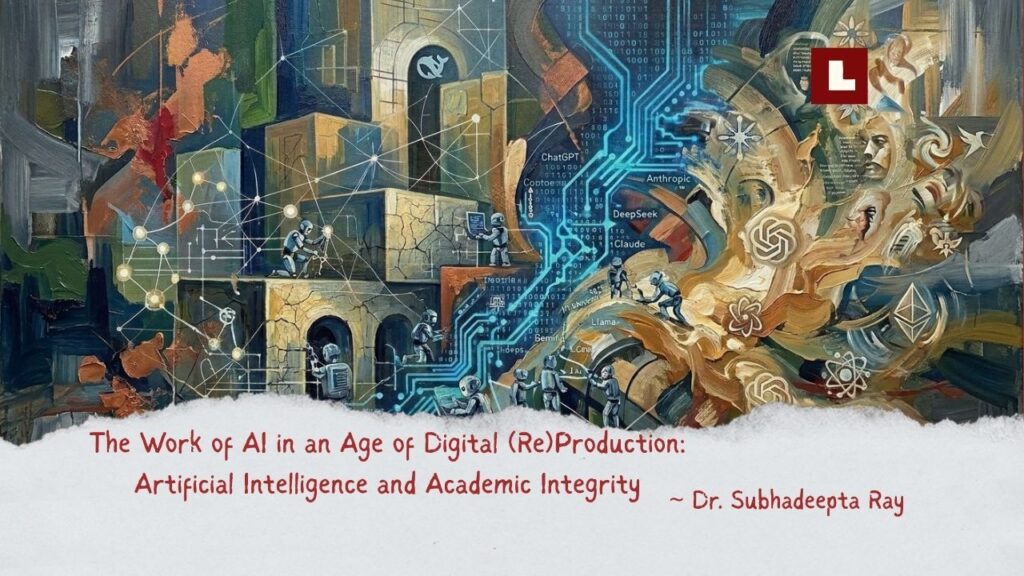

The release of Chat GPT an Artificial Intelligence (AI) application in November 2022, has unleashed a furore in the academic community. More such Large Language Model tools or companions like Claude, Gemini, Copilot has followed in its wake. In response to a prompt, the AI chat bots can generate coherent long form discursive prose on a given topic, prepare slides, summarise and generate content. This has led to universities in the USA to rewrite their academic codes of honour, initiating discussions on the issue, dividing academicians over whether they should ask students to go back to writing assignments by putting pen to paper or embrace AI and use Chat GPT as a tool, just like calculators. I argue that the Chat GPT and other AI tools obsession provides an opportunity to examine three issues that plague higher education in India in general and the university in particular. First, I examine the question of academic integrity (AI)[1] and the role of ethics in engaging machine intelligence. The second issue pertains to our response-ability to this AI turn. Finally I situate the Chat GPT controversy in the transformation of higher education and the university in contemporary times.
Academic Integrity: The Other AI
The University Grants Commission (UGC) has been formulating polices and recommendations regarding responsible conduct of research in higher education. In 2018, it introduced the UGC (Promotion of Academic Integrity and Prevention of Plagiarism in Higher Educational Institutions) regulations that prescribed punishment for academics and students engaged in plagiarism. In 2019, the UGC introduced a mandatory 2-credit course titled Research and Publication Ethics to be taught to PhD students across all disciplines in order to foster ‘awareness on publication ethics and publication awareness’. How does AI tool like Chat GPT complicate this situation? Apart from another additional factor of plagiarism, Chat GPT reveals that our epistemic and methodological frameworks developed in the 19th-20thcentury are inadequate to address issues that the ‘AI turn’ has ushered in. Foremost is the nature/society epistemic framework that organises our disciplinary hierarchies. For example our idea of the social as a distinct realm from the natural is premised on a set of separate methodologies and concerns with human interpretation that in turn is organised around dichotomies of fact and value or subjectivity and objectivity. For example research ethics is seen as, a moral issue of human foible, a lack of values, where responsible conduct of research means preventing falsification, fabrication and plagiarism or what in more prosaic terms are known as lying, cheating and stealing. If research ethics are a matter of pedagogic values that can be taught, what the AI turn reveals is that the non-human machine can also be taught. AI is different from software programming, though it is envisaged that future AI tools may be able to write programs as well. In both cases computers are used to solve human problems. For software engineers the task is to program computers using string of codes to carry out predetermined calculations and generate an output. AI extends this idea by engaging in a ‘pedagogy of the bots’ or machine learning, wherein AI platforms are provided with some initial rules of behaviour and are ‘taught’ by large human generated data sets. The ‘generative pre-trained transformer’ (GPT) is expected to explore and establish connections between various data sets independent of human instruction and produce intelligent solutions that are not predetermined outputs. That is, it uses human generated training data to mimic behaviours that are human like outputs. Does AI have bias? The case of Amazon using its recruitment software that relied on its human resource archive shows that the subjective/objective dichotomy afflicts machines as well. In this particular case, the AI demonstrated strong bias against women and despite repeated efforts to solve the problem, the research team abandoned using the AI based recruitment tool.[2]
The AI turn shows that our ethical configuration has to examine this relationship with the non-human other of the robotic machine. Ethics in this case is not only a human concern framed through utilitarian sum of consequences or Kantian sense of categorical imperatives. Is AI a sentient being and does it have feelings? Scholars have been examining this issue by comparing AI machines with invertebrate animals some of which like octopus have now been declared by law to be sentient beings.[3] But the larger ethical issue with Chat GPT is that it is not trustworthy and safe. The information collated may be inaccurate and bias and prejudice might creep into the data. It is now recognised that AI tools can ‘hallucinate’ that is create misleading, false and fabricated data. The anti-plagiarism software Turnitin fails to detect plagiarism in the Chat GPT response. Also in accessing Chat GPT our personal data is available for further use in ways that we do not know. How do we respond to these emergent issues that bring AI in collision course with AI?
Ethical Response-ability
If our existing methodologies seem slow to respond to the AI turn our assessment and evaluative procedures are no better. More importantly, in the research field, the use of AI brings to fore the question of authorship. Can AI tools be co-authors of research articles? Some journals are making explicit the range of AI usage that can be allowed in research publications and the need to self disclose such usage. However, authorship is still a vexed issue given our reservations of extending legal personhood to an AI tool. Varun Bhatta has rightly claimed that authorship cannot be attributed to Chat GPT since it does not conduct research.[4] Rather than the death of the author, Chat GPT announces the death of the written essay genre as the only gold standard of teaching and learning assessment. Ironically, the essay genre inaugurated by Montesquieu in the 18th century exploring the relationship with the cannibal racial ‘other’ finds itself cannibalised by a machinic other. So the anthropological quest to understand ‘patterns of culture’ has now shifted to non-human generation of ‘patterns of data’.
But the larger question is why write? Writing is perceived to be a skill that organises thought into coherent rational argument. It is one of three Rs (Reading, Writing and Arithmetic) that distinguishes humans from other species and informs our pedagogy. My contention is that technology already assists us in writing. For example the ‘grammarly’ suggestions that appear when we type email are one end of the spectrum, Chat GPT is a more sophisticated version of the other end. So is Chat GPT another digital tool that should be added to the repertoire of ‘digital humanities’? I contend that Chat GPT is an opportunity to engage in digital literacy. Rather than frame it as an ethics issue, I suggest that we engage with Chat GPT in our syllabi design making our position explicit in the teaching and learning objectives and learning outcomes. Instead of emphasising the written assignment as chief instrument of evaluation, we need to expand our canvas of assignments to include other multi-modal forms. This strategy would perforce allow us to explore applications and tools that the digital humanities revolution has ushered in. Students can be encouraged to do live class presentations, group work, make a video or pod cast that makes class room participation more engaging and process oriented. We can inculcate skills that machines cannot do such as critical thinking, teamwork, demonstrating creativity, honing communication and leadership skills. Maybe we can make our evaluation standards flexible by using Chat GPT to generate an assignment and comparing and annotating it. What does Chat GPT miss out? What are its strengths? How credible and accurate are its response? How do we create effective prompts? It is better to disclose the use of Chat GPT in the learning process rather than police and punish students because it is impossible to prevent students from using AI tools. Such time intensive assignments require more work on the part of teachers in the publish or perish model of the university where teaching is increasingly losing its meaning.
The University and its Discontents
Is Chat GPT another instance of technology replacing a human skill, just like the spinning jenny replaced hand weaving at the dawn of Industrial Revolution? Increasingly there is palpable fear that AI will replace jobs in all major sectors of our society including medical and legal professions. But steering clear of the celebratory or apocalyptic doom that AI portends, the Chat GPT controversy is a red herring that distracts us from other pressing issues of higher education in the university. The rise of the neoliberal administrative university has come about at a time when education in India has been declared a fundamental right and the idea of public university is being systematically gutted. The traditional idea of a university rested on knowledge as a public good. Education was seen as an instrument of social justice and mobility especially for marginalised groups (caste, tribe, gender, first generation learners). In India, the university was a space for inculcating democratic values of truth and justice, all of which seem an anomaly in the context of the rise of private universities and the shift towards neoliberal managerial efficiency and governance of the public ones. In the neoliberal administrative university, the student is a consumer and education is packaged product to be delivered through a grade. The celebration of technology overlooks the digital class, caste, gender and rural divide that was evident in the online class mode of teaching during the pandemic. The uncritical embrace of technology signals the demise of the university as a public sphere, an increasing instance of policing and surveillance marking the transition from a disciplinary to a control society. The reduction in funding has made the ad-hoc (adjunct) teacher a precariat, eking a living from semester to semester responsible for making ends meet.
More importantly the role of the university in producing data (that may be used by Chat GPT in the future) in the name of transparency, accountability and good governance is undermining professional values. The mind numbing hours spent by faculties at the cost of their teaching/research responsibilities in collating the same dataset for NAAC, IQAC, Annual Reports is turning teaching into what David Graeber (2018) calls ‘bullshit jobs’. Surely the tasks listed above welcomes an AI intervention. The increasing indices of measurement, ranking and auditing performance has resulted in an ‘audit culture’ that undermines professional autonomy. Moreover, the data generated has spawned a ranking race between universities and the rise of a commercial edutech sector that seeks to replace pedagogy by a product. AI led automation will generate an uneven nature of work. It will not lead to less work and more leisure, a utopia where a basic universal income will allow us to pursue our creative talents. In the future AI will shift the focus of automation from low skilled work to high skilled creative work such as pedagogy and teaching. In a country like India where labour is cheap it will result in a situation where low skilled routine work done by humans (that can be automated) will coexist with high skilled and creative work done by machines. The ethical issue is inherent in this paradox. What choices we make will shape the future of many fields including the academia.
[1] I use italics to distinguish Academic Integrity (AI) from Artificial Intelligence (AI)
[2] https://www.reuters.com/article/us-amazon-com-jobs-automation-insight%20/amazon-scraps-secret-ai-recruiting-tool-that-showed-bias-against%20-women-idUSKCN1MK08G
[3] https://aeon.co/essays/to-understand-ai-sentience-first-understand-it-in-animals?utm_source=Aeon+Newsletter&utm_campaign=ebc054fcb6-EMAIL_CAMPAIGN_2023_02_23_04_16&utm_medium=email&utm_term=0_-ebc054fcb6-%5BLIST_EMAIL_ID%5D
[4] https://science.thewire.in/the-sciences/can-chatgpt-be-the-author-of-a-research-paper/?fbclid=IwAR0W6ntXgrVJlqS1_WbN8nXLMjo1Bj7hPUS-oATB4qgjNMjo77NarHX5OcA




Good a blog toper