Discourses From the East
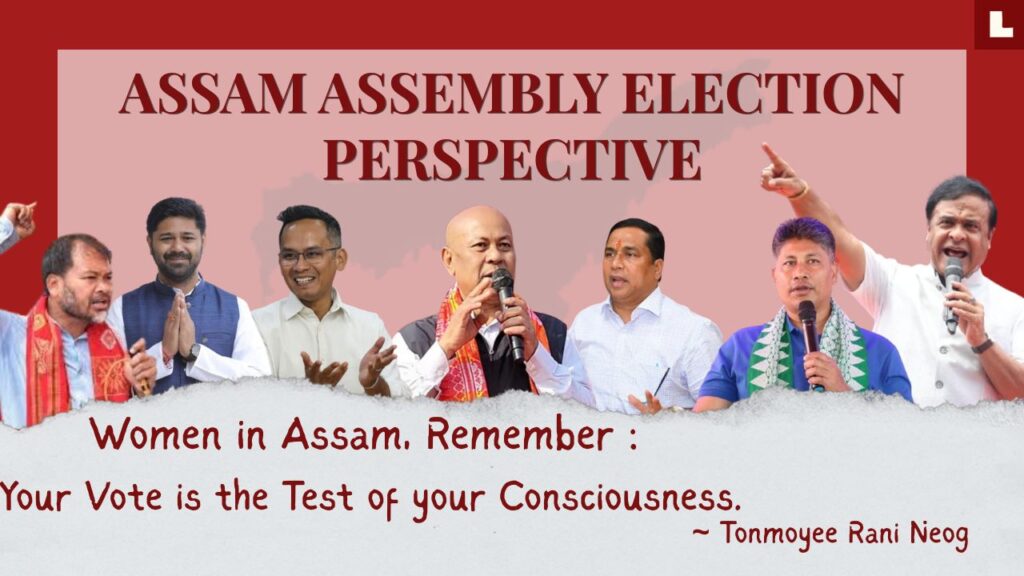

When a woman walks into a polling booth, she needs to carry some responsibilities beyond her individual political preference. She needs to carry with her the pain of the protests, petitions and the centuries of yearning. The right to vote, for women was not a gift voluntarily granted by the benevolent leaders. It was an achievement seized from the systems built to silence the women. This right was won with rebellion and immense courage.
Yet in recent times, as Assam prepares for the elections, a troubling pattern surfaces. Many women are drawn to the charisma and paternal promises of the conservative leaders. They are supporting and will undoubtedly vote without questioning the deeper motives that drive the politics of such leaders. It is not about telling the women whom to vote for, but it is about urging them to remember how hard this choice was once to claim and what it must still signify.
Before the independence of India, women suffrage was a subject of contestation. During the British colonial period, suffrage proposals started surfacing in the 1910s, influenced by the global women’s movements in Britain and United States. In India, leaders like Sarojini Naidu, Kamaladevi Chattopadhyay, Muthulakshmi Reddy and Begum Hamid Ali pressed for the inclusion of women in the electoral representation. The fight began within the folds of the freedom struggle itself. Women tied their demand for the vote to the larger claim of self-determination. If India was to be free, its women must not remain politically invisible.
In 1917, a delegation of Indian women, led by Naidu, met the Secretary of State for India, Edward Montague and demanded political equality. Their plea was politically dismissed. British administrators framed the demand as premature as according to them most Indian women were too ‘illiterate’ and ‘traditional’ to exercise political judgement. This may had concealed a fear that enfranchised women might upset the fragile balance of colonial control.
Yet, these early acts laid vital grounds. They challenged the notion that the women existed outside the realm of reason or public responsibility. The Government of India Act 1935 allowed limited suffrage for educated and propertied women. When India achieved independence in 1947, leaders like Hansa Mehta and Renuka Ray made certain that the constitution, adopted in 1950, guaranteed universal adult franchise. From the first general elections in 1951-52, every adult Indian citizen could vote equally. India started its democratic journey with formal equality at the ballot box.
Legal equality however did not automatically translate into political emancipation. The ballot is only as liberating as the consciousness behind it. A vote cast without questioning, a vote swayed by fear or by false promises and protection, can quickly become an instrument of one’s own subjugation. The point of suffrage was not to celebrate that women could now do as men do, but that they could think, choose and dissent as individual. It was like women’s voices would shape the consciousness of the country. Yet within the layers of patriarchal society, this right to vote remained partly unfulfilled. Political freedom cannot be measured merely by access to the ballot, but by the consciousness that animates it. Many women though enfranchised remain excluded from the deeper discourse of citizenship. The ballot alone could not dismantle the invisible architecture of subordination. Most of the women remain conditioned by inherited hierarchies. Patriarchy educates them to adapt not to question; to participate but not to think. The tragedy is not that women cannot vote, but that they are often not taught to imagine why their vote matters. True political education is in the realization that to think politically is also to exist fully as a human being.
As Assam gears up for its Assembly election on April 9, 2026, women voters nearly 50% of the 2.5 electorate are pivotal, yet increasingly vulnerable to manipulation. The BJP led government recently transferred Rs 9000 each to 40 lakhs women under the Orunudoi scheme (Rs 1250 monthly aid) just weeks before polls. As a result, women are flocking to rallies in support without addressing the deeper issues in the state. In today’s Assam, democracy often feels like a spectacle designed for emotional persuasion. There is absence of any civil reasoning. Social media, television campaigns fame the leader as savior. This appeals strongly to the women who have grown up within patriarchal patterns of authority. Many women find comfort in the figure of a strong populist leader who promises safety and welfare schemes. But they fail to understand that the welfare of the citizens is not a gift but an obligation of a state towards its citizens. Token representation doesn’t not substitute for genuine gender equality. The danger is that when a woman votes merely out of gratitude for receiving basic rights, she forgets that democracy demands active participation, not passive reverence.
The growing fanatism among the women in Assam for such populist leaders signals the failure of political education and the success of emotional propaganda. Women, having long been alienated from political debate find themselves seduced by visibility. This visibility can feel like empowerment, but the women fail to understand that it might not get translate into structural equality or autonomous decision making. Women fanatically rallying around charismatic populist leaders are enacting subjecthood in new costume of empowerment.
As Gramsci observed that domination thrives not by coercion alone but by winning consent and by persuading people to see power as natural and benevolent. This is the invisible mechanism that turns emotions to obedience, especially among those conditioned by generations of patriarchal trust. So being a conscious voter in such an environment means reading between the promises and remembering the historical struggles that placed the ballots in one’s hand. Conscious voting is a political act and a responsibility because it requires the voter to reflect upon existence. Who am I in this society, what structures limit my freedom. And how does my vote resist or reinforce these structures are some of the questions a woman needs to reflect repeatedly. Each woman voter must ask; does the leader I trust see me as a full citizen or just as a token of culture? Does this political movement value my mind or just celebrate my obedience? Are we voting for a future that expands our agency or a nostalgia past that reassigns us to service?
Across history, movements that seek to restore tradition begin by policing the conduct of women. The Manu smriti codified rules that confined women to domestic and reproductive roles and defined virtue as obedience to father, husband or sons. Practices like sati or purdah became moral battle grounds during the colonial era India. The obedient woman is considered respected while the assertive ones are spoiled. Political campaigns like Beti Bachao, Beti Padhao, Ujjwala Yojna etc. still picture women as dependents needing protection. A woman who is called Devi (goddess) is expected to tolerate injustice as scarifies. Idealization is seductive but also dehumanizing. Idealization replaces the real woman with a moral or religious idea. A leader or politics that humanizes her would focus on equal pay, bodily autonomy, equal representation and safety in public spaces. Simone de Beauvoir warned that woman is forever casts as ‘other’ revered and protected but never free. Modern populism continues this tradition but turning women into moral symbols of the nation but not citizens with voices of their own.
Politics in Assam has become a moral theatre and women as convenient carrier of its theatrics. To question and vote critically amidst such dramatics, is to interrupt this theatre, to assert that liberation cannot coexist with fear- fear of losing religious purity, family, honor, or male approval. The ballot becomes democratic only when it expresses autonomy. A regime that silences female journalists, restricts women’s movements, manipulate their emotions and undermines secular traditions cannot proclaim to protect women. Such politics protect patriarchy with a fresh coat of devotion. As Hannah Arendt observed that true political freedom demands we act, not merely applaud. In recent time, in assam, women risk becoming an audience to populist theatrics rather than co-author of their freedom.
To be a conscious woman voter in this era is to refuse seduction by emotional propaganda. It is to remember that Sarojini Naidu once stood before imperial power and said that Indian women seek no favors but justice. That Hansa Mehta insisted that the phrase, ‘all men’ be replaced with ‘all human beings.’ If women forget this history, their votes become signs of forgetfulness. But if they remember, reflect and choose with awareness, the simple act of pressing a button on the EVM becomes a declaration. That freedom once seized from the power will not be traded back for illusion.