Discourses From the East
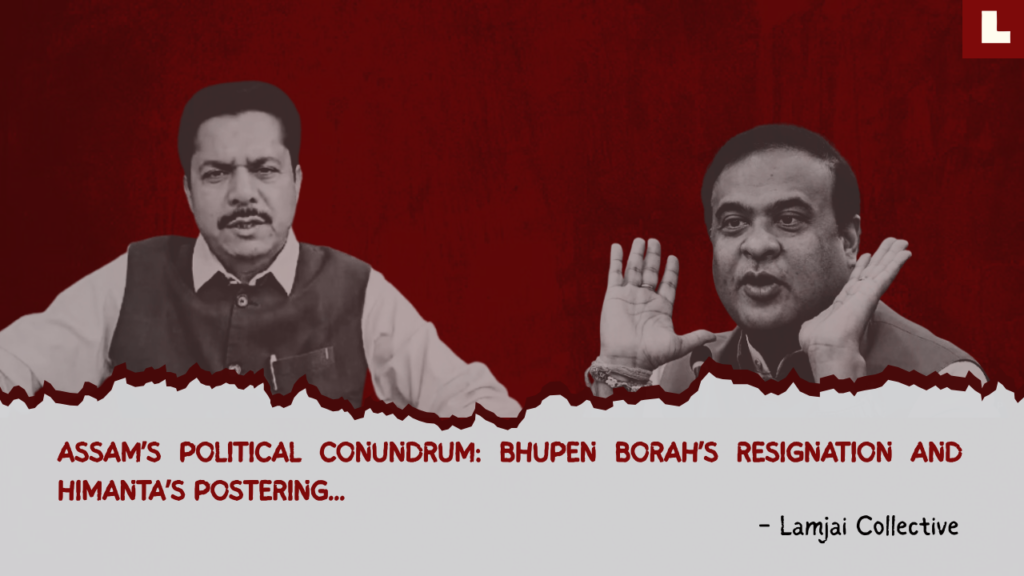
The resignation of Bhupen Kumar Borah from the Indian National Congress comes at a politically sensitive moment in Assam. With the Assembly election approaching, the move is more than a personal decision. It reopens an uncomfortable question for the opposition: is it organisationally prepared to contest power, or is it still struggling with internal coherence?
Borah is not an incidental figure. As a former president of the Assam Pradesh Congress Committee, he has been central to the Congress structure in Upper Assam and beyond. His tenure saw the party navigate a difficult period marked by the consolidation of the BJP’s influence in the state. That he has now chosen to step aside suggests deeper fault lines within the party’s state unit.
On the surface, the reasons cited appear organisational. Borah, in his public remarks prior to a closed-door meeting with party leaders, indicated dissatisfaction with internal decisions and the party’s recent direction. The transition of leadership to Gaurav Gogoi was meant to signal generational renewal and strategic recalibration. Instead, it seems to have exposed a gap between legacy leadership and the emerging command structure. Borah’s visible absence from the limelight in recent months had already sparked speculation. His resignation formalises what had become politically evident.
What this means in electoral arithmetic is another matter. Borah carries personal influence in parts of Upper Assam where Congress has historically retained pockets of loyalty. Losing such a figure, especially close to an election, risks erosion of vote share in constituencies where margins are often decisive. Yet Assam’s politics is not driven solely by personality. It is shaped by alliances, identity equations, and the broader narrative that parties manage to build. The Congress challenge was already formidable. Borah’s departure complicates it further.
The role of the Chief Minister adds another dimension. Himanta Biswa Sarma has repeatedly indicated that Borah would be welcome in the BJP. His remarks, both in the past and in the immediate aftermath of the resignation, are not casual. They reflect a calibrated strategy that the BJP has employed effectively in Assam: absorbing influential opposition figures at moments of vulnerability. The optics of such invitations serve two purposes. They signal strength to the BJP cadre and, at the same time, amplify perceptions of instability within rival camps.
Whether Borah ultimately joins the BJP remains to be seen. Political hospitality, especially during election season, often functions as both invitation and pressure tactic. If he does make that shift, it would not be the first high profile realignment in Assam’s recent political history. If he does not, the speculation itself still benefits the ruling party by keeping the opposition on the defensive.
Reactions from across the political spectrum underline the significance of the moment. Leaders within the APCC initially sought a dialogue, convening a closed-door meeting to assess the grievances. Such outreach indicates that the party recognises the symbolic and strategic loss. At the same time, offers from figures like Akhil Gogoi of the Raijor Dal, and expressions of interest from Left leaders including Manoranjan Talukdar, reflect an awareness that Borah remains politically relevant. These overtures are less about immediate arithmetic and more about repositioning within a fragmented opposition space.
There is also the media dimension. Commentary from senior journalist Atanu Bhuyan, who has recently been perceived as sympathetic to the BJP, has added to speculation that Borah may be edging closer to the ruling party. While such endorsements do not determine political outcomes, they contribute to the narrative environment in which decisions are interpreted.
The broader issue, however, is structural. Assam’s opposition has struggled to present a unified counter narrative to the BJP government. Electoral politics is not only about critiquing the incumbent; it is about convincing voters that an alternative is cohesive and credible. Repeated leadership exits and public disagreements undermine that perception. Even when the ruling party faces criticism, the absence of a consolidated opposition platform dilutes electoral impact.
Yet it would be simplistic to frame Borah’s exit solely as evidence of opposition failure. Internal churn is part of political life. Parties evolve, leaderships change, ambitions clash. The Congress nationally has been navigating transitions in several states. Assam is not insulated from that trend. The question is whether the party can convert this moment into introspection rather than fragmentation.
For the BJP, the situation reinforces its dominant position. The ability to attract or even appear capable of attracting opposition leaders reflects organisational confidence. For the Congress and other opposition groups, the episode is a reminder that leadership management and internal democracy are not abstract concerns. They shape public perception and, ultimately, electoral outcomes.
As Assam moves closer to the Assembly election, the immediate impact of Borah’s resignation will be measured in speculation and strategic recalculations. The long-term impact will depend on what follows. If it triggers further exits, it may accelerate a consolidation of power around the BJP. If it prompts structural correction within the Congress and sharper coordination among opposition forces, it could become a turning point rather than a setback.
For now, the resignation stands as both event and symbol. It is an individual decision, certainly. But in a pre-election landscape, individual decisions often carry collective consequences.