Discourses From the East
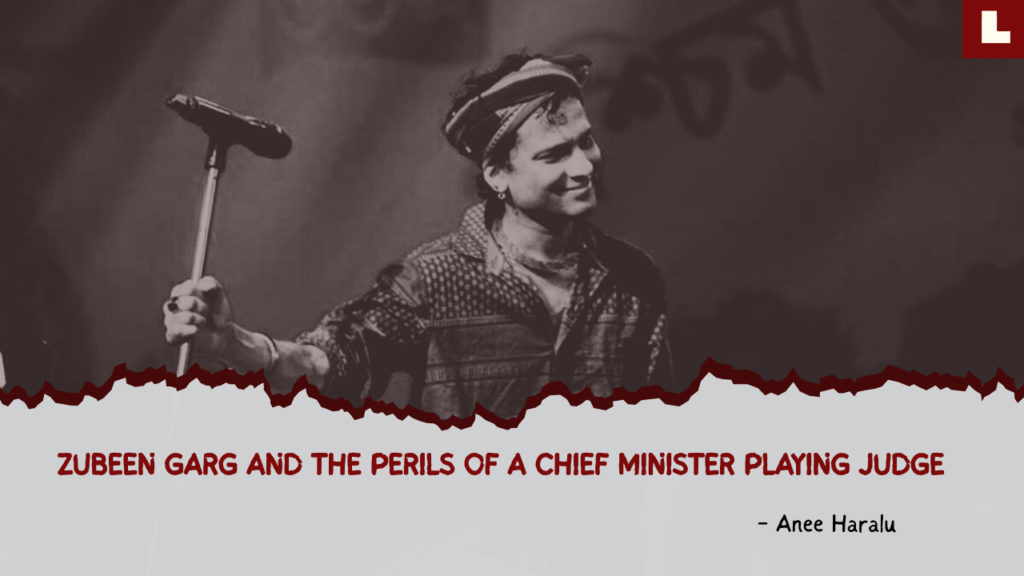

A sessions court in Guwahati has ordered the de-freezing of Shyamkanu Mahanta’s bank accounts and credit cards. Mahanta, along with Siddharth Sharma, is among the prime accused in the Zubeen Garg death case. The judge did it because the police did not follow mandatory safeguards under the BNSS while freezing the accounts. The court recorded two failures: no prior approval of the jurisdictional magistrate, and no report to that magistrate after the freezing. The prosecution framed it as “technical.” The court refused.
That refusal is the story.
This is where the case leaves Himanta Biswa Sarma’s microphone and enters the court’s record.
For months, Assam has been force-fed certainty. “Watertight chargesheet.” “Swift justice.” “No compromise.” The government wanted the public to behave as if guilt was already settled and only the calendar remained. Then the calendar arrived, and the record did what speeches could not do. It exposed the state.
When the executive speaks like a court, it trains the police and the public to treat the court as a formality.
This is a method of rule. The Chief Minister declares the conclusion. The police learn that the conclusion is not to be tested but fitted. The prosecution learns that safeguards can be brushed aside as “technical,” because the political executive has already delivered moral certainty.
The Zubeen case made this method visible because grief was public and the government’s need for control was public too. Calm, one narrative, one authoritative voice. Command over what people hear, when they hear it, and what they are allowed to call doubt.
Now look at how Himanta Biswa Sarma chose to speak.
On November 3, 2025, Sarma publicly said Zubeen Garg “was murdered” and announced a deadline for the SIT to file the chargesheet by December 8. That same day, the briefings also noted procedural clearances because the incident happened abroad. Sarma still chose to speak like a judge while the case was still being built.
This was wrong in a deeper sense. A Chief Minister has no business declaring “murder” as settled truth while the investigation is on and before charges are framed. In a rule-of-law system, the executive investigates through police and prosecutes through the state. It does not adjudicate.
An investigation is not a verdict. A chargesheet is not a conviction. A speech is not evidence. Yet Sarma chose to reverse that order. He announced the destination, set a deadline, and demanded the legal process catch up.
Then the record caught up. It did not match the microphone.
The unfreezing order is a window into how the state uses coercive power before trial. Freezing accounts is the state switching off access before conviction. That is why the law puts fences around it. The court recorded that the police ignored those fences. Then the prosecution asked the judge to overlook it as “technical.” The judge refused.
The state did not only fail procedure. The state then tried to train the court to accept the failure.
This is pre-verdict rule. It teaches police that ends matter more than method. It teaches prosecutors that safeguards are paperwork that can be argued away. It teaches everyone inside the system that the court is the last stop, not the first discipline.
Santanu Borthakur, senior advocate and vice president of the Gauhati High Court Bar Association, put it bluntly in a televised interview. This SIT was formed with officers the Chief Minister considers “efficient.” It filed a chargesheet. And yet it failed on a basic BNSS safeguard.
“If that SIT doesn’t know what is there in Section 107, then what does that indicate?” Borthakur asked. “Either they didn’t do a thorough job, or they did it deliberately. It has to be one of the two. Either way, they have deceived the people of Assam.”
On the unfreezing order, he used one Assamese word that carries the whole feeling: kerun. A catch. A hidden twist. Something wrong beneath the surface. Police officers receive training that seizures and freezes must be reported to the magistrate. “Despite that training, if the SIT did that procedural lapse,” he said, “that means there is some kerun somewhere.”
Borthakur returned to Sarma’s November declaration. “Who decides if a case is a murder? The court, of course. Then on what basis, with what material, did the CM announce that Zubeen Garg was murdered?” His answer was grim. “The material that has been produced before the court till now, I don’t think it is possible to prove in any court that it was a murder.”
He predicted what comes next. “You will see that after the election in April, one by one all the accused will be granted bail, which is their right.” And he named what the government will not admit. “The ruling party and the government have used the Zubeen case for political ends. People were demanding a fast-track court. But only now, just before the elections, is the government talking about it. What does all this show? They were and are using this case for electoral political gains.”
The court, meanwhile, continues the slow work that speeches ignore. It has set March 19 for consideration of charge hearing. It has rejected an attempt by Siddharth Sharma to obtain a copy of a Singapore police report, while allowing access to materials already acquired by Assam Police during a fixed window, March 10 to 12, 2 pm to 4 pm. It has also linked other contested issues to the same March 19 date, including the Mahabir Aqua angle.
And here is the line that should embarrass the entire “watertight” chorus. The court has made it clear that it cannot directly summon documents from Singapore. If additional documents are needed, the proper route runs through a Government of India request. The Chief Minister can declare “murder” on a mic. When the file needs Singapore, it runs through Delhi.
The record exposed a lapse. The government responded with a familiar offer: speed.
On February 27, 2026, the cabinet decided to approach the Gauhati High Court to constitute a dedicated fast-track or exclusive sessions court for day-to-day trial, framed as respecting the family’s demand. Sarma publicly said the government was “happy” with the existing court, especially since none of the accused have got bail, but chose to follow what the family wanted.
A fast-track court will not repair a sloppy file. It will expose it faster.
The government’s “speed” is theatre. It sells urgency while it manages delay. It did not want a fast-track court when the file was still soft, when the case could crumble in open court before the elections. It wanted time to hold the narrative together, time to keep bail away, time to keep the story looking “watertight.” Then a sessions court order exposed a procedural lapse, and suddenly the government rediscovered urgency.
Instead, Sarma has chosen to talk about “politics.”
On February 22, 2026, Sarma said, “This is full-fledged politics in the name of Zubeen,” and accused unnamed actors of trying to build an emotional environment ahead of elections.
When Sarma says “politics,” he means scrutiny.
This tactic has one purpose: it reverses accountability. Instead of Sarma answering hard questions about the state’s file, critics are asked to justify their right to ask questions at all. Ask about procedure and the response becomes motive. Ask why magistrate safeguards were ignored and the response becomes a sermon about emotion. Ask why the Chief Minister announced “murder” before a court process and the response becomes an accusation that questioning him is disrespecting Zubeen.
This is what a nervous government does. It shifts the spotlight from its paperwork to your tone.
But the court does not care about tone. The court cares about steps.
A record does not care about Himanta Biswa Sarma’s certainty. A record cares about whether the police obtained approval when the law requires approval. A record cares about whether the police reported what the law requires them to report. A record cares about whether coercive power was used lawfully. That is why the unfreezing order matters. It shows the record pushing back against the microphone.
This is not about guilt. It is about whether the state can prosecute without first tripping over its own shortcuts.
A government that declares murder in advance should also be able to prosecute with discipline. If it cannot, its moral certainty becomes the reason justice becomes harder, not easier.
Sarma chose the path of pre-verdict. He wanted to own the narrative early. Now the record is forcing a different lesson. The state cannot bluff its way through procedure. It cannot speak conviction into existence. It cannot treat safeguards as “technical” and still expect the court to protect its performance.
A state that wants a conviction should want fewer speeches and cleaner files. It should want fewer deadlines shouted into the air and more discipline written on paper. Otherwise, it creates the conditions for the defence to recast itself as the victim of an overconfident, careless regime. It hands defence lawyers the easiest argument in the world: if the state cannot even freeze lawfully, why should the court trust it on the rest?
If the Gauhati High Court constitutes a dedicated trial court, fine. Let it be a court, not a campaign prop. Let the prosecution do the slow clean work inside a fast timetable. Let Himanta Biswa Sarma stop speaking as if the verdict is already written.
The microphone can speak first. The record speaks last.