Discourses From the East
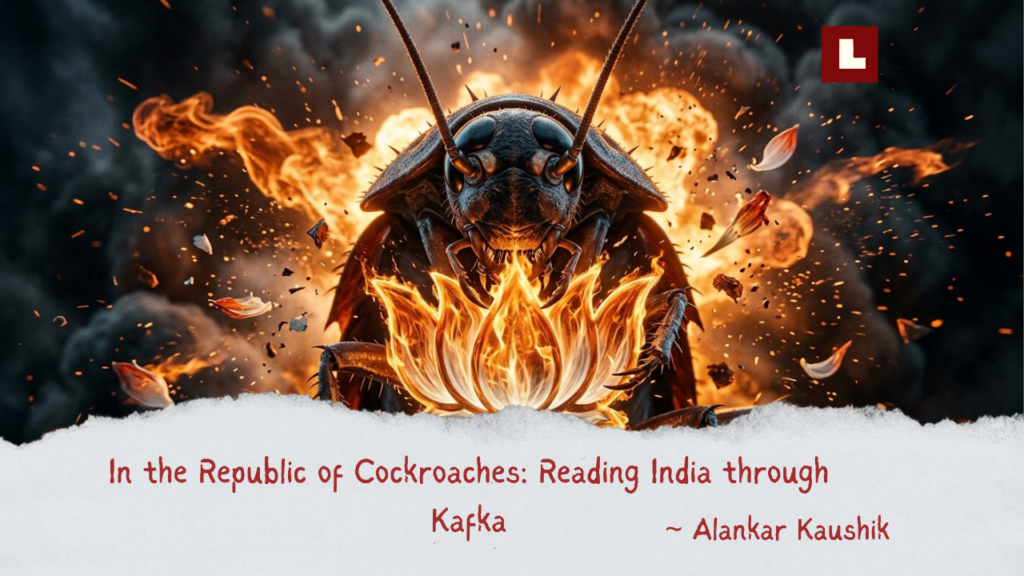

In Franz Kafka’s The Metamorphosis, Gregor Samsa wakes one morning to discover that he has turned into a monstrous insect. Yet the real terror of the story does not lie in the transformation itself. The horror emerges in the reactions around him. Gregor ceases to be seen as human. He becomes an embarrassment, an inconvenience, a burden to be hidden behind closed doors. His value collapses the moment his usefulness disappears. More than a century later, India’s youth seem to have staged their own Kafkaesque rebellion. Only this time, the insects are speaking back.
The sudden rise of the “Cockroach Janata Party”, abbreviated online as CJP, began as internet satire but quickly evolved into something politically revealing. Sparked by outrage over remarks allegedly comparing unemployed youth to “cockroaches,” the movement exploded across social media at astonishing speed. What initially appeared as meme culture soon transformed into a symbolic digital uprising. Young people embraced the very insult meant to humiliate them and converted it into a badge of resilience. The metaphor could not have been more precise.
A cockroach survives hostile environments. It adapts to collapsing systems. It feeds on the leftovers of structures it never built. It is despised not because it is powerful, but because it refuses to disappear. Perhaps that is exactly why so many young Indians chose it as their political mascot.
The emergence of CJP arrives at a deeply anxious moment in Indian democracy. India is simultaneously one of the world’s youngest nations and one of its most emotionally exhausted. Beneath the language of growth, digital transformation, and global ambition lies a quieter landscape of frustration. Millions of educated young Indians today inhabit a reality shaped by unstable employment, endless examinations, rising living costs, precarious gig work, and shrinking faith in institutions.
For years, the national imagination has been dominated by grand promises: development, startups, infrastructure, Digital India, global leadership, economic resurgence. The aspirational Indian citizen was told to acquire skills, work harder, remain competitive, speak the language of global capitalism, and success would eventually arrive. But aspiration without opportunity eventually mutates into exhaustion.
That exhaustion increasingly shapes the emotional landscape of urban and semi-urban youth culture in India. Young Indians today are more connected than ever before, yet many feel profoundly alienated from the political and institutional systems that claim to speak for them. They remain constantly visible in the digital world, while feeling socially unseen within structures of power and opportunity. Educational qualifications continue to expand, even as stable employment opportunities steadily contract. The language of entrepreneurship and self-made success dominates public discourse, while millions navigate lives marked by insecurity, precarious work, and quiet frustration. It was within this atmosphere that the remark emerged, a comment many young people experienced not merely as criticism, but as humiliation.
What followed was politically striking because the response did not resemble conventional outrage. There were no street marches, no party headquarters, no ideological manifestos, no charismatic leaders. There were memes, sarcasm, parody posters, fake campaign slogans, and viral jokes. Protest arrived not through organised politics, but through irony.
The Cockroach Janata Party weaponised absurdity itself. Its now-viral slogan “Secular, Socialist, Democratic, Lazy” may sound humorous on the surface, but it contains devastating political intelligence. It mocks not merely unemployment debates but the exhausted theatricality of Indian political language itself. Every party claims to represent “the people.” CJP instead claims to represent the emotionally fatigued. That distinction matters.
Historically, satire in India often functioned as entertainment rather than disruption. Cartoons mocked politicians; stand-up comics ridiculed public life. But social media has fundamentally altered the grammar of dissent. Memes now travel faster than manifestos. Irony carries greater emotional resonance than speeches. Humour has become not simply entertainment but a survival mechanism in societies where direct anger increasingly feels risky. This is precisely where Kafka becomes impossible to ignore.
Gregor Samsa’s tragedy in The Metamorphosis is not merely that he becomes an insect; it is that he becomes economically useless. The moment he ceases to function productively, his humanity collapses in the eyes of those around him. Modern India risks producing similar emotional conditions. An entire generation now lives suspended between relentless ambition and chronic exhaustion. In that landscape, the cockroach becomes an unsettlingly accurate metaphor for contemporary precarity, resilient, unwanted, and impossible to ignore. It reflects how many young people increasingly believe they are seen by power: excessive, unemployable, disposable, and politically inconvenient. But satire is never just satire.
Across history, absurd political symbols have emerged during moments of democratic fatigue. When conventional political language loses emotional credibility, societies often turn toward irony. Clowns, fictional characters, comedians, internet cultures, and parody movements rise not because citizens have stopped caring about politics, but because traditional politics no longer seems capable of expressing their emotional reality. The internet did not create India’s frustration. It merely accelerated its vocabulary.
What makes the Cockroach Janata Party fascinating is its refusal to behave like a conventional political movement. It oscillates constantly between parody and sincerity. One moment it jokes about unemployment and exam stress; the next it discusses media capture, inflation, institutional distrust, and political representation. Critics dismiss it as performative activism, and they are not entirely wrong. Digital movements often burn brightly and vanish quickly. Algorithms reward spectacle over substance. Attention spans collapse faster than ideologies. The internet excels at visibility but struggles with long-term organisation. Yet dismissing CJP entirely would be a mistake.
Because the real story is not whether the Cockroach Janata Party becomes an actual political party. It almost certainly will not. The deeper significance lies elsewhere: millions of young people instantly recognised themselves inside the metaphor. That recognition itself is political.
The phenomenon reveals something deeply unsettling about contemporary India: traditional political language no longer resonates emotionally with large sections of the youth, while television debates, ideological binaries, and political speeches increasingly appear scripted, repetitive, and detached from lived realities. In response, Gen Z has created its own political vocabulary chaotic, ironic, meme-driven, emotionally raw, deliberately absurd, and profoundly online though beneath the humour lies unmistakable despair.
The movement reflects uniquely Indian anxieties: competitive examination culture, precarious employment, rising mental fatigue, social media dependency, institutional distrust, and the growing fear that speaking honestly may carry consequences. Even reports of restrictions, takedowns, or alleged hacking attempts against online pages associated with the movement only intensified its symbolic power.
Nothing radicalises satire faster than censorship.The irony is extraordinary. A nation aspiring to become a global superpower now finds itself debating a political phenomenon built around cockroaches. But perhaps that absurdity reveals something essential about our historical moment. Cockroaches thrive in systems humans fail to clean. And beneath all the jokes lies a deeply unsettling question India can no longer avoid: what happens when an entire generation begins to believe that survival itself has become its only political identity? Kafka understood this long ago.
In The Metamorphosis, Gregor disappears slowly not because his body changes, but because society withdraws recognition from him. He becomes invisible while still alive. India’s youth are resisting that invisibility through memes.
The Cockroach Janata Party may eventually fade like countless viral internet movements before it. Algorithms move on. Outrage mutates. But even if the movement disappears tomorrow, it has already exposed something important about the emotional condition of modern India. It revealed a generation that has become deeply fluent in sarcasm because sincerity has repeatedly failed it. And perhaps that is the real metamorphosis. Not that young Indians became cockroaches. But that they learned to embrace the insult before power could weaponise it against them. That is not merely comedy. That is the politics of survival.