
Discourses From the East
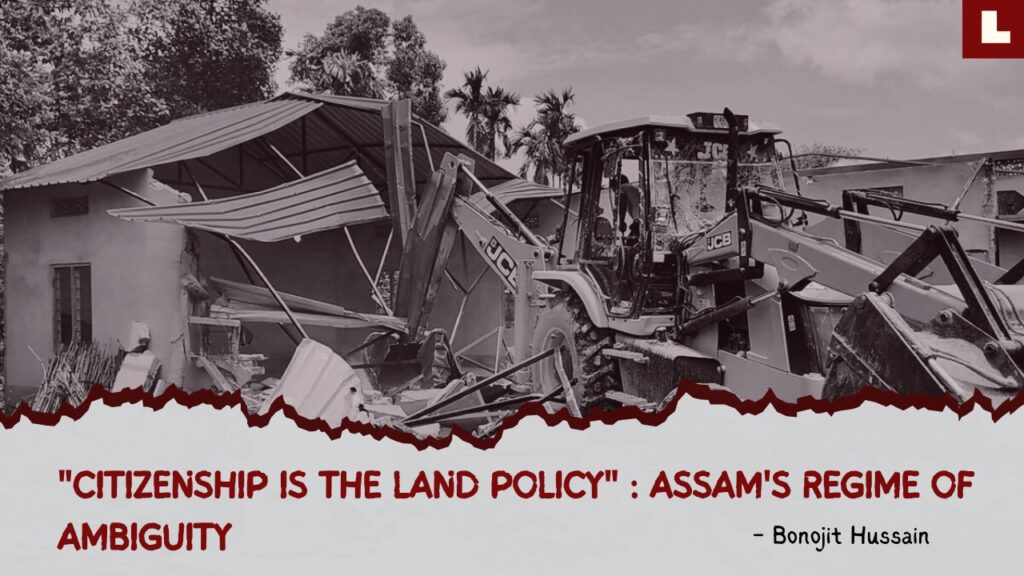

In Assam today, eviction is not merely an administrative act but a full-blown performance of citizenship, where the bulldozer does more than move earth, it actively sorts people into categories that are not neutral descriptors but the very operating system of land governance, a system powered not by clarity but by a deliberately cultivated and maintained state of ambiguity. This is not some new or sudden crisis but the logical culmination of a century-long project where the state’s persistent refusal to reconcile its paper records with the messy, lived reality on the ground has been refined into its primary tool of control, a regime where a category in a file can dictate the fate of a life and a home.
The Prehistory of Ambiguity: Learning Eviction Alongside Elections
The roots of this regime are not a mystery, having been laid down in political bargains and administrative evasions long before the bulldozers arrived. Assam did not discover eviction yesterday; it learned it alongside elections. By 1939, the politics of encroachment and settlement had already become the language of campaigns and ministries. During the fourth Saadulla ministry in 1943, for instance, a “grow more food” resolution promoted the distribution of so-called waste lands to encourage more migration from East Bengal, even as S. P. Desai’s inquiry reported widespread immigrant occupation and no true surplus to settle. The political storm that followed led to an all-party conference and a new government resolution in January 1945 that attempted to square these competing demands.
This 1945 resolution placed the proposed 1938 cut-off date at the centre of its remedy, reserving land for indigenous cultivators and tribal belts. On paper, it looked like a balance, but in practice, it preserved wide administrative discretion and left loopholes that allowed, for example, encroachers of more than three years to remain. The habits of discretionary enforcement formed in those years, the ability to enforce or ignore rules based on political expediency, continue to shape eviction politics today, establishing a precedent where policy is designed not to resolve conflict but to manage it through calculated ambiguity.
The Colonial Paper Trail and the Invented Idea of “Waste”
This early political maneuvering was built upon a foundation laid by a colonial taxonomy designed purely for fiscal control and extraction, a point scholars like Vittoria Di Palma have illuminated, showing how “wasteland” was never a neutral description of empty space but an elastic moral-economic idea where land was classified as “waste” not because people didn’t use it, but because they didn’t use it in ways that were legible to capital and the treasury, their practices falling outside the narrow metrics of revenue and improvement. This pliable vocabulary was a perfect administrative tool, allowing officials to translate complex, communally-managed landscapes, common pastures, shifting cultivation grounds, clustered hamlets, into sterile, governable office categories.
Under regulations like the Assam Land and Revenue Regulation of 1886, these officially designated “waste and unsettled tracts” could be granted at will to planters and settlers, while the Assam Forest Regulation of 1891 created “Reserved Forests” through a procedure that superficially invited claims only to systematically extinguish them unless licensed, a legalistic sleight of hand that alienated communities from their own habitats. The subsequent rhetoric, whether of “improvement” for plantations or later “ecology” for conservation, often masked a mechanism that remained fundamentally fiscal, a continuity where a landscape already made productive and meaningful by communities was rendered, on the official paper, a blank and vacant slate awaiting rescue and development, meaning the colonial categories did the quiet, bureaucratic work of dispossession long before the police or the bulldozers ever had to arrive.
The Postcolonial Pivot: From the Tiller to the “Indigenous”
At Independence, the new state inherited this entire bureaucratic toolkit but strikingly failed to dismantle its core logic, and the Assam Land Policy of 1972, for instance, while speaking a hopeful, developmental language of settling landless cultivators and converting precarious annual pattas into secure periodic ones, contained a fatal and telling flaw: it tried to settle people without first settling the record, with no time-bound mandate for a comprehensive survey of the very spaces, the chars, reclaimed beels, and forest fringes under hunger pressure, where “available” land actually lay and was already being used. This initial failure set a pattern, and by 1978 the government was already issuing remedial circulars to regularize “old occupations,” a clear sign that the policy on paper was disconnected from the ground, establishing the habit of deferring the hard, expensive task of accurate inscription and instead governing by exception and discretionary circulars.
The 1989 Land Policy, emerging from the politics of the Assam Accord, marked a decisive shift in language, moving from a general economic focus on landlessness to a specifically political one centered on the “Khilongiya/indigenous,” promising land to “indigenous landless cultivators” but crucially, and consequentially, never defining the term, while it gestured at regularizing long-term occupations it restricted this possibility to the small islands of already-surveyed land, leaving the vast ocean of informality to the discretion of local officers. The one act that could have turned these political promises into enforceable rights, a comprehensive, statewide resurvey of landholding that caught up with the reality since the 1960s, never materialized, so the rules and categories multiplied while the factual basis of the survey remained frozen. This was the fundamental hinge: the last effective statewide cadastral survey belongs to the mid-1960s, meaning on paper the agricultural frontier of Assam stops there, while in actual life it never did, and successive governments, Congress and others, found it electorally convenient and financially easier to preserve this documentary mismatch as a form of bureaucratic inertia, allowing ambiguity to become the very medium through which political power and patronage could flow.
2019: When Ambiguity Hardens into a Citizenship Filter
The 2019 Land Policy inherits this skeletal framework but refits it for a new, hardened citizenship moment, slashing allotment sizes down to three bighas for cultivation and explicitly elevating “indigenous” from a qualifier to the organizing principle of the entire policy, yet still, stubbornly, refusing to define it, thereby outsourcing the most critical decision of belonging to committees and local common sense that never quite settle it. Two stark clauses now convert decades of administrative discretion into outright doctrine: one states that mere possession by encroachment creates no entitlement whatsoever, and another mandates that revenue officials are duty-bound to evict “at the earliest,” a pairing that means the state’s own historical failure to inscribe lived tenure onto paper is now brilliantly recast not as a problem requiring redress but as the very grounds for removal and erasure.
This is the precise mechanism where citizenship becomes land policy in its most brutal form, because with “indigenous” left undefined, eligibility inevitably travels by common-sense proxies, surname, religious affiliation, settlement history, the pending NRC file, ensuring that the groups most in need of secure tenure, the erosion-displaced, the forest-dependent, often find themselves facing an eligibility test designed to doubt them first, so that a Mising household in Upper Assam and a Muslim peasant family in Dhubri can both stand outside the paper world for different reasons and yet be equally reduced to the category of “encroacher” when the excavator arrives, their differing rhetorics of exclusion culminating in a shared mechanics of removal.
Furthermore, digitization, often touted as a neutral tool for good governance, in this context merely accelerates the filter, and Mission Vasundhara serves as the proof of concept, marketed as service delivery for Khilonjiya households but functioning in practice as a state audit, compelling full disclosure of actual working holdings on government land where for many families a patta arrived only for a small regularized sliver of two or three bighas while the remainder of the land they relied on was clarified, mapped, and effectively queued into a new government inventory. When Advantage Assam 2.0 subsequently announced a Land Bank to pool this “available” land for industrial and infrastructural projects, the entire pipeline snapped into focus: the cadastral freeze produces the ambiguity, digitization turns that ambiguity into actionable lists, and the Land Bank converts those lists into bankable corporate stock, revealing that the bulldozer and the online form are not opposites but two complementary hands of the same governing body.
Citizenship as a Smokescreen for Broader Dispossession
The loudest and most politically resonant public script is, of course, that of the Bengali Muslim “encroacher,” a figure potent enough to fill rallies and dominate prime-time debates, but this powerful script, while real in its consequences, often functions as an alibi that buries a more pervasive and less televised story of dispossession. According to compilations by groups like the Land Rights Joint Struggle Committee (ভূমি অধিকাৰ যৌথ সংগ্রাম সমিতি), as of August 2025, of the over 55,000 bighas of land across the state recently marked for eviction, a staggering 49,000 bighas, nearly ninety percent, consist of indigenous tribal commons, ancestral lands, grazing reserves, and community-managed forests now staring down the barrel of dispossession, often to be rendered “available” for the very Land Bank meant to protect indigenous interests. This disproportionate targeting of tribal commons is ignored by the national outrage cycle because it is not profitable to centre tribal loss.
Autonomy and the Corporate Front Door
While the heated citizenship rhetoric effectively polices the back door, asking who entered and who belongs, large-scale dispossession often simply walks in through the front door, which is politely held open and marked “development.” Consider the recent allegations from Diphu in Karbi Anglong, a Sixth Schedule area endowed with constitutional autonomy for self-governance, where a political leader has alleged that about 1,53,250 bighas of tribal land are being lined up for corporate transfer, a list that includes parcels for major industrial houses; if even partially accurate, this would represent the largest single handover of land to corporate entities in Assam’s history.
The question here is not only about the jaw-dropping numbers but about the very meaning of constitutional autonomy, asking what autonomy truly means when elected tribal bodies under the Sixth Schedule are reduced to becoming brokers or rubber stamps for corporate land grabs, and what remains of self-government if the land that has sustained generations can be declared “surplus” by the state and parcelled out for private profit. When the language of “citizenship” is invoked to justify evicting the poor at the margins, and the language of “development” is invoked to justify alienating the commons at the centre, the two discourses, seemingly distinct, clasp hands over the same map, completing a circle of dispossession.
The Manufacture of Consent and the Necessary Path Forward
A modern regime of ambiguity like this one governs not only with files and machines but also with curated images and strategic omissions, so that when outside cameras arrive only for the spectacles framed around the “foreigner,” the state gains the political permission to act with impunity elsewhere, on tribal grazing reserves, in community forests, in settlements that lack pattas precisely because the state refused for decades to survey and recognise them. And when courts do intervene, the state can simply shift the legal category of the land, invoking forest protection one week, public purpose the next, and ease of doing business the week after, because the very elasticity of administrative names is the policy, and the steadfast refusal to clearly define key terms is the programme.
The consistent thread running from the 1972 policy to those of 1989 and 2019 is unmistakable: the recurring promise of settlement, the perpetual refusal to complete the factual inscription, and the steady, deliberate rise of citizenship and indigeneity as the ultimate criterion for mercy. The first two policies, for all their flaws, still lived with ambiguity; the third now actively weaponizes it.
The alternative, then, cannot be a nostalgia for colonial registers or a naive technocratic faith in digitization alone, but must be a robust political programme that deliberately reverses the current order of things, insisting on recognition before record, and rights before inventory. This would mean having the courage to finally define “indigenous” in a clear, justiciable law, or to retire the strategically vague word altogether from legal documents. It requires enacting a statutory right to resettlement for any household evicted from government land, with enforceable timelines and independent oversight, not leaving people to the mercy of arbitrary orders. It demands proactively publishing every eviction list with location, category of land, number of households, and a demographic breakdown, attaching the court orders authorizing removal and the official rehabilitation plan, or forcing the government to explain publicly why none exists. It means putting the Land Bank fully in sunlight, publishing its parcels, their provenance, planned use, and the consent or dissent recorded in gram sabhas, especially where constitutional protections like the Sixth Schedule apply. In these scheduled areas, free, prior, and informed consent must be made a non-negotiable precondition for any transfer, aligning tribal council decisions with community referenda.
None of this will happen, however, if we continue to allow citizenship to be used as an all-purpose solvent for political accountability. A politics that only ever names the “foreigner” at the back door while ignoring the broker at the front door will keep losing land by the acre even while it wins likes by the hour, a losing proposition for the very people it claims to protect.
We must call the present order by its true name: it is a regime of ambiguity, a sophisticated pipeline running from deliberate cadastral silence to corporate allocation, a process laundered through a citizenship filter that is left undefined on purpose. It governs by keeping people unrecorded, by keeping fields provisional, by keeping lived tenure permanently outside the law’s imagination. It dispossesses as efficiently by bureaucratic form as by physical bulldozer. To resist it, we will need more than momentary outrage; we will need a committed counter-cartography and a vision of citizenship that is a guarantee of rights, not a weapon of exclusion. The first, crucial step is to stop mistaking the political spectacle for the underlying policy, and to find the will to write, at last, a public record that is honest enough, and robust enough, that the bulldozer cannot simply erase it.









[…] entrepreneur, is that tribality? No. This caution comes from what I have elsewhere called Assam’s regime of ambiguity, where the state recognises people enough to govern them but not enough to secure […]