Discourses From the East
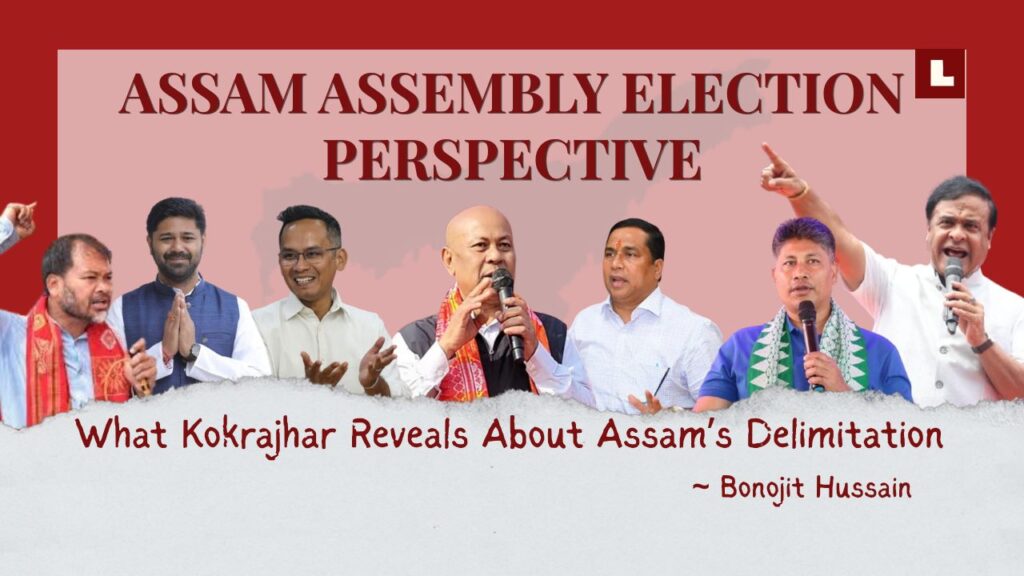

Assam’s 2023 delimitation is often described as communal gerrymandering. That is true, but it does not go far enough. In a state where electoral politics runs across multiple fault lines, religion, tribe, caste, language, autonomy, land, and local leadership, delimitation works less as a boundary correction than as an exercise in social engineering. But such engineering rarely produces clean outcomes. It redistributes power, yet also generates unintended consequences. Kokrajhar shows why the effects of delimitation cannot be read in a simple, one-directional way.
Formally, the 2023 exercise did not increase Assam’s 126 Assembly seats. It redrew boundaries and redistributed representational weight. That redistribution was not politically neutral. Chief Minister Himanta Biswa Sarma publicly claimed that after delimitation the BJP-led NDA could aim for 104 seats. The claim matters less as a prediction than as a window into how the ruling side understood the new map. Muslims have, in effect, been packed into around two dozen constituencies across Assam. The broader purpose seems clear enough: to compress minority influence into a limited number of seats and make the larger electoral field more manageable.
If the aim was simply to reduce the number of Muslim MLAs, the exercise may well be judged a success. But if the larger aim was to reduce the influence of the Muslim electorate across Assam’s wider field, the outcome is less clear. Reducing the number of seats from which Muslims can win is not the same as reducing Muslim electoral relevance. In a fractured state, a bloc can be packed, thinned, and still remain pivotal. Kokrajhar district in Bodoland offers one clear example of this limit.
In Bodoland, this mattered enormously because the new lines intervened in a political arena already shaped by autonomy, territorial bargaining, and rivalry between the two main Bodo regional parties, the Bodoland People’s Front, or BPF, and the United People’s Party Liberal, or UPPL.
The BPF emerged in 2005 and dominated the BTC for years under Hagrama Mohilary. The UPPL was formed later and, after the 2020 BTC election, led the ruling arrangement under Pramod Boro.
Before delimitation, Kokrajhar district had three Assembly constituencies: 28 Gossaigaon, 29 Kokrajhar West, and 30 Kokrajhar East. After delimitation, it has five: 1 Gossaigaon, 3 Kokrajhar, 2 Dotma, 4 Baukhungri, and 5 Parbatjhora. The Bodoland Territorial Region went from 13 to 15 seats. This was not merely an expansion. It created space for a finer redistribution of social blocs across the district.
That redistribution is visible in minority shares. Parbatjhora has around 168,000 voters, roughly 107,000 minorities. Dotma has around 104,000 voters, only about 13,000 minorities. Baukhungri has about 159,000 voters, roughly 45,000 minorities. Gossaigaon has 113,082 voters, around 19,500 minorities. In this belt, and in Manas as well, the minorities are overwhelmingly Muslims of East Bengal origin. These figures suggest a graded map of concentration and dilution.
Parbatjhora is the clearest packed seat. With a minority share of roughly two-thirds, it absorbed much of the minority concentration removed from adjoining constituencies. The main contest there is between Congress and the NDA-backed BPF candidate, and both sides have fielded Muslim candidates. Packing did two things at once. It thinned minority influence in adjoining seats while creating one where a Muslim victory became structurally much more likely. This is significant in Bodoland, where no Muslim MLA has won from within the region since the formation of the BTC.
Dotma is the opposite. Its minority share is around 12.5 percent. Baukhungri sits in between. Minority voters are not dominant there, but they are considered crucial. The district cannot be read through a simple binary of packed and erased.
The case of Gossaigaon is where the limits of this engineering become most visible. In 2021, old No. 28 Gossaigaon had 189,510 voters, of whom around 59,000, or 31 percent, were minorities. In the new No. 1 Gossaigaon, the minority vote has fallen to about 19,500 out of 113,082, or 17 percent. On paper, this is clear dilution. But the actual politics tells a more complicated story.
I had a ringside view of the campaign. Both the BPF and the UPPL remained deeply worried about minority voting behaviour. The BPF was worried because it needed to retain enough minority support to stay competitive. The UPPL was equally worried because its earlier alliance with the BJP had created a trust deficit among minority voters. Yet the internal assessment on both sides was simple: whoever secured the lion’s share of minority votes would likely win the seat.
The reason lies in Gossaigaon’s social composition. It is too fragmented for any single group to settle the contest alone. Bodos are the largest group, but they do not vote as a solid bloc. Santhals and Oraons together form a large Adivasi segment, but that vote is also split. Muslims remain substantial. Bengalis, Rajbongshis, Rabhas, Nepalis, Koch-Rajbongshis, Assamese caste groups, and smaller communities make up the rest. In such a field, size alone does not determine electoral centrality. What matters is how blocs split, align, or move outside the main contest.
According to party cadres and local activists, the Bodo vote was expected to split roughly 60:40 between UPPL and BPF. Hindu Bengalis and Rajbongshis leaned toward the BPF because of its alliance with the BJP. The Adivasi vote, however, was moving substantially toward the Jharkhand Mukti Morcha, or JMM, with Congress retaining some support because it fielded a Santhal candidate. Out of the Adivasi votes likely to be polled, the JMM would take the largest share, Congress a smaller but significant portion, and both BPF and UPPL very little. One major bloc was split, another partially aligned, and a third was drawn outside the direct BPF-UPPL contest. Under those conditions, the reduced minority electorate became decisive, not because it was the largest, but because it remained the most consequential bloc available for decisive aggregation.
The new map did not eliminate minority leverage in Gossaigaon. It changed its form. What was once a larger representational bloc became a smaller hinge. Delimitation reduced demographic weight without abolishing electoral centrality.
Field conversations underscore this. Many Muslim villagers of East Bengal origin said they would not vote for the BPF. Their reasoning was direct. In the BTC election, a significant section of Muslims had backed the BPF tactically against the UPPL-BJP combine. But after winning the council election, the BPF aligned with the BJP. For many, this was a breach of trust. They felt their vote had been used and reversed. Many now said they would vote for Congress. The UPPL, in turn, tried to persuade Muslims that a Congress vote would only strengthen the BJP.
There was also a third line of reasoning. Some voters argued that Hagrama Mohilary would not allow harm to come to minorities and that, if a Congress-led opposition came close to power, the BPF could still shift after the election. BPF cadres themselves advanced this argument, stressing that Bodoland had remained relatively insulated from the harsher anti-minority climate elsewhere, and that the BPF’s alliance with the BJP was shallow and reversible.
In one small bazaar near the Bhutan border, a young activist from the Muslim community added a harder edge to this logic. Adivasis and Muslims had traditionally voted Congress, he said, but this time the JMM would draw most Adivasi votes, making a Congress vote wasted. He then asked why Muslims should vote for an Adivasi candidate who, in his view, could not offer protection against the BJP and Himanta Biswa Sarma. The remark was harsh, but politically revealing. It showed how tactical voting, ethnic calculation, and the search for protection were converging.
The struggle for minority votes was visible in more organised forms as well. One morning, in an open field, I came across a huge gathering with roughly 2,000 women seated before a dais occupied by around 20 to 25 clerics in white robes and white headgear. There were no party banners, but the message over the sound system was explicit. The meeting was in support of the BPF, the NDA-backed party in the contest. I had already been told by sources that clerics linked to the Jamiat would begin intervening from 5 April. Some local clerics later identified the visitors as having come from Hojai and as being associated with the Jamiat Ulema-e-Hind. The precise organisational coordination behind the event may remain opaque, but its political meaning did not. Minority voters were being courted not only through routine canvassing and tactical appeals, but through larger religious and social networks as well.
But there was another layer: the fear of eviction. In Gossaigaon, I repeatedly heard that while evictions had intensified across Assam in recent months, Bodoland had remained relatively insulated, and that a BJP return could bring the same regime into the region. This fear cut across communities. Adivasis, small farmers, and even some Bodo households on contested land spoke in similar terms. Delimitation had already altered the electoral map. The fear of eviction added a second, more existential layer, making the election not only about representation but about security of habitation.
Nor is Kokrajhar the only place where delimitation has produced effects beyond straightforward Hindu-Muslim arithmetic. In the Manas constituency of Baksa district, the new demographics appear to have opened an unexpected possibility. By field accounts, a Raijor Dal candidate of the Congress-led opposition alliance, a caste Hindu Assamese, has become genuinely competitive in a seat where such an outcome would be historically unusual. The seat appears to contain roughly 61,000 Bodo voters, 60,000 Muslim voters, 55,000 Assamese-speaking voters, and 21,000 Hindu Bengali voters. The candidate said he was confident of winning. Local activists said he was drawing support from a majority of Assamese voters, including some with BJP leanings, and he believed that even a quarter of the minority vote could carry him through. When Akhil Gogoi campaigned in Manas, he concentrated especially on minority voters. Even where the new map may have opened space for a caste Hindu Assamese candidate, victory still depends on assembling minority support.
There may be another history at work in Manas. Part of the Assamese consolidation cutting across party lines draws on an older memory from the early phase of BTAD, when sections of non-Bodo society rallied together against Bodo assertion, before many reconciled to the permanence of Bodoland and aligned with one or another Bodo party. The new demographics in Manas seem to have reopened limited space for that earlier kind of Assamese consolidation. Delimitation does not simply rearrange present numbers; it can also reactivate older political sediments.
This is why Kokrajhar matters beyond Kokrajhar. The district shows several effects at once: Parbatjhora, where packing is clearest; Dotma, where thinning is sharpest; Baukhungri, where minority voters remain crucial without being dominant; Gossaigaon, where minority voters have been reduced but remain a hinge bloc; and Manas, where a caste Hindu candidate still needs minority support. The same delimitation exercise produces different political forms across adjoining and nearby constituencies.
That may be the larger lesson. The communal logic of the map is real, but its effects are mediated by other social divisions, tribal alignments, Adivasi voting patterns, local leadership, territorial autonomy, linguistic memories, and land insecurity.
Kokrajhar does not by itself explain all of Assam’s delimitation. But it does show why the exercise cannot be read through a single, clean arithmetic. In a socially fractured field, reducing minority representation does not automatically eliminate minority relevance. The communal logic of the new map is real, but its political effects may be more uneven, unstable, and locally mediated than its designers intended. That is reason enough to treat the new electoral order not as a settled fact, but as a field whose consequences are still unfolding.