Discourses From the East
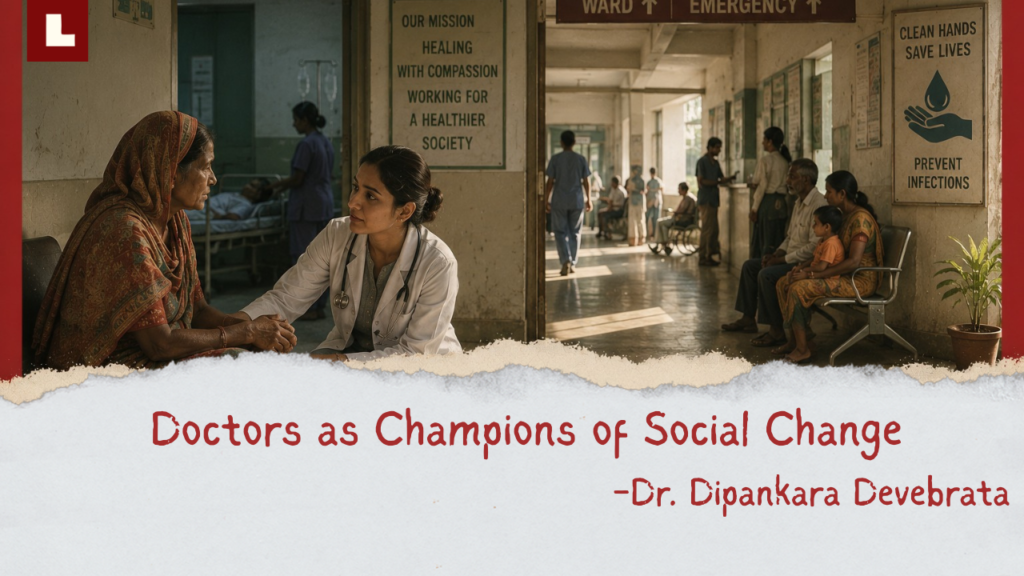

July 1 is Doctors’ Day, an annual observance aimed at appreciating the roles and responsibilities being played by each and every Doctor to keep India healthy. It is also a time for doctors to reflect on their own standards of practice, realise the responsibility they bear and improve the quality of patient care. The Day was established by the Government of India in 1991 to recognise the contributions of the legendary and internationally renowned physician Dr. Bidhan Chandra Roy. He was born on July 1, 1882 and died on the same date in 1962. He achieved the rare feat of obtaining F.R.C.S and M.R.C.P degrees simultaneously. He was also an educator, freedom fighter and politician. He served as the second Chief Minister of West Bengal for 14 years(1948-1962). Dr. Roy was honoured with India’s highest civilian award, Bharat Ratna, in 1961.
“The physician is the natural attorney of the poor”
– Virchow
Society expects doctors to help restore the sick back to their normal. However a doctor is trained not only to diagnose and treat a disease but also to analyse and find solutions to the adverse social factors contributing to diseases. According to the World Health Organization, “The social determinants of health are the conditions in which people are born, grow, live, work and age. These circumstances are shaped by the distribution of money, power and resources at global, national and local levels”. Clean air, clean water, safe housing and sufficient food are instrumental in promoting health. Issues such as equality, social justice, human rights and access to healthcare profoundly influence treatment outcome. Doctors witness the effects of the socioeconomic determinants of health in various degrees in every patient they see and are expected to advocate for economic and social changes that ameliorate human suffering. However this advocacy for societal changes is not an obligation and many doctors limit their advocacy to matters concerning individual behaviour like smoking and tobacco cessation, cancer screening, helmet and seat belt use etc.
Doctors have a long tradition of advocacy for health equity. The father of pathology, Dr. Rudolph Carl Virchow was a 19th century German physician. He believed that physicians have an obligation to work on behalf of the downtrodden and was an inspiring proponent of social medicine. He was born on October 13, 1821 in Schivelbein, Pomerania, then in eastern Prussia and died on September 5, 1902 in Berlin. In 1848 Virchow was appointed by the Prussian government to investigate an outbreak of typhus in Upper Silesia. This epidemic coincided with a famine, which had resulted from crop failures in previous years. Virchow in his report concluded that the typhus epidemic was more a social than a medical problem. He emphasised that although the origin of typhus is a bacteria, the spread and individual susceptibility to the disease is determined by social factors such as housing, working conditions, diet and sanitation.
The practice of medicine is distinguished by the need for judgement in the face of uncertainty. A doctor’s up-to-date knowledge and skill provide the explicit scientific basis for such judgements. Doctors have to take responsibility for the consequences of their decisions. A doctor can be said to be a good professional if he has excellence, altruism and accountability. Excellence requires doctors to continuously improve their knowledge and surgical skills and deploy new technology for better treatment outcomes. Altruism is selfless concern for the well-being of patients. Accountability is the doctor taking ownership of treatment outcome. However there is always a clash between patients’ high expectation and what doctors can deliver. Medical information, once the exclusive province of the doctor, is now readily available to anyone who has access to internet. However this carries a potential risk of misinterpretation and misinformation among the public. A doctor should have good communication skills as it helps to build a healthy doctor-patient relationship resulting in accurate diagnosis, appropriate counselling, improved compliance to the treatment and overall patient satisfaction. One can imagine the futility if a doctor prescribes medicines that the patient cannot afford or writes a legible prescription for an illiterate patient.
Doctors can become champions for social change by integrating advocacy into their daily practice. They enjoy a high level of respect and have an authoritative role in informing patients and communities on issues in health care. They should try to understand the social factors that influence the health of their patients, identify the local resources to address the issues raised and help the patients connect with these resources. They should engage in community outreach programmes and try to identify the social barriers to health care. Once identified, they should try to find solutions individually as well as in association with community organizers, policy makers and media. They can write Opinion pieces to raise awareness on social barriers. Medicine is both a science and an art, while the former implies excellence and dedication in practice the later expects the doctor to be a vocal supporter of policies that improve public health. Worldwide, life expectancy and health are directly linked with the government spending on public health programmes.
A reformer is a person whose action reshape the society for better. Presently climate change is the defining issue and more than an environment crisis, it is a social crisis. Health is affected through the impacts of extreme weather (floods, droughts, heat waves), poor air quality, changes in the spread of infectious diseases and decrease in food and potable water quality and quantity. Psychological stress due to displacement and loss of lives and belongings due to climate change leads to depression, anxiety, PTSD etc in vulnerable population. Doctors are trusted by communities and respected by policy makers especially against the backdrop of Covid 19 pandemic. Thus doctors are in a unique position to accelerate the creation of policies to mitigate climate change. Since impact of climate change is felt first and worst by the economically weak, climate equity is irrefutable. Health professionals are key climate advocates and they need to realise it immediately for a secure future for our children.