Discourses From the East
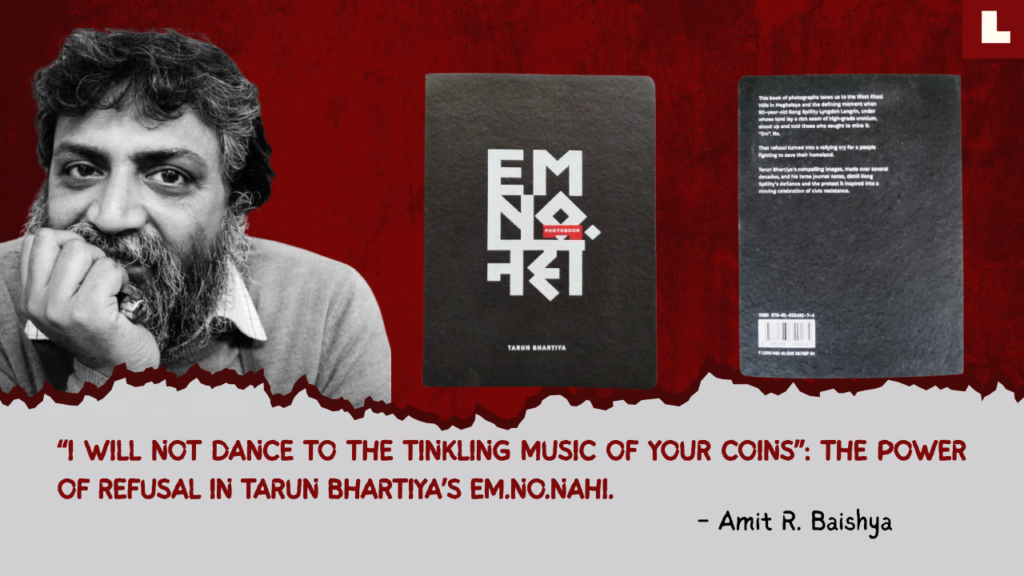

The late Tarun Bhartiya has the unique distinction of being part of the cast of characters in two of the finest contemporary English-language novels from Northeast India, Kynpham Sing Nongkynrih’s Funeral Nights and Janice Pariat’s Everything the Light Touches. Following the tracks of his appearances in the two novels, I initiate a cross-textual, transversal dialogue of the novels with his posthumously published photobook, Em.No.Nahi. My purpose here is to both review Em and to place it in a wider field of cultural production.
Roughly one-thirds into Em, we come across the following lines formatted in a verse-like format ostensibly in the voice of Kong Spillity Lyngdoh Langrin (d. 2020) from Domiasiat, West Khasi Hills, an aged Khasi landowner and matriarch who famously resisted the takeover of her ancestral lands by UCIL (Uranium Corporation of India Limited) for uranium mining:
When children,
like the drunken
servants of a
thlen-rearing family
were bleeding dry the
present I have seen the future:
When children were
drooling over the power-
stone I stood rooted
in my forefather’s land.
I do not recognize
the colours of your world,
They blind me:
I will not dance to the
tinkling music of your coins,
It is a screech to my ears. (55)
In her “Afterword” to Em, Bhartiya’s partner, Angela Rangad, writes that in 2007, public objections were raised to uranium mining (although the history of this resistance goes back to the late 80s), its most famous expression being the “single minded ‘em’ by Kong Spillity Lyngdoh Langrin, a resounding no from a resident of Domiaisat who happened to own most of the hills under which high-grade Uranium lay in large quantities” (191). Kong Spillity was offered Rs 45 crore for a 30-year lease of her land, but said, “Money will not buy my freedom” (159). While this statement by Kong Spillity amplifies her refusal of material gains in the verse-like segments above, the reference to the “drunken/servants of a/thlen rearing family…” introduce a geo-cosmological register to the resistance of the aged Khasi matriarch. I borrow “geo-cosmological” from the editors of the collection New Earth Histories who write that “geo-cosmologies” impels us to ask, “how earth has been imbued with spiritual significance or consider the spiritual traditions that identify earthly sites as mediating between the material and divine planes” (6).
Poet, novelist and folklorist Kynpham Sing Nongkynrih, especially, has explored and adapted the geo-cosmological myth of Thlen extensively in his folktale collection Around the Hearth, his masterful poem “The Ancient Rocks of Cherra,” and his two novels Funeral Nights and Distaste of the Earth. In “Ancient Rocks of Cherra,” Nongkynrih explains the Thlen-legend in a footnote: “Legend has it that the immense gorges of Sohra or Cherrapunjee, the wettest place on earth, were caused by the death throes of the Thlen, a gigantic man-eating serpent that once supposedly stalked its wilderness” (Yearning of the Seeds, 84). In Around the Hearth, Nongkynrih narrates that the man-eating Thlen was eventually killed when he was tricked into swallowing a hot iron-ball. Thlen’s death throes are a geo-cosmological narrative, as they “were so powerful that they made deep cracks in the land and created one of the most famous gorges in Sohra” (63). His death made the earth shake and caused the hills to tumble down with the debris blotting out the sun for a brief while.
Nongkynrih deploys the plasticity of the Thlen-myth flexibly in his fictions, most notably in Distaste of the Earth where a serpent speaks in a multispecies dorbar and presents a different ontological perspective to the putative anthropocentrism of the Thlen tales. I won’t go into this reversal of anthropocentrism from a multispecies perspective here, focusing instead on how Thlen is used to depict the vicissitudes of extraction in a resource frontier. The tale of the voracious man-eating serpent does not end with his presumed death. After Thlen dies, his destroyer, the divinity Suitnoh, mandates that the flesh of the serpent should be consumed in full. Not a single piece of Thlen should remain. An old woman though kept a piece of Thlen’s flesh for her son. The piece of flesh, having assumed the form of a small snake, tempted the old lady with promises of wealth if she preserved it. Fear and greed impelled the old lady to obey. Thlen kept his part of the promise but soon demanded “Khasi blood” and flesh as compensation. The old lady was forced to keep her part of the bargain, and since then Thlen’s bloodlust has continued unabated finding new accomplices who succumb to greed.
In Braiding Sweetgrass, Citizen Potawatomi thinker and botanist Robin Wall Kimmerer devotes a chapter to the monstrous figure of the Windigo. The Windigo is more than a mythic monster, and is an integral part of Anishinaabe ontology. Kimmerer writes:
Creation stories offer a glimpse into the world-view of a people…Likewise, the collective fears and the deepest values of a people are also seen in the visage of the monsters they create. Born of our fears and our failings, Windigo is the name for that within us that cares more for its own survival than for anything else. (305)
In Kimmerer’s new book, The Serviceberry, this insular, accumulative, egocentric attitude is characterized as the Windigo, “who suffers from the illness of taking too much and sharing too little” (81). The Windigo is a cannibal, “Windigo thinking” fosters a “cannibal economy” (91), contemporary Windigos like “Darren” [a generic name modeled on the CEO of ExxonMobil, Darren Woods] are “stealing our future, while we pass around the zucchini” (70-71).
Replace Windigo with Thlen and we are in Nongkynrih territory. The last chapter of Funeral Nights is titled “The Tenth Night: Serpent Tales (The Metaphor Gone Wrong).” His depiction of “Thlen-thinking” at the closure of Funeral Nights mirrors the “cannibal economy” and “Windigo thinking” depicted in Braiding Sweetgrass and The Serviceberry. The concluding pages of Funeral Nights ends with reflections on the costs of Thlen-thinking on the “Khasi psyche” (1000)—the story and its allegorical application to the present is a warning against Khasi “fratricidal tendencies” but “we misread it and chose to make Thlen a reality, an excuse to turn on each other” (1001). Thlen’s story is “the metaphor gone wrong, the metaphor misread, the metaphor mistaken for the literal truth” (1006).[MM1] [AB2] Thlen-thinking can also be read as a reflection of extractive practices. The effects of Thlen-thinking where local elites often collude directly with potentates from the post-colony to devastate lifeworlds and the environment are directly represented at various points in Funeral Nights, an example being the following depiction of the slow violence of extractive practices: “When the rain comes, coal dust is carried into rivers and streams and water sources, turning them yellowish-brown with acid and carbon. Neither humans nor any other creature can drink the water. There are many such dead streams and rivers in our state because of rat-hole mining” (97).
Spillity’s verse-like statements in Em is also an example of the Thlen-metaphor gone wrong. The segment contrasts “children”—the younger generation—twice with the speaking “I.” The “children” are legatees of the old woman’s greed, “servants of a/thlen-rearing family,” “drooling over the power-/stone.” Like vampires, they suck the lifeblood of the present. But the “I” is “rooted” in the past and sees the future. This temporal bi-directionality—rooted in the land of the forefathers and seeing the future—is accentuated by the ocular and the auditory. The “colours” of the realm of Thlen blind the “I,” the “tinkling music” of coins transmogrifies into a horrific “screech.” Temporal bidirectionality fuses with a spatial bifurcation: rooted in the “now,” the “I’ institutes a sharp demarcation between the realm of Thlen and the habitable world that needs to be respected, nurtured and preserved. In Botany of Empire, Banu Subramaniam makes an important distinction between the “native” in settler colonial discourses and the “native” in indigenous studies. “Native,” as it is used in invasion biology is “the ‘native’ of settler colonialism, of stolen land, commodification of plants, and short-term profits…” (196). The “native” of indigenous studies refers to “affective ecologies, relationality, and attachments nurtured over long periods of time” (196). Spillity’s “rootedness” in the soil is an index of such relationalities and attachments nurtured over the longue durée.
Unlike Nongkynrih and Pariat’s fictions, Em is a multimodal text, fusing text and image—so it would be amiss to focus on the written word alone when we approach it. The specificity of Em’s compositional principles and narrative trajectory can be contended with better if we contrast it with Bhartiya’s collection of postcards Niam/Faith/Hynñiewtrep. I have suggested elsewhere that the techniques and principles of montage underpin Niam. In Niam, Bhartiya invites us to make non-linear, contrapuntal correspondences between images of the everyday, archival documents and pictures, snippets from Uttar Pradesh’s notorious anti-conversion bill, and segments from narratives like those by U Radhon Sing Berry Kharwanlang. I write: “Multiple histories plotted multiperspectivally and kaleidoscopally via the ephemeral: it would not be amiss to use this as a tagline to describe Niam”
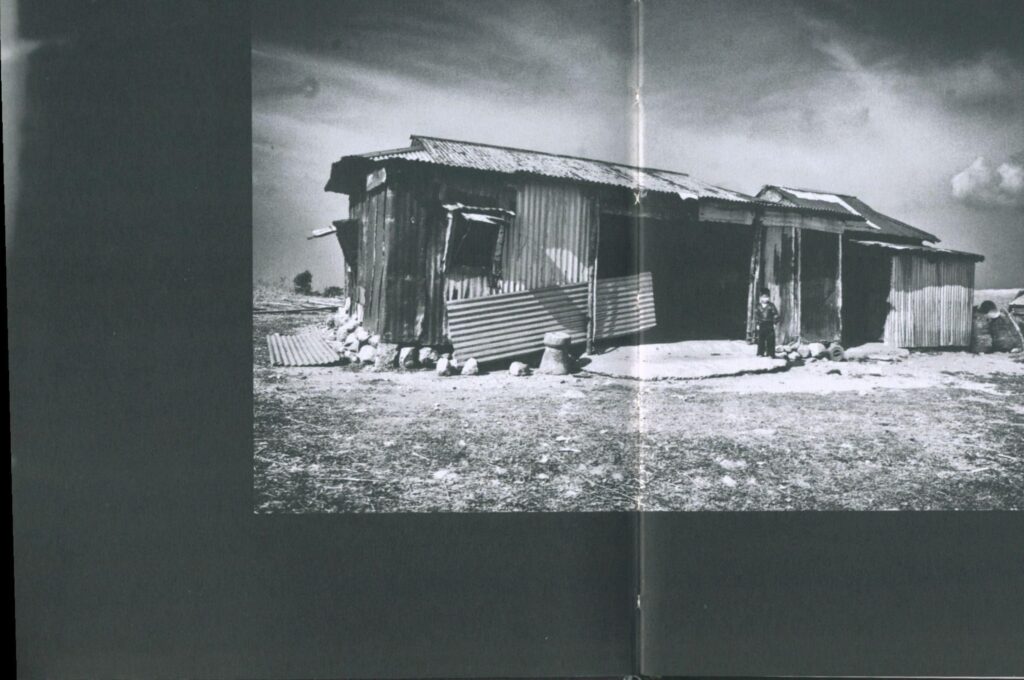
The principle of composition and arrangement in Em is different and leans more towards the narrative flow of a documentary film with attendant time shifts. There are 72 B&W images in the collection (the only colour image is that of Kong Spillity towards the end) taken in a two-decade period between 2006-25. The first four images are like a prologue—a montage of “establishing shots” of the landscape of the West Khasi Hills with the third one especially using letterboxing to aid contrast enhancement. In this letterboxed image, a small child stands in front of a ramshackle hut possibly looking at a vehicle passing by (Figure 1). These four images denote the progress of a journey which ends in Domiasiat on October 28, 2020, the date of Kong Spillity’s death. The first “chapter” deals with Kong Spillity’s funeral and the associated funerary rituals with the last image being that of a sacrificed pig about to be incinerated.[1]
The second “chapter” loops back to 2006 and begins with a previous journey to Domiasiat: “Eight hours from Shillong by a rickety wooden bus, then an hour’s walk. India’s largest Uranium deposits lie beneath it” (27). The chronotope of the (rickety) road reveals contiguities between Everything the Light Touches, Funeral Nights and Em. In all these texts, as we journey via the rickety road to Domiasiat, we notice poverty eating into the hills, to echo Nongkynrih from “Ancient Rocks of Cherra.” We are in the realm of Thlen. In Everything the Light Touches, the urbane Shailin (or Shai), the central character in one of the four narrative threads, describes the road on the way to rural West Khasi Hills thus:
The road, though already potholed starts deteriorating rapidly beyond Mawkyrwar…
We could be at the very end of the world, except I can see clusters of houses, small villages…
As we near the Domiaisat area, the asphalt road ceases to exist. In fact, its more of a riverbed, all boulders and deep pits, and our bus is the lone vehicle rafting on these rapids of mud and stone…(36-7).
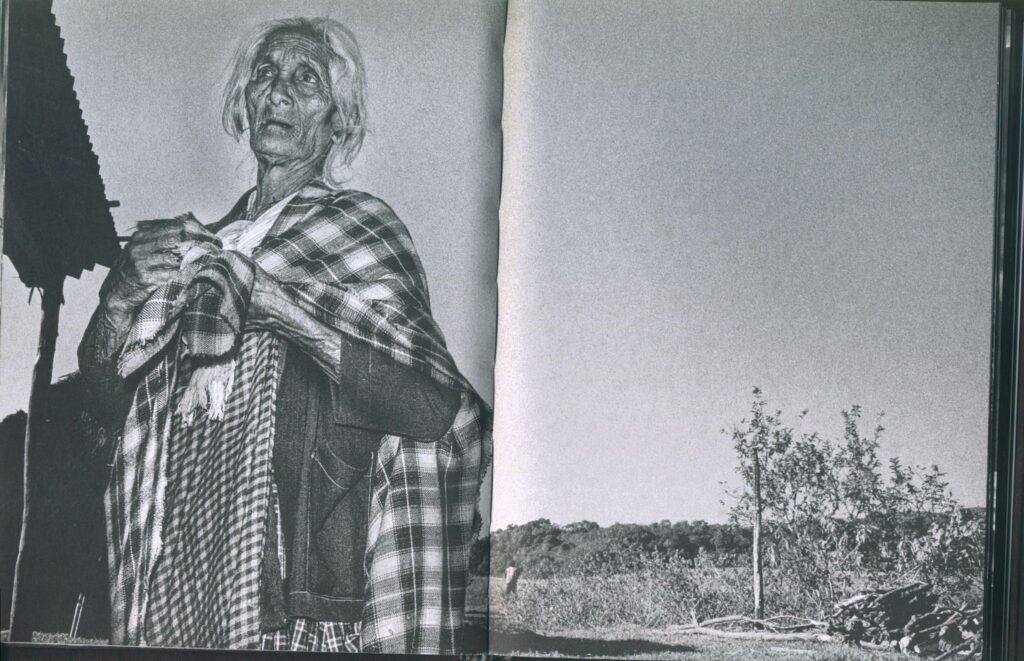
Bhartiya provides a visual complement to this narrative passage with the first image of the second “chapter” where he shows the back of a vehicle as it wends its way on the dirt track towards Domiasiat. A centerfold of the winding road then reveals four images of the sights seen during this journey including one of Mawbynnas (Khasi-Jaintia ritual megaliths) that are such a striking visual presence in Niam. Two pages of text in Khasi and English (38-9)—Em is a bilingual edition—mark a caesura which indicates that the bus route has ended and that we need to walk towards Domiasiat. After four other images of the sights encountered during the journey by foot, we come across the first full page spread of Kong Spillity (Figure 2). We set foot in Domiasiat and Bhartiya enables us to wander around and glimpse life in the village in the subsequent images comprising this “chapter.”
The third “chapter” of Em is set in 2007 when Bhartiya was able to con his “way into an exposure trip to Jadugoda” which UCIL organized for some Khasi notables to counter the “so-called false narrative that the anti-Uranium movement was supposedly spreading with screenings of (the documentary) Buddha Weeps in Jadugoda, dubbed in Khasi” (77, emendations in parentheses mine). The photographs constituting this “chapter” were taken after this trip in Nongbah Jynrin in the Khasi Hills and shows both pro and contra views towards UCIL and uranium extraction. Rangad writes in the “Afterword”:
While there was a firm ‘em’ from Kong Spillity and constant vigilance and strategic campaigns to block Uranium mining by the Khasi Students Union, there also began to appear a ‘tentative yes’ from villages that had been neglected for decades. The promise of ‘development’ and its spoils were attractive in a place where viable roads were almost non-existent. The ‘anti-politics machine’ was kickstarted into action and soon development began to be peddled. (191-93).
The shadow of militarization, the diabolical twin of extractivism in Northeast India, is evident from the very first image of this “chapter” where the framing from inside a tea-stall shows an army man in fatigues silhouetted by a door while shadows and darkness reign in the interior space. A centerfold of people signing bureaucratic documents opens into a four-fold single image of a line of women probably waiting for official disbursement. A full-page spread of an open-pit—poverty eating into the hills and squeezing a living from the stones, to paraphrase Nongkynrih again—is at the head of a triptych of images. The other two are those of abandoned run-down, hutments and the deanimated and fragmented corporealities of trees alongside a headstone that ironically states: “Donated by Uranium Corporation of India.” One is reminded of the following lines from Nongkynrih’s “Kynshi”:
Inevitably, however, here too,
time has left its ugly wounds.
Pines like filth are lifted from woodlands in truckloads.
Hills lose their summer green,
blasted into rocks,
into pebble and sand
and the sand is not spared. (Yearning of the Seeds, 44)
However, these images of militarization and the vicissitudes of extraction are counterpointed in this “chapter” by images of people protesting in places like Maykyrwat and snippets of quotidian life and activities.
Janice Pariat’s arborophilic novel Everything the Light Touches has several intertexts—Carl von Linnaeus’s Lachesis Lapponica and Systema Naturae, JW von Goethe’s Italian Journey and Metamorphoses of Plants, Craig Holdrege’s Thinking like a Plant, and Kimmerer’s Braiding Sweetgrass. Since both Kong Spillity and Bhartiya appear in the last part of the novel, and since there are clear connections between what Bhartiya writes here and how he is represented in Pariat’s novel, Em can retrospectively be considered a central intertext for Everything the Light Touches as well. These connections are strongly evident in this third “chapter,” including the representation of the peddling of development and the impact of the anti-politics machine. The senior Tagore-philic Bengali bureaucrat who took a liking to Bhartiya during his trip to Jadugoda and is mentioned twice in this “chapter” (77, 99), appears in a slightly different guise as a figure pontificating about the myth of the lazy (Khasi) native in Everything the Light Touches. In Em, Bhartiya asks the bureaucrat about making people refugees in place because of uranium mining. The bureaucrat responds: “What displacement? We will rehabilitate them It is so easy. How many have to be rehabilitated? A thousand, maximum. We will pay them, even make houses for them, give some of them salaried employment. They will become ‘reachable.’ Anyway, they are such unproductive people, they may have land, but don’t know the value of that land” (99). Notice the repetition in what the technocrat says in Pariat’s novel: “We will rehabilitate them—it’s so easy. How many have to be rehabilitated?…We will pay them, make houses for them, give them salaried employment, they will become rich and anyway they are such unproductive people, they have the land, but they don’t know the value of that land…” (459).
Besides the repetition of characters and situations, Em is also an important intertext for Everything the Light Touches because of the counterpoint to the Bengali bureaucrat’s instrumentalist worldview provided by Bhartiya. Compare what Bhartiya says in the “Endnote” of Em (179) with this passage by Tarun (the stand-in for the actual figure) in Everything the Light Touches:
Most people in this country…have no idea how to deal with others who think of land not merely as a factor of production but as imagination, an Eden to live in…People who have lived with land being privatized, expropriated, labor being turned into commodity, and hierarchy being sacralized, find it difficult to understand Kong Spellity. It’s a conflict between those who think a bigha of land makes you finally free and those who think many hills don’t make you rich. It’s the world of productivity against the dream of commons lived and kept alive. (459)
This passage shares elective affinities with Pariat’s other inspiration Braiding Sweetgrass where Kimmerer contrasts settler colonial attitudes to land with those of the displaced indigenous inhabitants: “In the settler mind, land was property, real estate, capital or natural resources. But, to our people, it was everything: identity, the connection to our ancestors, the home of our nonhuman kinfolk, our pharmacy, our library, the source of all that sustained us. Our lands were where our responsibility to the world was enacted…it was a gift, not a commodity, so it could never be bought or sold” (17). Braiding Sweetgrass and The Serviceberry are Kimmerer’s response to Garrett Hardin’s controversial essay on the “tragedy of the commons.” In his 1968 essay, Hardin introduces his well-known phrase by conjuring a picture of a “pasture open to all” (1244). While “tribal wars, poaching and disease” (1244) keep numbers of herdsmen and beasts within limits for a while, once an optimum level of social stability has been achieved, the tragedy of the commons is inaugurated. The herdsmen using the commons are motivated by self-interest and keep adding cattle to their individual herds. Eventually, limitless acquisition of heads of cattle by individual herdsmen leads to a situation where ‘Freedom in a commons brings ruin to all’ (1244). Kimmerer says in The Serviceberry that if indigenous onto-epistemologies are considered seriously, then this kind of egocentric calculation does not arise at all. It is abundance, and not austerity that could be the basis for economic thought—“The Tragedy of the Commons became the Abundance of Community” (105). This is the crucial lesson about freedom, the imagination of “Eden,” and the commons that Bhartiya also takes from Kong Spellity in Em—as he says, “the freedom which comes out of monetizing ownership versus freedom which comes out of belonging” (179). This recognition is embedded in Everything the Light Touches, which braids the thought and actions of Kong Spillity, Kimmerer and Bhartiya.
Em closes with a fourth “chapter” and an “Ode.” The fourth “chapter” hurtles forward to 2021, the year there were public protests against a proposed dam to be built over the Umngot river. Kong Spilitty died in 2020—these protests were literally in her afterlife and also illustrates the afterlives of her defiant “Em.No.Nahi.” “Remember Meiieid Spilitty, we have to have her courage,” says Kong Merrysha who lifted her daughter on her back and went to a protest against the proposed dam. Kong Merrysha had joined the anti-Uranium protests in 2008 when she was ten (143). The next page reveals a full-page spread of Kong Merrysha with her daughter looking straight ahead at Bhartiya’s camera (144-45) and is followed by series of images of the public protests.
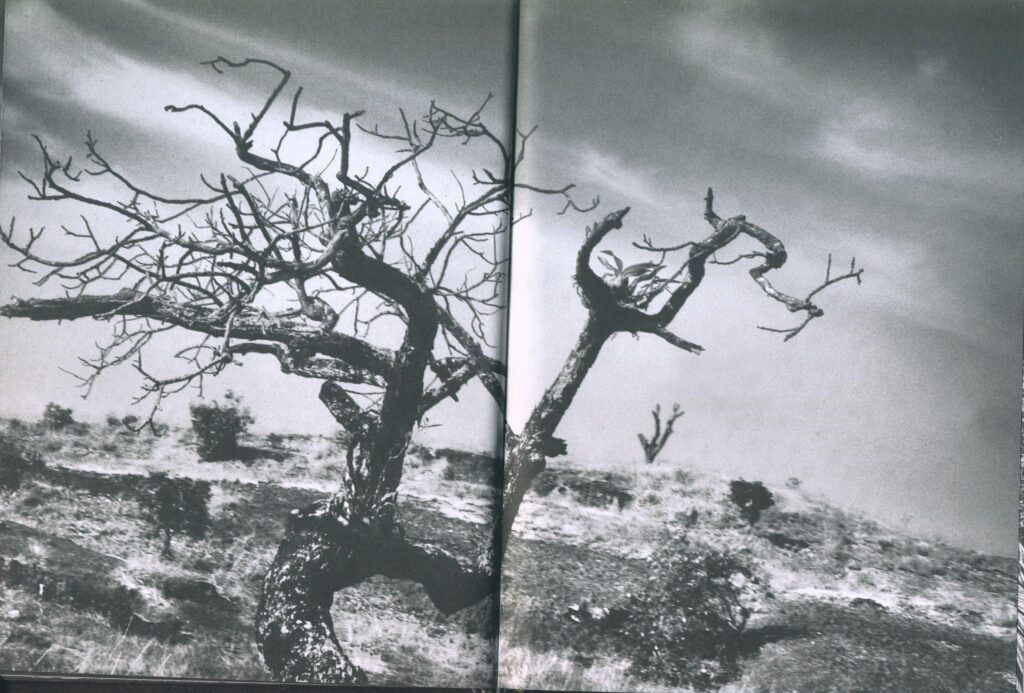
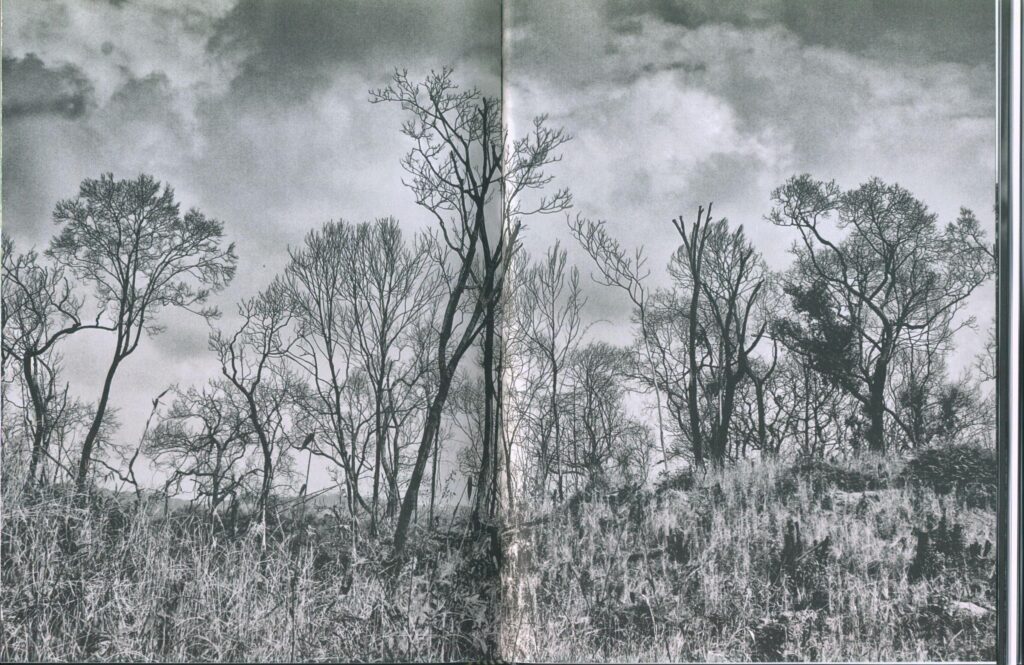
Em ends with an “Ode,” a montage of lyrical images of landscapes. In his essay on Em in The Wire, Bengt Karlsson begins with a reference to a comment by Sabastiao Salgado about pictures ennobling the subject or revealing deep human or natural beauty. Karlsson, however, focuses largely on the pictures of humans struggling for dignity. One of the distinguishing features of Bhartiya’s luminous B&W photography are his stunning pictures of landscapes. He had a romantic sensibility that enabled him to access the arresting beauty of the ruins of history (human and natural) or the hauntological splendor of ghosts from the past. In Niam, I was struck by the recurring images of monoliths that were heralds of history over the longue durée and of the deep time of lithic history. One of the most arresting images in the second “chapter” of Em that documents his journey to Domiasiat in 2006 is a full-page spread of a desolate and denuded tree that occupies the foreground of the image (Figure 3, 40-41). If poverty eats into the hills, there is no better image to depict this decrepitude than this solitary, denuded tree. But this haunting image of the ruins of natural history are counterpointed by lyrical images of trees in bloom in the concluding “Ode” (Figure 4, 164-65). Trees arrest us with their luxuriant and ecstatic growth in a space which is initially presented in a necropastoral register. Time passes, and in ruins and hills eaten by poverty, there are outgrowths of new forms of life. The singularity of an arboreal image coalesces into a temporal movement that shows an orientation towards futurity—these, too, are the afterlives of Kong Spillity and Tarun Bhartiya. What they have planted or represented via images lives on in the present.
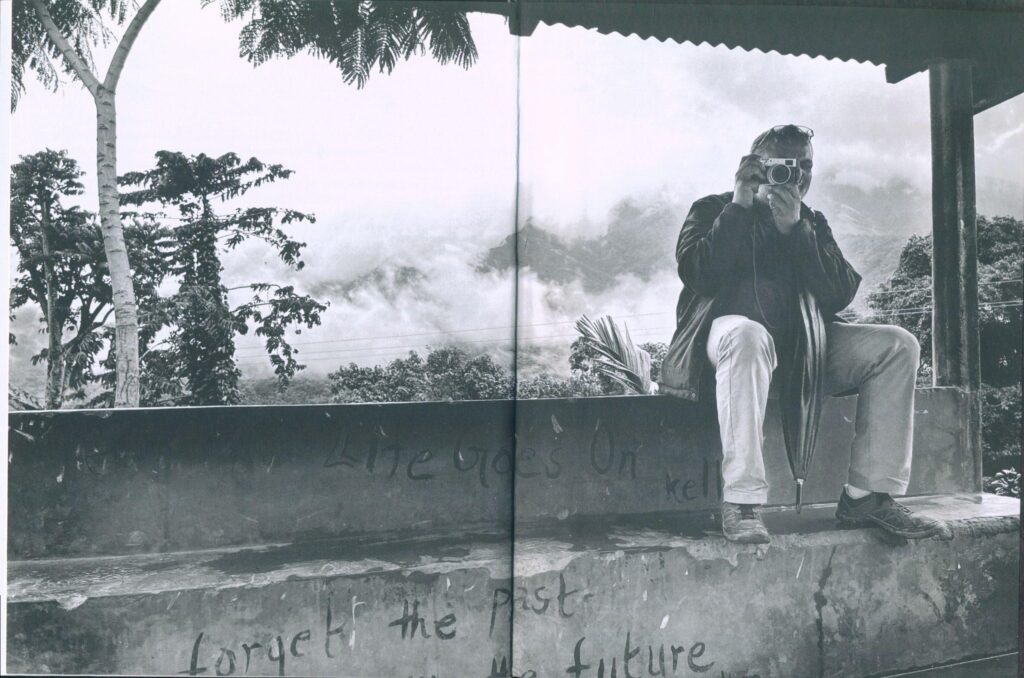
The last image of the book is Tarun looking at us through his camera (Figure 5). The mise-en-scene shows a cloud-covered landscape in the backgfound, maybe evoking the fetishized touristic images of hilly Meghalaya, the abode of the clouds. The graffiti on the steps where Tarun is sitting reads: “Life Goes on. Forget the Past. (partially obscured) Look to the future.” The Angelus Novus in Paul Klee’s painting looks horrified as the debris of progress accumulates in front of his feet. If, as I suggest, Tarun occupies the position of the Angel of History in this final image of Em, the horrified look is replaced with a rueful half-smile as he breaks the fourth wall and looks at us through his camera lens. Life goes on. Forget the past. Look to the Future. Could there be more ironic statements about the debris that progress and development leave in its wake? But, alternatively, the ceaseless accumulation of nationalist and capitalist debris could potentially be arrested by the untimely afterlives of photographic images, and the memories they preserve of the reverberations of defiant speech acts like Em.No.Nahi. That, I believe, is the challenge embedded in Tarun’s direct address to us in this final photograph.
Works Cited:
Baishya, Amit R. “The Animate Circuit of the Ordinary: The Everyday as Unfolding in Tarun Bhartiya’s Niam/Faith/Hynñiewtrep.” Rupkatha Journal, Vol. 14, Issue 2, 2022, pp. 1-17.
Bashford, Allison, Emily M. Kern and Adam Bobbette. Edited. New Earth Histories: Geo- Cosmologies and the Making of the Modern World. University of Chicago Press, 2023.
Bhartiya, Tarun. Em.No.Nahi: Photobook. Yaarbal, 2025.
—.Niam/Faith/Hynñiewtrep. Exhibition Portfolio, 2021.
Buddha Weeps in Jadugoda. Dir: Sriprakash, 1999.
Goethe, J.W. von. Italian Journey. Translated W.H. Auden and Elizabeth Mayer. Penguin, 1962.
—.The Metamorphosis of Plants. Translated Gordon L. Miller. MIT Press, 2009.
Hardin, Garrett. Hardin. “The Tragedy of the Commons.” Science, 162 (1968), pp.1243–48.
Holdrege, Craig. Thinking Like a Plant: A Living Science for Life. Lindisfarne Books, 2012.
Karlsson, Bengt G. “Understanding ‘No’ through Tarun Bhartiya’s Lens.” thewire.in, 20 January 2026.
Kimmerer, Robin Wall. Braiding Sweetgrass: Indigenous Wisdom, Scientific Knowledge and the Teachings of Plants. Milkweed Editions, 2015.
—.The Serviceberry: Abundance and Reciprocity in the Natural World. Scribner, 2024.
La Sang des bêtes. Dir: Georges Franju, 1949.
Linnaeus, Carl von. Lachesis Lapponica. Translated J.E. Smith. Scholar Select, 2016.
—.Systema Naturae. Scholar Select, 2022.
Nongkynrih, Kynpham Sing. Around the Hearth: Khasi Legends. Penguin, 2007.
—.Funeral Nights. Westland, 2021.
—.The Distaste of the Earth. Penguin, 2024.
—.The Yearning of Seeds. HarperCollins India, 2011.
Pariat, Janice. Everything the Light Touches: A Novel. Harpervia, 2022.
Subramaniam, Banu. Botany of Empire: Plant Worlds and the Scientific Legacies of Colonialism. University of Washington Press, 2024.
[1] I never met Bhartiya in person although we had numerous exchanges on social media and on Whatsapp. One of our conversations were around multiple images of slaughtered pigs that he had taken over the years. I had recommended Georges Franju’s 1949 documentary Le Sang des bêtes (Blood of the Beasts) to him and we talked informally about collaborating on a future project on these photographs. Alas, that never came to be.