Discourses From the East
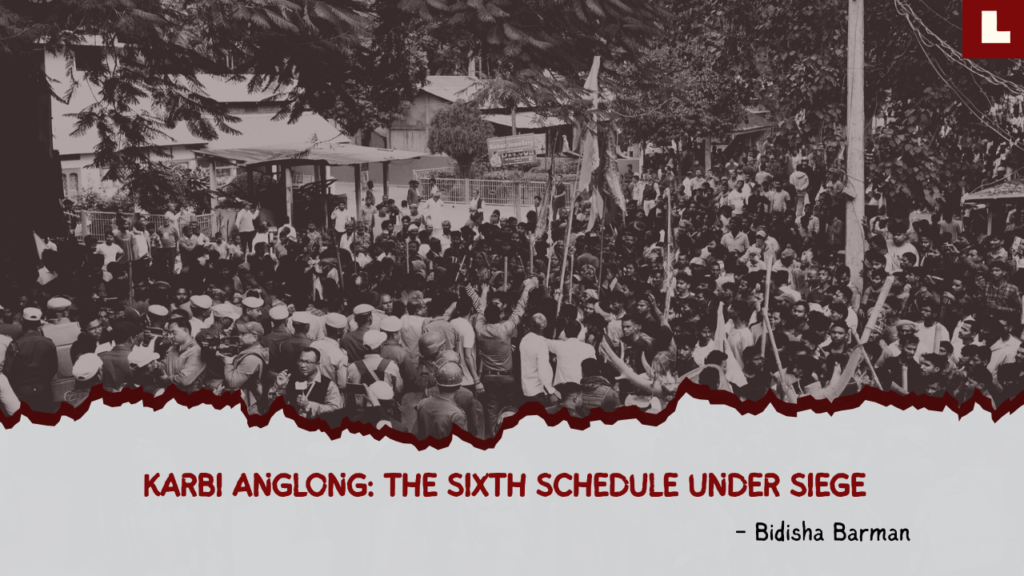

The violence that engulfed West Karbi Anglong on December 22, 2025, leaving two dead and over seventy injured, was not a spontaneous eruption. It was the inevitable consequence of years of institutional paralysis in addressing land alienation and unchecked settlement in a Sixth Schedule area, which is supposed to guarantee heightened constitutional protection for indigenous communities.
The torching of Karbi Anglong Autonomous Council Chief Executive Member Tuliram Ronghang’s residence marked a decisive rupture: the crisis has moved far beyond mere law and order failure into a full-blown governance breakdown. Decades of democratic protests, petitions, and appeals by the Karbi people have been met with inaction or delay, leaving communities frustrated, fearful, and increasingly helpless.
At this stage, the state can no longer plead ignorance or claim helplessness. The fault lines are structural, not incidental, and the lives, land, and dignity of indigenous people hang in the balance. What we are witnessing is a warning that unless decisive action is taken to safeguard Sixth Schedule protections, the crisis will only deepen.
Institutional Betrayal
In February 2024, the KAAC issued eviction notices to around 10,000 people, non-tribals mostly from Bihar’s Nonia community, for allegedly occupying Village Grazing Reserve and Professional Grazing Reserve lands in Kheroni, West Karbi Anglong.
Soon after, Rachnatmak Nonia Sanyukta Sangh (RNSS), a seemingly right-wing social organisation, filed a petition in Gauhati High Court against the eviction. Meanwhile in February 2024, RNSS leaders met President Droupadi Murmu and presented a memorandum with audacious demands during her Shillong tour, demanding creation of a Nonia Satellite Council in Assam, land rights for settlers in Karbi Anglong, and rehabilitation and land rights for landless Nonia families in areas like Morigaon.
In direct opposition to these demands, the KSA and ASDC Youth Front organized a demonstration on February 15, 2024, at Donkamakam. They demanded the eviction of illegal settlers from these reserves to protect indigenous land rights. As the activists were returning to Diphu from their protest, they were intercepted and brutally assaulted by a mob at Kheroni Chariali around 5:00 PM. The attack resulted in severe injuries to at least 15 members and extensive damage to their vehicles. Following the incident, the Assam Police arrested 17 individuals in connection with the violence.
In October 2024, when the case regarding the PIL filed by 243 non-tribal settlers at the behest of RNSS came before Justice Devashis Baruah, he didn’t stay the evictions immediately. He asked one simple administrative question: Are these lands officially designated as PGR/VGR under the Sixth Schedule? The KAAC, which maintains these records, was directed to file an affidavit answering this basic factual question.
Expected time: weeks, perhaps a month. Required effort: checking land records and drafting a document.
However, the affidavit has never been filed by KAAC even after several hearings and repeated reminders from the court.
By February 2025, when the case came up again before Justice N. Unni Krishnan Nair, the court warned that if instructions weren’t received, KAAC’s competent authority would be required to appear in person to dispose off the case. The interim order preventing action against petitioners would continue, but only because KAAC refused to provide the basic information the court needed to decide.
This isn’t bureaucratic inefficiency. This is institutional betrayal, apathy of the KAAC, and it reveals whose interests the autonomous council actually serves.
After repeatedly holding demonstrations and protests regarding the matter for more than a year, on December 6, 2025, a few Karbi protesters led by Litson Rongphar began a hunger strike at Phelangpi in West Karbi Anglong, demanding eviction of non-tribal settlers from protected lands. For over two weeks, they waited. KAAC did not respond. The state government did nothing.
In the early hours of December 22nd, police forcibly removed some protestors and took them to Guwahati. The administration made no public announcement, issued no press release, provided no transparency about where the protesters had been taken or their condition.
In that information vacuum, rumours filled the void. By afternoon, thousands had gathered in Kheroni, convinced the protesters had been arrested by police. Police opened fire later, and amid the ensuing chaos, the lives of a young Karbi man and a specially abled young man were tragically lost.
What unfolded on December 23 exposed an even more disturbing reality. Hindi-speaking settlers marched through Kheroni, openly shouting “Karbi go back” and chanting “Jai Shree Ram.” On land protected under the Sixth Schedule of the Constitution, illegal settlers were brazenly instructing indigenous people to leave their own homeland. This was not just intimidation: it was a direct challenge to constitutional authority itself. When this line is crossed, it signals a profound breakdown of the very framework meant to safeguard indigenous communities, their land, and their dignity.
Months earlier in Diphu, a dispute over a “vegetarian cremation site” exposed the contempt many non-locals feel toward the tribal people. Members of the Marwari community demanded separate cremation facilities, calling existing Karbi crematoriums “unhygienic” because tribal locals “eat non-veg.” This was a brazen display of caste and cultural superiority. These incidents are part of a troubling pattern. The urgency to protect and strengthen Sixth Schedule provisions has never been greater. Without decisive action from the State, the constitutional protections that safeguard indigenous homelands risk being hollowed out, leaving communities vulnerable to demographic domination and cultural erasure. The brazen assertiveness displayed by the RNSS and the Marwari Yuva Manch is rooted not merely in claims of cultural and caste superiority, but is significantly reinforced by their political affiliations, which closely align with the ruling governments of both the Autonomous Council and the Assam government. Their political patronage has become particularly evident in the context of the recent incidents in Karbi Anglong.
Corporate Efficiency, Indigenous Dispossession
While the KAAC drags its feet for months on filing even a basic affidavit, it moves with alarming speed when it comes to transferring land in the Sixth Schedule area of Karbi Anglong for corporate interests. Tens of thousands of bighas of protected indigenous land are being handed over with remarkable efficiency in the past few years – 18,000 bighas for a PPP model solar power project, 12,000 bighas earmarked for a CBG plant for Reliance India, large tracts diverted for palm oil cultivation to entities linked with Ramdev’s Patanjali, and vast areas granted to institutions associated with Ravi Shankar. These actions expose a clear pattern of corporate appeasement, carried out at the cost of constitutional safeguards, indigenous rights, and the very spirit of the Sixth Schedule.
Chief Minister Himanta Biswa Sarma repeatedly claims his government cannot act because the matter in Kheroni is “sub judice.” This sounds constitutionally proper but conceals a deliberate fiction and insincerity, the court hasn’t stayed evictions without consideration , rather it asked for land classification information that KAAC refuses to provide. The government cannot claim judicial deference while the autonomous council obstructs the judicial process.
If the KAAC could have proved that those are PGR/VGR land, then there might have been a different decision by the court, maybe evictions would have been ordered.
The selectivity is instructive however. Elsewhere in Assam, for religious minorities and marginalised indigenous people, eviction drives proceed with clinical efficiency. But in Karbi Anglong, where Sixth Schedule protections should provide even stronger legal foundations, the government discovers newfound restraint.
The Stakes Ahead
The KAAC must present the land papers immediately. Those responsible for months of defiance must face consequences. There must be an audit of all land transfers in Karbi Anglong over the past decade to understand the full scale of indigenous land alienation. Most fundamentally, the government must acknowledge it created the conditions for violence through institutional failure. Calls for a tripartite or whatever dialogue with protestors ring hollow without that recognition.
Two young men died because of state negligence and a callous disregard for the lives and rights of citizens. The Karbi people paid for constitutional autonomy with decades of struggle and sacrifice. It must not be undone by bureaucratic incompetence and a council which cannot side with its people, nor should Karbis have to die defending what was already won with blood.
The question is not whether the state can act, its efficiency in serving corporate interests proves it can. The question is whether constitutional protections for indigenous communities will ever matter as much as corporate profits, whether the Karbi people will remain threatened in their own homeland, whether “Karbi go back” becomes the new reality on land the Constitution promised to protect.
We confront a fundamental constitutional reckoning: whether India’s Sixth Schedule is a living, enforceable safeguard for indigenous peoples, or merely a symbolic promise. The real question is whether autonomy earned through generations of struggle will be upheld, or systematically eroded by a capitalist state machinery that serves profit over people. Everything else is commentary.