Discourses From the East
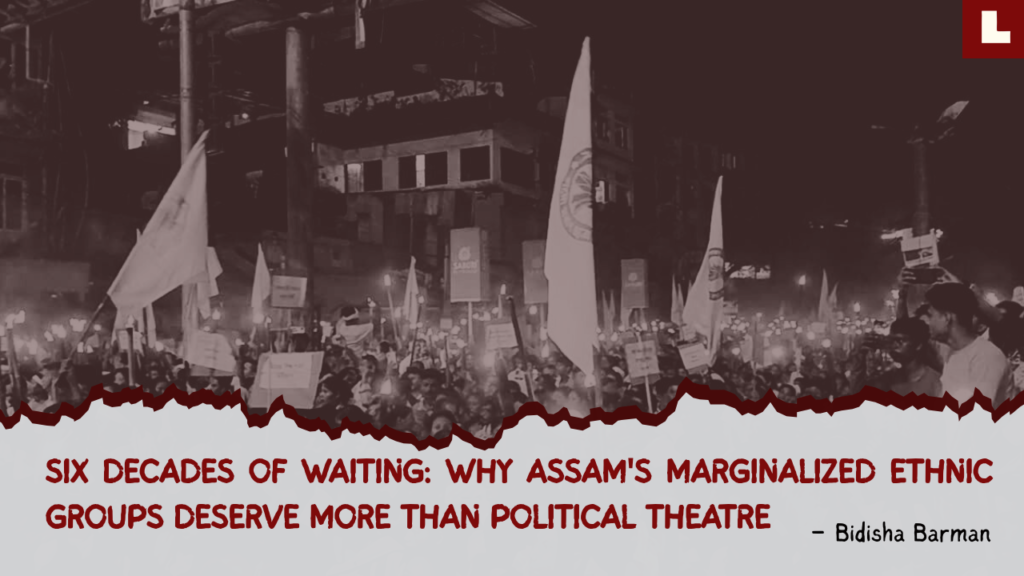

On November 27, 2025, the Assam Cabinet approved the Group of Ministers’ report on granting Scheduled Tribe status to the six historically marginalized ethnic communities of Assam. Two days later, on November 29, the interim report was tabled in the Legislative Assembly on the final day of the winter session. Across Assam, section of people from these communities heaved a sigh of relief. Some of their leaders, particularly those aligned with the ruling government, tried to convince people that the tabling of the report in the assembly was an achievement towards fulfilling their decades-old demand.
However, the fight seems to be far from over. This is not unfounded skepticism but history compels us to be more vigilant than hopeful. The pattern of betrayals for over six decades, with an understanding of what the ruling class would possibly be bereft of once constitutional protections are in place, suggests that optimism may be premature. Equally concerning is the risk that this protracted struggle will end up benefiting only some organizational leaders and political intermediaries while the actual deprived communities see no substantive change in their lives. When marginalized communities demand their rights, they are too often pulled into cycles of empty promises, manufactured hope, and repeated betrayal, a pattern witnessed across the country for years.
While tabling a report and making announcements costs the government nothing, whereas actual constitutional amendments require political will which has consistently lacked in successive governments when it comes to empowering historically oppressed communities. The timing now reveals the cynical political calculation at work. With the Assembly elections approaching in 2026, the BJP government has designed a situation in which it appears to concede something, yet offers little of substantive value, but generating considerable confusion and social disharmony amongst the ethnic communities.
Historical Roots of a Six-Decade Struggle
One current dominant narrative portrays this movement to grant ST status to the six ethnic groups as a very recent political demand. However, the truth remains that this struggle is a longstanding battle rooted in the systematic marginalization of these communities. Their ethnic identities, cultural practices, and socio-economic disadvantages have long been known and extensively documented, yet their constitutional status has been denied for decades despite meeting every criterion for tribal recognition. These claims are not opportunistic.
The Koch-Rajbongshi community first raised this demand in the 1960s, over six decades ago. By 1996, when the Assam government formally recommended their inclusion through an extraordinary presidential ordinance, the demand had already been alive for three decades. More significantly, it nearly became constitutional reality in 1998, after clearing every legislative hurdle including Parliamentary Select Committee approval and the withdrawal of objections by the Registrar General of India, which had rejected similar proposals eight consecutive times between 1981 and 2006.
Competing Claims and Constitutional Complexities
The 14 existing Scheduled Tribe (ST) groups make up about 12 percent of Assam’s population, while the six communities seeking ST status together form nearly 40 percent. Granting them full ST status with reservation benefits would push total reservations beyond the 50 percent cap once SC/OBC quotas are included.
The anxieties of the existing ST communities must be taken seriously. These communities have endured generations of structural, political, and historical oppression at the hands of dominant social groups of Assam. The ruling class of this state cannot and should not forget this history of systematic marginalization. Any solution that fails to acknowledge and protect the hard-won rights of existing tribal communities risks compounding historical injustices rather than remedying them. Their fear of dilution is not exaggerated; it reflects the fragile protections they have struggled for over generations in a state that has routinely viewed rights of tribal communities as expendable and easily overridden. Their worries about increased competition for limited resources are understandable and deserve careful constitutional safeguards, ones that protect all marginalized groups instead of setting them against each other.
Let it be unequivocally clear that the inclusion of the six communities seeking ST status need not and must not come at the expense of existing tribal communities. The constitutional framework allows for creative solutions that expand protections without diminishing existing rights. It is an opportunity to correct historical injustices for multiple marginalized groups simultaneously. Closer attention must be paid to the State itself whose persistent failure to adequately resource, protect, and uphold tribal rights is too often obscured by invoking inter-community conflict as a convenient smokescreen for its own shortcomings.
At the same time, Assam’s demographic reality is not very simple. If these six communities are added, the state’s ST population would rise from 12 percent to around 40–42 percent. This would make Assam unlike any other state in India, neither a “mainstream” state with about 8.6 percent ST population nor a tribal-majority state like Mizoram or Nagaland, where tribal form 80–90 percent. Rather than confronting this complexity directly, the government’s new classification categories within the ST category seem designed to sidestep the real constitutional questions, particularly those about how recognition might establish more assertive right to land, resources, and livelihoods for the indigenous groups.
However, Constitutional pathways do exist. The government could request Supreme Court approval to exceed the 50 percent limit, as some north-eastern states have done. It could create clearly defined sub-categories with fair reservation percentages that protect existing tribes while including historically marginalized groups. It could even consider amending Article 342 to address Assam’s exceptional situation, where nearly 40 percent of the population seeking recognition has been denied it for decades. Most importantly, the government could significantly increase the quantum of resources, seats, and opportunities available so that expansion of coverage does not translate to meaningful reduction in what existing communities currently access. This requires not just constitutional creativity but fiscal commitment to genuinely empowering all marginalized groups rather than forcing them to compete for resources.
Instead of pursuing these options, the government has chosen to deepen divisions among communities who should be united in their demand for justice. By presenting the six communities as competitors to the existing 14, it shifts attention away from its own unwillingness to undertake the constitutional reforms necessary for true inclusion. This was bound to create inter-community tensions and obscure ongoing governmental neglect, while allowing continued exploitation of land and resources of the marginalised people.
1998: When Every Box Was Checked, Then Abandoned
On January 27, 1996, the Narasimha Rao government promulgated an ordinance granting ST status to Koch-Rajbongshi despite Parliament not being in session. For less than a year, members of this historically deprived community were Scheduled Tribes. Students secured medical and engineering admissions. Jobs were offered. For a brief moment, constitutional recognition seemed to acknowledge generations of marginalization and exploitation. Then it vanished.
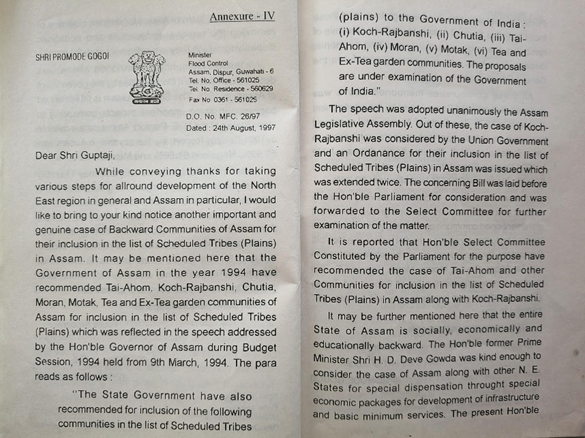
The bill introduced on February 29, 1996, lapsed when the Lok Sabha dissolved. The ordinance was re-promulgated four times. In July 1996, it went to a Parliamentary Select Committee of 15 members. The Committee delivered in August 1997. The Koch-Rajbongshi community possessed “most of the tribal characteristics among them.” The Registrar General of India, which had rejected proposals eight times, “raised no objection to include Koch-Rajbangshis in the list of Scheduled Tribes of Assam.” In Meghalaya, Koches are already Scheduled Tribes. The Committee recommended inclusion of Koch-Rajbongshi, Tai-Ahom, Chutia, Moran, Motok, and the Tea Garden Workers Community (or Adivasi Community of Assam), all groups that had documented their ethnic distinctiveness and socio-economic disadvantage with painful precision.
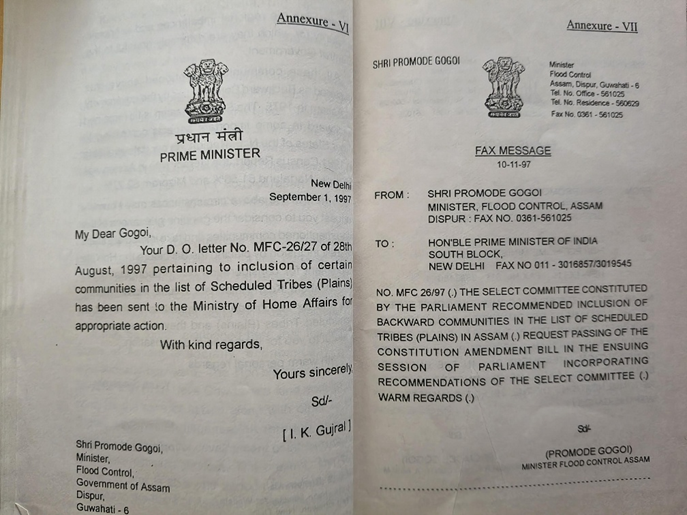
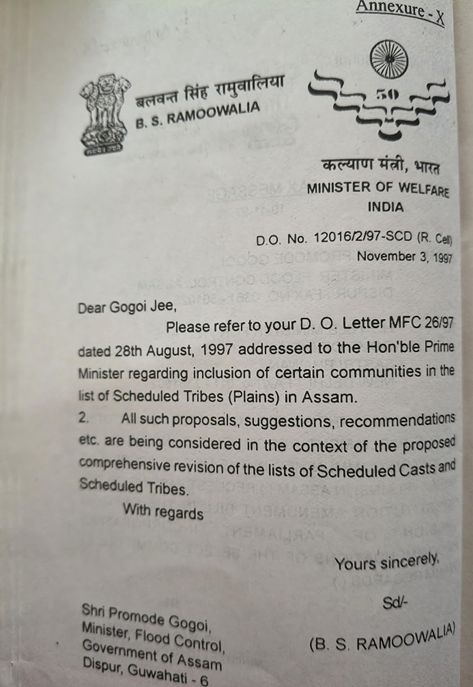
By 1998, every requirement was met. CPI MLA Mr. Pramod Gogoi, Minister for Flood Control and Irrigation, Govt of Assam, met the Union Home Minister multiple times and the Union Welfare Minister, who “assured to consider the matter favourably.” The matter reached the Prime Minister, Home Minister, and Union Minister of Welfare. The Union Minister had placed the bill on July 12, 1996. Mr. Gogoi had written several letters to the government in Delhi, a few of which are attached herewith.
The bill wasn’t brought to a vote. It lapsed. The State chose to let it die quietly.
Students from these marginalized communities lost admissions. Jobs were revoked. MPs Amar Roy Pradhan, Dwaraka Nath Das, and Madhab Rajbanshi raised it in Parliament, their voices echoing in chambers that seemed to conveniently ignore such pleas without action. Rajbanshi noted that SC/ST ordinances in other states were replaced by bills within six months; this one languished for over two years despite unanimous approval. “A great injustice was done to the Koch Rajbongshi Community by denying fundamental rights under the Constitution.” The question is: was it indifference or deliberate denial?
The Politically Invisible Communities
It must be noted with deep concern that several of these six communities have been so historically marginalized that they have never had the political capital or representation to raise this demand under the aegis of leaders from their own community. Their ethnic marginalization has been compounded by political invisibility, making them doubly vulnerable to exploitation.
The Tea Garden Workers Community (and Adivasi Community of Assam), constituting 20 percent of Assam’s population, were brought as indentured labourers under colonial exploitation and remain among the most dispossessed groups in the state, landless, educationally disadvantaged, and politically invisible despite their demographic weight. They have been systematically denied the constitutional protections their counterparts enjoy in Odisha, Madhya Pradesh, Bihar, and Andhra Pradesh, their states of origin. While they labour on tea estates that generate enormous wealth for corporations and the state, they remain without land, without rights, without recognition. This is not an oversight, it is structural violence.
The Motok, Moran, Chutia communities, though indigenous to Assam with distinct ethnic identities and cultural practices, have less numbers and have lacked the organized political voice that other larger groups have been able to mobilize. Their demands have often been articulated by others or subsumed under broader coalitions, reflecting their structural marginalization even within movements for recognition. Their historical deprivation is no less real, no less urgent, for being less visible.
A common objection raised against granting ST status to the Tai-Ahom community is that they are an “advanced community” whose members have achieved upward social mobility, making reservations unnecessary or even unjust. While this narrative contains elements of truth, but it simplifies a more layered reality. It is undeniable that a segment of the Tai-Ahom community has achieved educational, economic, political progress. Also important to recognize that some within this upwardly mobile group have perpetuated caste-based discrimination against tribal communities which is a contradiction that warrants honest reflection and cannot be overlooked or justified. However, a significant section of the Tai-Ahom community spread across upper Assam still remain very deprived, their socio-economic conditions marred by centuries of resource plunder from those regions, the devastation of the bloodied 1990s, and by systematic marginalization that persists despite the visibility of a privileged minority. Rather than using the relative advancement of a section as grounds to deny recognition, a more just approach would be to implement carefully designed exclusionary criteria within the reservation framework. Mechanisms such as creamy layer provisions, income and asset ceilings, or multi-generational benefit limits could ensure that protections reach those who genuinely need them while preventing their capture by already privileged sections.
Moreover, if upon thorough examination the government determines that constitutional or socio-economic grounds warrant withholding ST status from the Tai-Ahom community, then it must state this position explicitly with full justification rather than maintaining strategic ambiguity. However, such a determination regarding the Tai-Ahoms, whatever its merit, cannot become grounds for further delay or denial for the remaining five communities. The claims of the Koch-Rajbongshi, Chutia, Moran, Motok, and Tea Garden Workers/ Adivasi Community rest on their own independent documentation, their own histories of marginalization, and their own validation by constitutional bodies. Each community’s case must be decided on its own strength, and after six decades of systematic denial, the time for such decisions is long overdue.
Such nuanced policy design is constitutionally permissible and administratively feasible. What it requires is again the political compassion and willingness to craft equitable solutions.
For decades now, young people from most of these ethnic communities have joined armed struggles in Assam, sacrificing lives and futures in insurgent movements born of frustration with continued marginalization and the state’s refusal to address legitimate grievances through democratic channels. If now, after generations of conflict, these communities are instead choosing a democratic path to ensure their rights and claim on resources, the government should be more than eager to address this issue as transparently and compassionately as possible. The choice to pursue constitutional recognition rather than armed resistance represents a crucial democratic opening, one that demands good faith engagement, not political manipulation and electoral calculations. The ruling dispensation is squandering an opportunity to resolve decades of grievance through democratic means.
Decades of Promises, Decades of Betrayal
In 2007, a young girl from the Adivasi Community of Assam, was mercilessly violated in Guwahati during protests demanding ST status. The image of a child brutalized for demanding her community’s rights should have shaken the conscience of the nation. National outrage followed. Nothing changed for her community. The state’s response was to wait for the outrage to fade rather than address the injustice that provoked it.
In 2015, Chief Minister Tarun Gogoi submitted a memorandum to the Prime Minister. The BJP’s Vision Document 2016-25 promised ST status. In November 2019, the Constitution (Scheduled Tribes) Order (Amendment) Bill, 2019, was introduced in the Rajya Sabha specifically to address the historical marginalization of these six communities. It has been pending for six years despite the BJP-led NDA’s comfortable majorities in both Houses. Six years of waiting while communities remain at the edge, vulnerable to huge losses.
The BJP’s cynical manipulation of these communities’ aspirations deserves particular scrutiny and condemnation. Since 2014, the party has repeatedly weaponized this demand for electoral gain, promising ST status within six months in 2014, announcing bills before the 2019 elections, and consistently using the issue to consolidate vote banks while delivering nothing substantive. When faced with opposition from existing ST communities in 2019, the BJP government conveniently shifted responsibility to the state government. The state BJP then offered autonomous councils to three communities, Moran, Motok, and Koch-Rajbongshi, a calculated move to divide the unified movement and fragment their collective demand. This strategy of divide and rule, creating autonomous councils without constitutional protections, mirrors the current “ST-Valley” proposal: symbolic gestures designed to fracture solidarity while avoiding genuine reform.
Opposition leader Lurinjyoti Gogoi raised a question that demands notice: why form a new panel when a Constitution Amendment Bill has been pending since 2019? The answer seems to be clear, because panels can study, deliberate, and delay, while bills require votes and accountability.
Passing the 2019 bill would require hard constitutional choices: seeking Supreme Court permission to exceed the 50 percent reservation cap, creating separate categories with differential benefits that protect both existing and historically deprived communities, or amending Article 342. Difficult, yes, but not impossible for a government with full parliamentary majority. The 2025 report chooses symbolic recognition instead of substantive justice, revealing where the government’s priorities truly lie.
Why Constitutional Protection Is Existential, Not Just Aspirational
Constitutional ST recognition is not a symbolic demand; it provides concrete protections which are safeguards against socio-economic disadvantage, guaranteed political representation, and land protection laws that prevent the alienation of tribal lands to outsiders. For these small, marginalized communities, this is not about privilege or special entitlements. It is about securing protection from the exploitation and dispossession they have endured for generations.
The urgency of these protections has grown dramatically as the pace of capital’s intrusion into Assam has accelerated. Forceful land acquisitions for industrial projects, infrastructure expansion, and commercial extraction have systematically undermined indigenous land rights and livelihoods. Communities find themselves defenceless against corporate and State actors who view them not as rights-bearing people, but as obstacles to profit.
For the Tea Garden Workers or Adivasi Community of Assam that constituting nearly 20 percent of Assam’s population the stakes are existential. As tea estates are sold to corporate interests and lands are repurposed for commercial projects, entire communities face eviction without any constitutional mechanism to prevent their displacement. The state that once depended on their ancestors’ forced labour now refuses them the basic protection of legal recognition.
For many from the Tai-Ahom, Chutia, Motok, and Moran communities, the wounds of the violent 1990s remain unhealed. People from these communities bore disproportionate suffering during that decade of insurgency, brutal counter-insurgency operations and the extrajudicial killings and other horrifying events carried out by the State under draconian laws like AFSPA. This violence compounded their existing marginalization, leaving scars that persist decades later in the form of interrupted education, broken social structures, and deepened economic vulnerability. The recognition they seek today is also about acknowledging these layers of historical injustice that official narratives conveniently forget.
The demand today goes far beyond reservation benefits. It seeks constitutional machinery for self-governance, empowerment, cultural preservation, and resource protection, mechanisms essential for communities facing intensified threats. Between 1996 and 1998, when Assam’s demographic profile was not substantially different for these communities the Parliamentary Select Committee acknowledged the legitimacy of these communities’ claims and recommended the full inclusion of all six groups. What has changed since then is not the constitutional complexity or the reality of their marginalization, but the political will to extend justice to communities whose empowerment may unsettle existing power structures and entrenched patterns of resource extraction. And if the current government thinks any of these communities are ineligible for the recognition, it should say so clearly citing due reasons instead of exploiting uncertainty to sway emotions.
The Unanswered Questions That Demand Accountability
The 1996 Bill having cleared every institutional requirement was allowed to lapse. The 2019 Bill has remained frozen for six years, untouched despite repeated public commitments. A demand first raised in the 1960s, backed by decades of documentation, endorsed in principle in 1998, and reaffirmed through promises in 2007, 2015, and 2019, continues to be deferred in 2025. This is not administrative delay; it is a sustained pattern of political evasion.
The communities seeking recognition are not asking for concessions. The 1997 Parliamentary Select Committee recommended their inclusion unequivocally. The Registrar General, after decades of rejections, finally validated the claim. The matter traversed through multiple Union Ministries and received consistent assurances. The proposal reached the Prime Minister’s office and still stalled.
The struggle persists, it must continue. However, effective advocacy requires vigilance not only against State apathy but against internal hierarchies that reproduce exclusion.
Successive governments have repeatedly chosen spectacle over genuine policy work. Instead of undertaking the constitutional reforms needed to correct a long-standing injustice, they have opted for performative gestures that maintain the existing hierarchies of power. This is structural violence in its most insidious form perpetrate through meticulous bureaucratic neglect, all while proclaiming commitment to inclusion.
These communities have waited long enough. They have exhausted every democratic pathway, negotiated the procedural requirements and sacrificed generations to a fight that the state has repeatedly acknowledged yet refused to resolve. They deserve more than recycled promises and another cycle of managed delay. They deserve the protections envisioned by the Constitution. Above all, they deserve justice and not just the political theatre that has kept them marginalized for decades.
Pictures courtesy : Communist Party of India, Assam State office