Discourses From the East
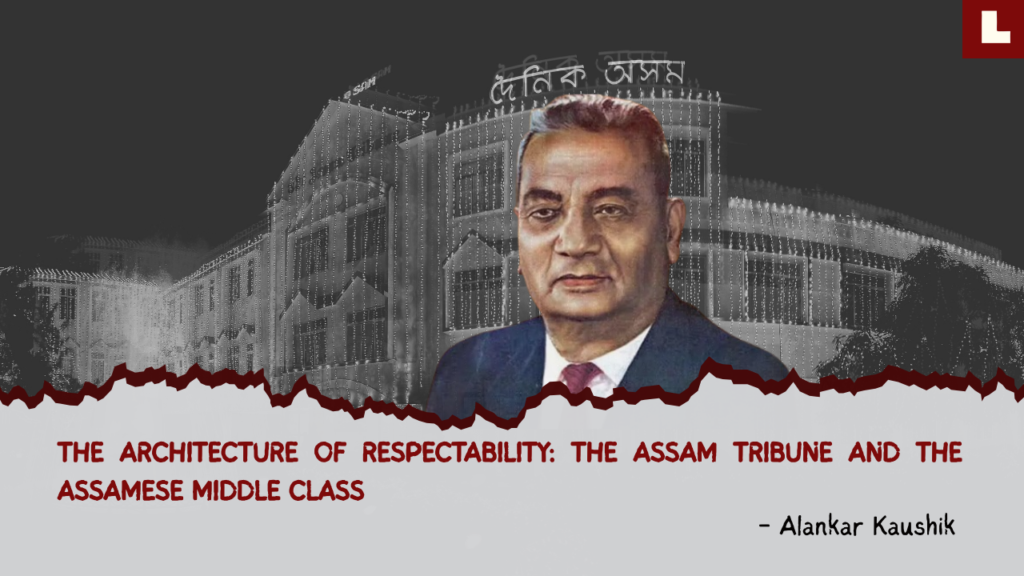

In the Brahmaputra Valley, the morning newspaper has never been merely a bundle of printed sheets. It is a ritual an act of self-fashioning. For generations, the soft thud of The Assam Tribune landing at the doorstep has signified more than access to information. It has marked entry into a moral and social order: disciplined, aspirational, respectable.
Founded in 1939, the Tribune has survived empire and independence, insurgency and accords, liberalization and digitization. Yet its most enduring legacy is not simply journalistic longevity. It is sociological. To understand the Tribune is to understand the making of the Assamese ‘mordhyobitto sreni’ (the middle class) that forged its identity through English education, competitive examinations, and an enduring architecture of respectability.
English as Access, English as Aspiration
The Assamese middle class took shape in the long shadow of colonial modernity. After the 1826 Treaty of Yandaboo brought Assam under the East India Company, administrative restructuring reshaped social hierarchies. By the late nineteenth century, a new elite lawyers, teachers, clerks had emerged, not from Ahom aristocracy but from English-medium classrooms and bureaucratic corridors. English became the language of mobility: of courts, government employment, and imperial administration.
It was in this context that the Tribune’s founding assumed historical significance. Conceived under the vision of Radha Govinda Baruah, the newspaper offered Assamese intellectuals a platform to address Delhi and London in the empire’s own idiom. Earlier reformers such as Anandaram Dhekial Phukan had already articulated the importance of language in shaping a modern Assamese public sphere. The Tribune institutionalised that impulse. It provided an English voice that was regionally rooted yet nationally intelligible.
Later thinkers like Lakshminath Phukan deepened this intellectual tradition, arguing that modern Assamese identity required not only linguistic proficiency but critical discernment. For Phukan, the emergence of a reflective reading public was central to self-governance. A society that could read itself carefully could also govern itself responsibly. His reflections on literature and ethics resonate in the Tribune’s editorial sobriety. If the newspaper offered a daily rehearsal of civic reason, thinkers like Phukan supplied its philosophical vocabulary reminding readers that English must serve Assamese self-understanding, not eclipse it. Often hailed as an architect of modern Assam, Radha Govinda Baruah saw institutions as foundations of dignity, and through The Assam Tribune used English strategically to create a public sphere that was regionally rooted yet nationally resonant.
The Pedagogy of the Drawing Room
In countless middle-class homes, the Tribune functioned as an informal classroom. Its editorials were treated as lessons in “proper English.” Children were asked to read aloud, absorb vocabulary, imitate syntax. The newspaper became an apprenticeship in bureaucratic prose.
This linguistic hierarchy shaped cognition. Assamese remained the language of intimacy of kitchen conversations, Bihu songs, family grief. English became the language of the head: of applications, interviews, policy, and statecraft. To master “Tribune English” was to acquire symbolic capital.
Competitive examinations cemented this relationship. For aspirants to the Union Public Service Commission or the Assam Public Service Commission, the Tribune was both syllabus and supplement. It chronicled state budgets, policy shifts, and demographic debates that national dailies often skimmed. Coaching centres and digital platforms amplified this ritual; daily current-affairs analyses frequently began with the morning’s Tribune. News consumption blurred into self-cultivation.
The Newspaper as Status Symbol
The Tribune’s presence in the drawing room signified more than literacy. It signaled belonging to the “educated citizenry.” Even in households that consumed Assamese dailies such as Asomiya Pratidin or Dainik Asom for emotional immediacy, the English daily occupied the most visible space. It was displayed.
To cite a Tribune editorial at a gathering was to perform informed citizenship. Its tone measured, restrained, authoritative offered stability in a region marked by insurgency, migration debates, and ethnic friction. The paper positioned the middle class as the “reasonable centre,” distinct from radical street politics and bureaucratic inertia.
Columns such as Indrani Raimedhi’s long-running “Third Eye” cultivated intellectual leisure, linking local readers to global conversations. Parenting dilemmas, ethical puzzles, cultural curiosities these essays allowed Assamese professionals to imagine themselves as participants in a wider English-speaking modernity.
The Political Triangle
The Tribune’s authority rests on a triangular relationship between newspaper, middle class, and political establishment. The paper frames events; the middle class consumes and circulates those frames; politicians seek validation within them. This triangle has shaped Assam’s modern political vocabulary.
During the Assam Movement (1979–1985), led by the All Assam Students’ Union and the All Assam Gana Sangram Parishad, migration became the central narrative. The Tribune articulated anxieties about demographic change in the language of constitutionalism and security. The framing of “illegal immigration” as an existential threat later underpinned policies such as the National Register of Citizens.
This discourse was rarely sensational. It was disciplined, couched in the idiom of indigenous rights and constitutional order. By distinguishing between “genuine Assamese Muslims” and “Bangladeshi infiltrators,” the paper crafted a regionalism that claimed legality rather than communalism. The middle class could thus defend hardline positions while preserving the aura of reasonableness.
Yet this architecture of respectability has exclusions. English-language discourse privileges bureaucratic idioms over lived marginality. Char dwellers, migrant labourers, and tribal communities often appear filtered through administrative categories. Human stories risk being subordinated to policy frameworks. Respectability can obscure inequality.
Historical Memory and Persistent Anxiety
The roots of this securitised imagination lie in the 1930s and 1940s, when colonial policies encouraged migration from East Bengal. Administrative experiments such as the “Line System” sought to regulate land settlement. Leaders like Gopinath Bordoloi voiced fears of cultural erosion. The Tribune, emerging at this historical threshold, amplified these anxieties. Migration was narrated as structural transformation, not episodic influx.
This memory endures. For the middle class, the Tribune remains a sentinel guarding the soil. Each editorial on citizenship, land rights, or border policy reactivates inherited concerns. The newspaper’s authority lies partly in this continuity its ability to connect present debates with historical apprehensions.
Digital Adaptation, Enduring Authority
In an age when print globally confronts obsolescence, the Tribune has demonstrated adaptive resilience. Its e-paper, online archives, and social media platforms connect a global Assamese diaspora. Headlines circulate instantly; multimedia storytelling supplements traditional reportage.
Yet the core appeal remains legacy. In an era saturated with misinformation, an 85-year-old institution carries weight. When rumours swirl, many still seek confirmation in the Tribune’s measured prose. The ritual has migrated from paper to screen, but the quest for authoritative language persists.
More than a newspaper, The Assam Tribune serves as a mirror in which the Assamese middle class sees it’s rational, educated, and regionally rooted self. Its English pages have built an enduring architecture of respectability that lends coherence to a postcolonial society in flux. Yet this authority invites scrutiny: whose voices are centred, whose lives reduced to policy? To read it daily is to participate in shaping modern Assam’s language, legitimacy, and layered identity.