Discourses From the East
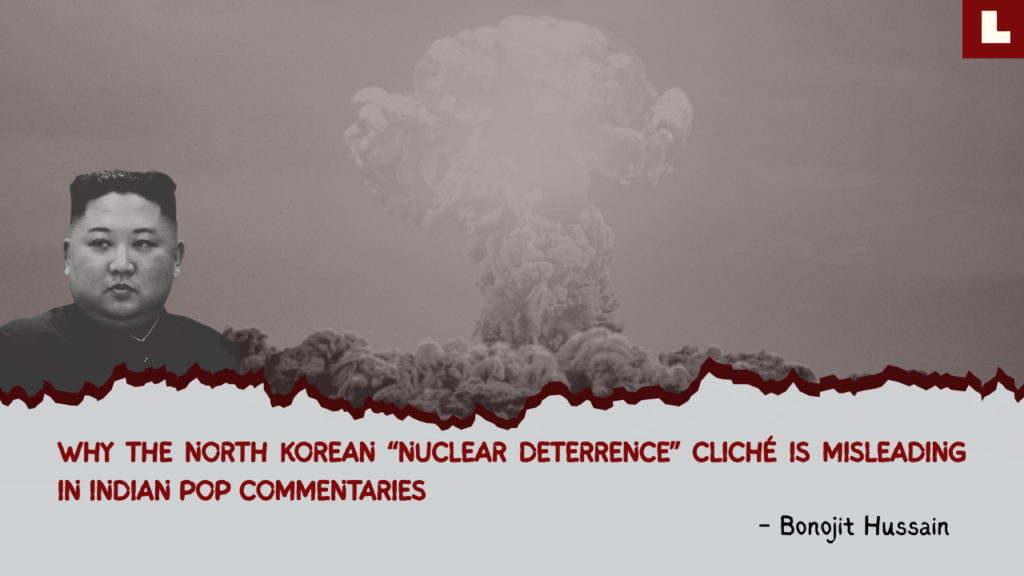

A familiar meme circulates in India’s left-liberal ecosystem whenever a new war breaks out. It says: nuclear weapons are the ultimate deterrent. North Korea built the bomb and avoided attack. Iran did not, and now it is being bombed. The implied lesson is blunt: in a treacherous world, build the bomb quickly, build it quietly, and stop talking.
This frame feels hard-headed. It also feels like a shortcut to peace, because it promises fewer wars by making war too costly. But when you use the Korean Peninsula as proof, the argument breaks. Korea does not support a one-variable deterrence story. North Korea was not “safe” simply because it built a bomb. Restraint against preventive war on the peninsula rests on older, deeper layers: Seoul’s exposure to conventional retaliation, South Korea’s political veto inside the alliance, China’s proximity, and a long history of managing crisis without triggering a war that would devastate a frontline capital.
Korea is also not an abstract security puzzle. The Korean War of 1950–53 devastated the peninsula and ended in an armistice, not a peace treaty, leaving the two Koreas technically still at war and shaping how both states, and the United States and China, price the costs of escalation.
As South Korea’s president Lee Jae-myung reiterated on March 1, 2026, in his Independence Movement Day address, calling for resumed talks, respect for the North’s system, and rejection of absorption-based unification, the peninsula’s enduring restraints remain clear. That makes reductive memes even more outdated in 2026.
I lived in Seoul from January 2007 to November 2009. Those years sit inside a real test case. If nuclear weapons alone explained “no attack,” you would expect the period around North Korea’s second nuclear test in 2009 to push actors toward a preventive war logic. It did not. The region responded through sanctions, calibrated pressure, and deterrence management. The underlying reason was simple. A war on the peninsula is structurally disastrous even before you add nuclear escalation.
A timeline the meme flattens
Three sets of dates matter.
On February 13, 2007, the Six-Party Talks produced the “Initial Actions” agreement, a stepwise plan tied to reciprocal measures. On October 3, 2007, the parties agreed on second-phase steps toward disablement and declarations. These were not symbolic rituals. They were attempts to translate security steps into concrete bargains.
Then, on May 25, 2009, North Korea conducted its second nuclear test. On June 12, 2009, the UN Security Council passed Resolution 1874, expanding sanctions and enforcement tools. The response still did not shift into a preventive war track. That matters because it exposes the weakness of the meme’s counterfactual. The bomb did not suddenly create restraint in 2006 or 2009. Restraint already had foundations.
Why those negotiations felt unique
The Six-Party period, especially 2007, had a bargaining texture that is easy to forget now. It did not look like pure coercion. It looked like a messy, transactional attempt to trade steps for steps.
One detail from that period stayed with me because it captured the odd specificity of the process. Food, including large rice shipments from South Korea, sat alongside energy and economic assistance inside the broader “action for action” atmosphere. That did not mean rice was mechanically exchanged for a specific wrench turned at Yongbyon nuclear facility. It meant the negotiations mixed nuclear disablement with material flows that mattered to everyday survival and regime stability.
This is part of what the meme erases. The Korean nuclear issue has always sat alongside questions of energy, food, and state capacity. It is not only a weapons story. It is also political economy. When outsiders reduce it to “build the bomb or be bombed,” they erase what negotiations actually tried to trade and why so many actors kept returning to bargaining rather than war.
Korea’s deterrence was never only nuclear
The meme works by turning deterrence into a single variable. Korea forces you to see deterrence as a stack. Remove one layer and the other layers still constrain war.
First, Seoul is a frontline capital
Seoul’s metropolitan region, home to about 26 million people, one of the world’s largest and densest urban areas, sits about 50 kilometers from the DMZ. Conventional retaliation from massed artillery and rockets positioned near the border can produce catastrophic damage quickly. Even if you believe an attacker can ultimately prevail, you cannot prevent mass casualties at the start. War would begin with civilians under fire in one of the world’s densest urban regions.
Here is the key logical point that many memes scramble. Seoul’s vulnerability does not “protect” North Korea. It constrains the likely attacker. Any major attack on North Korea risks immediate, catastrophic punishment on South Korea’s capital region, meaning an allied civilian population pays first.
This constraint existed long before North Korea tested a nuclear device in 2006. It existed throughout the Cold War. It existed when North Korea’s nuclear program was a disputed capability rather than a mature force. Nuclear weapons raise the ceiling of danger, but they did not create the baseline restraint.
Second, South Korea has a political veto inside the alliance
Deterrence is not only about weapons. It is about politics, especially the politics of allies who pay first. The United States can hold bases and commitments, but it cannot treat war as a US-only choice when retaliation will land on Seoul. If a US action triggers mass casualties in South Korea, the alliance can break in legitimacy even if it survives on paper.
This is why South Korean governments, even when they take a harder stance toward Pyongyang, do not treat a preventive war as an acceptable instrument. They can tighten conditionality, reduce cooperation, harden messaging, and expand deterrence posture. But the destruction of the capital region is not a “price” a democratic government can rationally volunteer for.
This is also where a second restraint enters, one that many outside commentators miss. Even if war did not happen, sudden Northern collapse carried its own nightmare for Seoul, an absorption shock that could strain fiscal capacity, destabilize markets, and damage South Korea’s global economic standing. That fear of a sudden collapse often shaped Seoul’s caution even when war was not on the table.
So when an India-based post implies that the only reason North Korea was not attacked is the bomb, it erases the political weight of South Korean consent and South Korean risk. That consent and risk have always been central.
Third, China turns a peninsula war into a major-power crisis
Any large-scale conflict on the peninsula carries China’s immediate stakes: no war on its border, no sudden collapse that sends refugees into China, and no strategic transformation that places a US-aligned Korea closer to China’s northeast. You can argue about what China would do in an extreme scenario, but you cannot ignore that the risk of Chinese escalation shifts the entire US calculation.
China is not the only regional actor that thickens the crisis environment. Japan sits under direct missile threat from North Korea, so a peninsula crisis quickly becomes a Japan–US alliance event, with missile defence posture, surveillance, and domestic pressure for visible resolve. Russia is less central than China, but it still has a border near the theatre and was a formal participant in the Six-Party framework. These actors do not replace the Seoul-first logic, but they widen the set of stakeholders and escalation pathways.
None of this guarantees North Korea’s safety. It raises the escalation risk and uncertainty of any major attack, which pushes decision-makers toward containment and crisis management rather than preventive war.
Fourth, nuclear weapons increase danger, but they are not the foundation of restraint
None of this denies that North Korea’s nuclear capability matters. It increases the danger of miscalculation. It raises the consequences of breakdown. It complicates crisis management.
But it does not support the clean counterfactual the meme implies, that absent the bomb a US attack would have happened. A better statement is narrower and more accurate. Nuclear weapons can raise the cost of coercion and regime change. But deterrence is context-dependent. On the Korean Peninsula, conventional punishment of Seoul, allied veto politics, China’s proximity, and collapse anxiety created strong restraint long before nuclear weapons became the main variable.
Reunification and collapse anxiety shape South Korean restraint
The meme also deletes reunification, which sits in the background of Korean politics even when it recedes from daily headlines. Both Koreas retain, in different ways, a national horizon of reunification. That does not mean they share a plan. It means neither side treats the other only as a foreign enemy in the way many outside commentators assume.
In South Korea, reunification has long been embedded in official national identity and state symbolism, even as public enthusiasm has shifted and younger cohorts often feel less urgency, or more anxiety about costs. In my Seoul years, one recurring argument in policy talk and media discussion was not only fear of war, but fear of sudden Northern collapse. A rapid Northern collapse raised fears of humanitarian overload, security volatility, and a punishing absorption shock. That fear reinforced Seoul’s caution.
In North Korea, reunification exists in a different ideological form. Pyongyang has often framed it as national liberation, with the South cast as occupied by foreign forces. That framing can coexist with harsh military postures. It can even fuel them. But it still matters because it provides a language to justify both negotiation and confrontation depending on context.
These competing visions do not make peace easy. Often they do the opposite, because each side imagines reunification on its own terms. But the existence of a reunification horizon, plus South Korea’s anxiety about sudden Northern collapse, still distinguishes the peninsula from many theatres where outside commentary can treat deterrence and war as abstract puzzles, without facing how quickly costs would hit civilians, markets, and regional stability.
A revealing youth current inside South Korea
During my Seoul years, I also encountered a striking undercurrent among a section of younger South Koreans. Some did not only fear North Korea’s nuclear capability. Some imagined a different end state: a reunified Korea that retained nuclear capability and therefore counted as a serious power, not a perpetual middle power trapped between bigger states.
Many South Koreans rejected that idea as reckless, immoral, or delusional. The point is not to endorse it. The point is to register what it reveals. Nuclear weapons in the Korean context do not only function as “North Korea’s shield.” They enter South Korean debates about national status, autonomy, and what reunification could mean in a hard regional order.
That complicates the meme further. The meme pretends deterrence is only about preventing invasion. On the peninsula, deterrence also interacts with long-term national imaginaries, including sovereignty, reunification, and Korea’s place in East Asia.
A quick note on the Ukraine counter-argument
A savvy reader may say: what about Ukraine, which gave up nuclear weapons and got invaded.
The observation is real, but it does not rescue the meme. It proves the opposite point: deterrence depends on who bears the first catastrophic costs, and on what political constraints bind the attacker. As argued above, any major attack on North Korea would quickly translate into mass civilian risk in South Korea’s capital region.
Ukraine is a different structure. Russia was the attacker, not an ally constrained by another ally’s exposed civilians. Moscow believed it could take Kyiv quickly, judged Ukraine’s conventional retaliation as painful but not war-stopping, and faced no allied veto over its decision. Different structures produce different outcomes. That is why Korea cannot be exported as a single-variable lesson for Iran, or for anyone else.
Why the meme persists anyway
This genre of post survives because it offers moral clarity and a single policy tool. It also expresses a justified anger at Western hypocrisy: states get punished for trusting agreements, leaders tear up deals, and coercion appears selective.
But the fix is not to turn nuclear weapons into a universal solution. The fix is to keep analysis specific to each theater.
The Six-Party period underlined the same point from another angle. In 2007, the parties still pursued stepwise bargaining rather than war because the problem was dangerous but war was worse.
The moral failure is the simplification
Some readers will misread this argument as moralism. It is not. North Korea’s nuclear posture is dangerous and destabilizing. It raises the chance that crises spiral. That is not in dispute.
The dispute is about what actually restrains war on the peninsula, and what gets erased when commentators turn Korea into a slogan about ‘the ultimate deterrent.’ The meme fails because it strips away structure. It treats deterrence as one weapon, not as a regional configuration of exposure, alliances, and great-power stakes.
If India’s commentators want something usable from Korea, the lesson is not “build nukes.” The lesson is that deterrence is layered and context-bound, and structure often does the heavy lifting. Nuclear weapons can raise the costs of war, but deterrence is not a one-variable story.