Discourses From the East
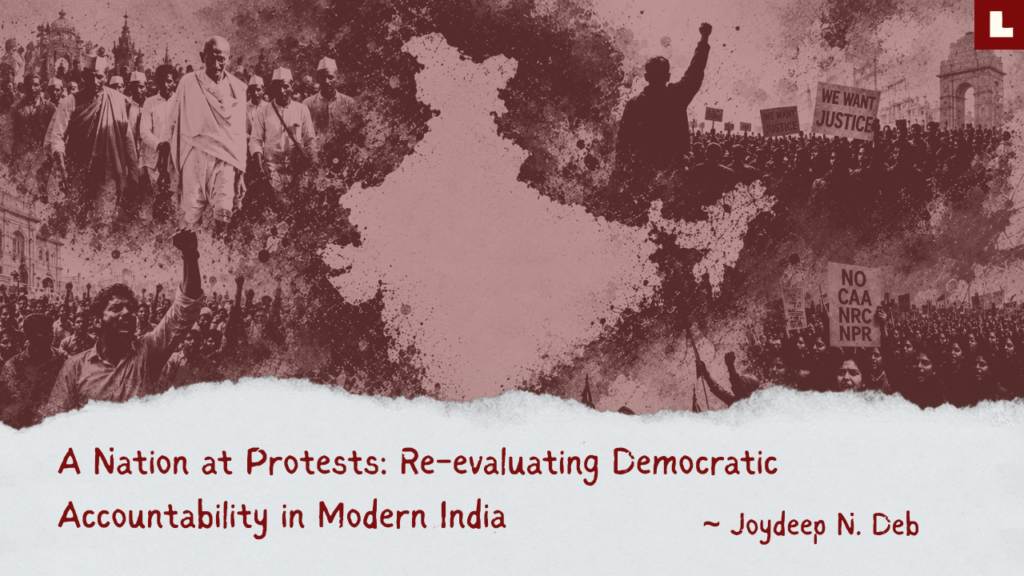

The Preamble to the Constitution of India loftily defines the nation as a “Sovereign, Socialist, Secular, Democratic Republic,” textually committed to securing Justice, Liberty, Equality, and Fraternity for its constituent populace. Yet, for a nation numbering roughly 1.41 billion citizens, the operational realities of these constitutional guarantees are persistently contested. Governing a demographic landscape of such immense scale and diversity introduces chronic systemic strain.
Consequently, the actualization of basic civic rights has necessitated a continuous cycle of public agitation. Far from being an anomaly, public protest has evolved into the functional expression of India’s famed “unity in diversity”, a structural mechanism through which fragmented populations assert their presence before the state.
An historical analysis reveals that the preservation and practice of civil liberties are fundamentally tethered to the act of resistance. From the pre-independence agitations deployed against the British imperial apparatus to contemporary mobilizations demanding institutional accountability, dissent remains the primary vehicle for democratic course correction.
However, the nature of the state’s responsiveness has undergone a profound transformation. During the anti-colonial struggle, the moral weight of hunger strikes occasionally compelled the colonial administration to make concessions, despite its status as an occupying power.
Even in the post-independence era, this moral leverage initially endured. The most defining testament to this was the fast of anti-corruption crusader Anna Hazare, whose 2011 hunger strike galvanized a nationwide civil society movement. Faced with an absolute collapse of public confidence, the then-government felt compelled to negotiate directly with civil society representatives, leading to the tabling of the Jan Lokpal Bill.
Though the legislative outcome was complex, the state at least acknowledged the moral currency of peaceful, mass satyagraha. In the contemporary era, conversely, democratic administrations elected from the very soil they govern increasingly exhibit a systemic apathy toward grassroots movements. This phenomenon transcends partisan lines; it represents a structural transformation in the nature of governance itself, where the state machinery remains aloof, choosing strategic exhaustion over democratic engagement.
This institutional insularity becomes painfully evident when one shifts focus from central urban movements to the contested peripheries of the nation, where the cost of dissent is carried directly on the bodies of the marginalized. The most stark historical precedent of this peripheral alienation is found in the entry of Irom Sharmila Chanu, the “Iron Lady of Manipur,” into the annals of civil resistance.
Following the Malom massacre, where ten civilians were shot by paramilitary forces, Sharmila initiated an unprecedented hunger strike demanding the absolute repeal of the Armed Forces Special Powers Act (AFSPA). The response of the state machinery was not one of dialogue, but of legal and clinical containment. For sixteen years, the state kept her alive through judicial detention and forced nasogastric feeding, transforming her very body into a zone of political conflict.
The structural conclusion of her campaign offers a sobering case study in institutional neutralization. When she eventually transitioned from civil resistance to electoral politics, the state machinery, coupled with deeply entrenched structural realities, resulted in a crushing electoral defeat, effectively demonstrating the system’s capacity to absorb, neutralize, and marginalize profound moral dissent.
The containment strategy utilized against figures like Sharmila or climate activist Sonam Wangchuk, who engaged in a grueling fast over Ladakh’s ecological and political autonomy is mirrored globally in how the state handles grassroots resource conflicts.
In the heartland of Madhya Pradesh’s Chhatarpur district, this tension has manifested in the “Chita Andolan” (funeral pyre protest) against the mammoth Ken-Betwa River Linking Project. Here, indigenous Gond and Kol tribal women have physically laid themselves upon symbolic funeral pyres, sending a grim message to the administration that the impending displacement, lack of rehabilitation, and environmental destruction of their ancestral lands are equivalent to a death sentence.
Alongside desperate symbolic acts, such as villagers standing under bridges with nooses around their necks; these protests highlight a massive disparity where localized communities are expected to bear the catastrophic costs of “national development” while being shut out from the decision-making process through the enforcement of restrictive assembly laws.
Ultimately, these disparate movements stretching from the anti-corruption rallies of New Delhi to the fasts of Manipur, the targeted arrests of indigenous leaders like Pranab Doley in Assam, and the funeral pyres of Chhatarpur, illustrate the precise methods by which the contemporary state routinely handles dissent. The state operates not through dialogue, but through strategic exhaustion, bureaucratic silencing, or deliberate indifference.
The fact that ordinary citizens must resort to radical bodily sacrifices merely to demand basic dignity and constitutional rights suggests a troubling dynamic: an entrenched administrative apparatus that views the electorate not as sovereign citizens, but as administrative subjects to be managed. Far from being the hallmark of a specific administration, this phenomenon aligns with a more expansive global pattern among contemporary nation-states, in which the preservation of institutional power routinely overrides accountability to the citizenry.