Discourses From the East
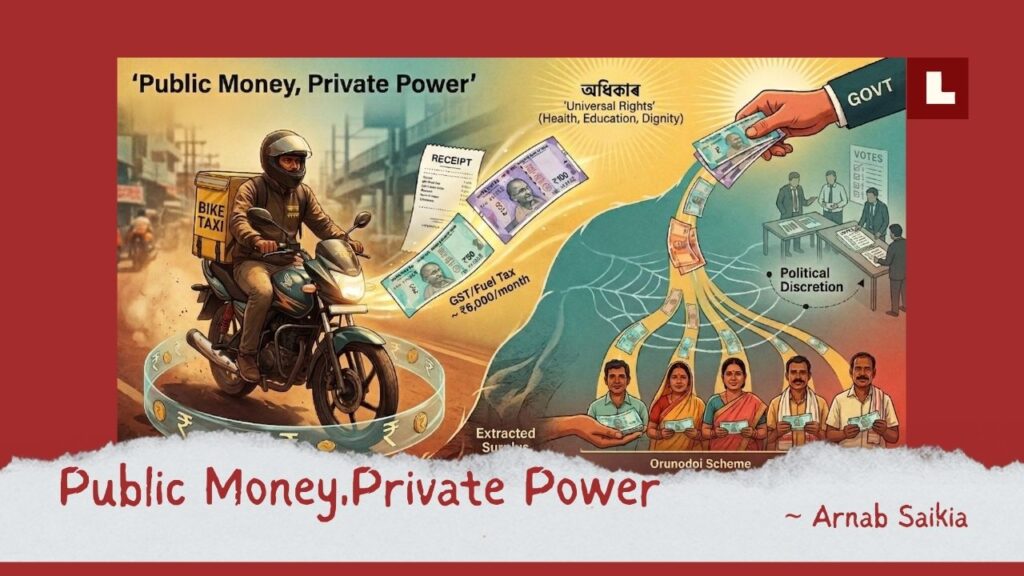

Got a Rapido ride from Chandmari to home and struck up an instant rapport with the captain. Paid Rs. 50 as fare, and he showed me that out of the Rs. 50, Rs. 5 went as GST. He further explained, on average, Rs. 100 per day goes as GST. This means that if he works all 30 days in a month, he pays around Rs. 3,000 as GST alone in a month. Additionally, in a typical month, he needs 60–65 liters of petrol, where nearly 50% of the price is tax. At an average rate of Rs. 98 per liter, he ends up paying around Rs. 3,185 as tax embedded in fuel costs.
Combine these, and a modest Rapido driver—working daily, riding through heat and dust— contributes roughly Rs. 6,000 a month in taxes simply to remain in motion. With that amount, at least five beneficiaries of the Orunodoi Scheme can be supported for a month. The arithmetic is disarmingly simple: money flows from one precarious pocket into another. This small conversation on a moving bike opens a wider political question: what kind of social contract is being forged in Assam today? The Rapido driver’s monthly Rs. 6,000 is not just a number. It is a quiet ledger of the state’s reach into everyday life. It is also a reminder that beneath the spectacle of distribution lies an economy of extraction—steady, normalized, and largely unquestioned.
Under the current regime led by Himanta Biswa Sarma, cash transfer schemes has acquired an unprecedented centrality. Cash transfers, targeted benefits, and group-specific schemes have expanded rapidly, creating a dense web of administraion-mediated and politically motivated support. But beneath this expansion lies a subtle transformation—not of distribution alone, but of political subjectivity itself.
What emerges is not a republic of rights-bearing citizens, but a landscape of segmented dependences. The figure of the citizen—historically imagined as a bearer of rights, capable of making claims upon the state—is slowly being recast as a beneficiary, whose access to survival is routed through political discretion. This is where the distinction between citizen and denizen becomes analytically important. A denizen receives protection and benefits, but without secure, universal, and enforceable rights. Their position is contingent—always subject to verification and political loyalty.
In such a landscape, welfare ceases to be redistributive in a structural sense. It does not alter relations of production, land access, or labour conditions. Instead, it normalises them—softening the edges of deprivation while leaving its causes intact. The tea garden worker, the urban informal labourer, more importantly section of rural women—all may receive periodic transfers, but their structural vulnerability remains untouched.
There is also a temporal dimension: benefits are regular but revocable. This temporariness disciplines their political behaviour. The govt appears as a constant provider, but also as a silent arbiter—capable of inclusion or exclusion. This resembles a transition from welfare as right to
welfare as patronage, even when delivered through formal bureaucratic systems. It is not feudal patronage in the classical sense—but a modern, data-driven, administratively rationalized form of it which is extensivly used for electoral politics.
At its sharpest edge, this politics reduces people to countable units. Beneficiaries—especially women under schemes—are converted into numbers to be displayed: in rallies, in campaign narratives. Their presence is not valued as political voice, but as measurable support. The larger the turnout, the stronger the claim to legitimacy. Their participation is less about articulation of demands and more about demonstrating alignment. This is the deeper reduction: from citizens with agency to numbers that can be counted, circulated, and politically leveraged. The crowd becomes evidence; the person disappears.
Yet, it would be too simple to dismiss these schemes outright. For many households, especially women, programmes like Orunodoi have provided a minimal but real buffer against crisis. The contradiction lies here: immediate relief coexists with long-term politicization.
The deeper question, then, is not whether welfare should exist—but what kind of welfare.
- Does it enable autonomy, or reproduce dependence?
- Does it universalize rights, or fragment populations into administratively manageable categories?
- Does it transform structures, or merely manage their consequences?
In Assam today, the drift leans toward the latter. The grammar of politics is being rewritten—not in the language of collective rights and transformation, but in the quiet, repetitive transactions between the rulling party and the beneficiary. This is not redistribution as transformation; it is redistribution as circulation. Money moves, but relations remain intact. Land ownership does not change. Employment structures do not stabilize. Public goods—healthcare, education, transport—remain uneven. What expands instead is a political economy of immediacy: small payments that sustain life, but do not alter its horizon. The act of voting, formally free, becomes embedded within a wider economy of reciprocity, where dissent carries potential costs, and compliance secures continuity.
The Rapido driver’s predicament is instructive. His costs are high, his earnings uncertain, and his labour remains unprotected. No scheme addresses the conditions of gig work, fuel price volatility, or urban precarity. But by simply transferring people’s money back to people, a section of the population is made to show loyalty, to appear as numbers in political rallies, to feel obliged to ruling political forces, and to have their votes effectively transacted in return for money that has been extracted from the people themselves. A politics that merely redistributes fragments of extracted surplus risks entrenching the very inequalities it seeks to soften. A politics that universalizes rights—health, education, employment, social security—moves in a different direction: from dependence toward dignity.