Discourses From the East
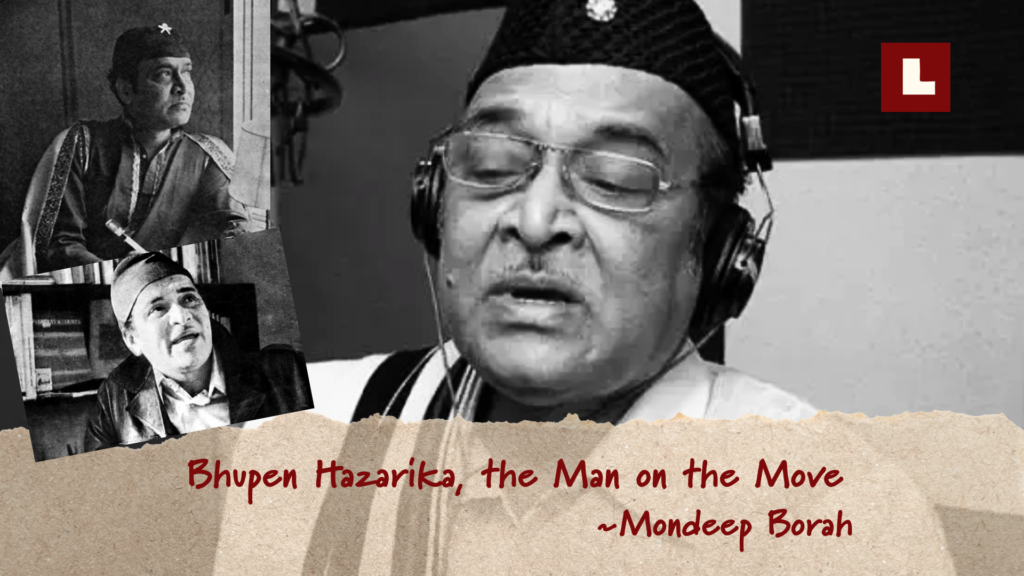

Filmmaker Kalpana Lajmi describes Dr. Bhupen Hazarika as a “Dhumuha”, the Assamese word for storm. In one of his songs too, he declares, “I will leave my speed with the storm” (Dhumuhat moi thoi jaam mur goti). Dhumuha here represents movement, speed. He was a man always on the move, calling himself a “jajabor”, a nomad. His famous song “Moi Eti Jajabor” narrates his trials and triumphs of travelling around the world. He travels from the Luit to the Missiipi, telling Mark Twain’s stories in Gorky’s grave, encountering the destitute millions and the prosperity of the flourishing few. In one of his interviews, he says that he is a “jajabor”, both in its metaphorical and literal sense. One does not always have to travel physically, he argues. The flights of one’s imagination also make one a “jajabor”.
This year marks the hundredth birth anniversary of Dr. Bhupen Hazarika. One of South Asia’s greatest cultural ambassadors, Dr. Hazarika has attained a god-like stature in Assam through the years. Celebrated as “xudhakontho” (the voice as sweet as nectar), he had already turned into a mythical figure during his lifetime, people literally chanting prayers and lighting lamps to welcome him in different parts of the state. The crisis-ridden peripheral state found in him a life-affirming anchorage. He was proclaimed as the messiah of Assamese nationalism; his figure being coloured with the moral coherence of identity.
While this fixed imagery of the artiste legitimises the status quo, the quest for constant movement that characterises Bhupen’s life and songs does not only destabilise the former but also offers glimpses of an alternative vision of life, although steeped in ambiguity.
Most of Bhupen’s songs embody the drama of movement, both in the lyric as well as the music. Sometimes it is the relentless movement of the train heralding equality and sometimes the arduous movement of the palanquin bearers carrying the back-breaking weight of the rich. He imagines the divine horse of heaven, the “pokhiraj ghora”, descending on earth to be with the masses. His lover’s eyes too take on an electric swiftness: “bidyut khipra nayan”. Perhaps it was his fascination with movement and flow that brought him so close to the rivers. No one understood better than Bhupen the waterscape of this eco-region. Rivers, always on flow, became entry points to narrate his tales. From the Brahmaputra to the Missisipi, the Ganga to the Nile – the rivers are central to his artistic expression.
This urge to move translated into his calls of popular mobilisation for change. Even at the very beginning of his career, with his tender voice, he recorded renaissance figure and his mentor Jyotiprasad’s song “Biswa Bijoy Najowan” (o’ world-conquering youth), which was a popular call during the nationalist struggle. He called himself the blazing spark of the age of fire: agnijugor firingoti and vowed to build the heaven of equality on earth. Inheriting the ethos of artist-activist comrade Bishnu Prasad Rabha, whom Bhupen considered his guru, the latter sang of the peasants’ plight and their resolve to claim back their due, symbolised by their sharp sickle. Hailing the revolution in China, he wrote:
“Crimson rays of the morning sun fall on my hair
The hazy mist around me flees in fear
The raising masses shout in unison
Hit by their echoes, the mountains crumble.”
He presided over the Indian Peoples’s Theatre Association and during the heydays of the language riots of the 60s roamed around Assam with Hemanga Biswas to appeal for peace. His famous song “manuhe manuhor babe” (“people for people”) was written as a part of this campaign for harmony. They sang together the “Haradhon-Rongmon kotha” (“the tale of Haradhan and Rangmon”), a tale of two peasants who kept their age long trust even after the provocations of the divisive forces. Even when the Assam agitation of the 1980s took on a chauvinist turn, Bhupen in his song “Brahmaputra Mahamilonor tirtha” (“Brahmaputra, a sacred confluence”) drew the long history of migration in the region, movement and inter-mingling of different cultures.
This conviction with movement allowed him to see the world always in flux. He knew that freedom is never in being but in becoming. It is in motion that one can be free. It made him defy many binaries. He moved swiftly in between the classical and the folk work, often blending the two. He traversed between numerous forms of artistic expression, from songs to cinema, sketching to journalism, besides his doctoral degree from Columbia University. This fluid view of life allowed him to delicately defy the boundaries of the decent and vulgar to explore the realm of the erotic, moving against the middle-class morality of Assamese society. His songs “Bimurta Mur Nixati”, “Gupute Gupute”, “Ei Dhuniya Godhuli Logon” exemplify his pure genius in expressing the most intimate encounters with his lovers with utmost sensibility.
However, this quest to be always on the move comes with a larger obligation of choosing a direction. Throughout his life Bhupen kept wandering around the world and across ideas but political inconsistency became its inadvertent fallout. He traversed diverse ideological lines which were often contradictory. The socialist hero of the 50s who identified himself as the “traveller of the third class”, turned into the great nationalist in the 60s after the Chino-Indian war. With the anti-foreigner movement beginning in the late 70s, he was again hailed as the uncontested hero of Assamese sub-nationalism. In an account as narrated by Kalpana Lajmi, the student leaders of the Assam movement even offered him the post of the Chief Minister after the 1985 elections that brought in a regional government to power. It was his same fascination with flights of imagination that he overtly supported young ULFA cadres, singing of them as tiny doves seeking freedom. Soon he was to be disillusioned and wondered, “If the rising sun is our goal, why are you running towards the setting sun”, the former being the symbol of the Liberation Front. With the right ward turn of the 90s, Hazarika came close to the BJP and contested the Lok Sabha election of 2004 with its ticket.
These contradictions are what make him a man of flesh and blood, far more interesting than his bland iconography that the Assamese elites attempt to draw. Bhupen Hazarika was a people’s singer, with conflicts of his own. In him, a spectrum of human emotions found expressions and made him a member of every household of the state that was fraught with violence and fear. He remarked once that he has a bed to sleep and two meals to eat at every household in Assam.
This dhumuha named Bhupen Hazarika also paused sometimes and longed for some warm solace. From the interstices of his wanderings came out some of the most beautiful verses of love and longing. He wrote, “each day I receive the applause of thousands, then why do I seek the love of that special one?”. Emulating Kalidas’ Meghdoot, he wrote:
“A tender fragment of cloud passes by
My wild hamsa too loses its path
I am waiting on this autumn day in front of my window
For the one my heart longs for.”
Yet even as we try to understand his life and works through his quest for movement, it pushes us to ask a far more important question: why did he prefer movement? Why did it become almost an existential condition for him? It is tempting to point to an innate restlessness in him or artistes being naturally unsettled. Artistes all around the world in his time, from Bob Dylan to the Beat generation similarly turned the road into both a physical route and a metaphor for freedom. Was Bhupen then a restless man of a restless century? But it does not address the larger historical contradiction at play here. He came of age in a time when colonial rule came to an end and new nations were formed. It was precisely the point in history when people were asked to think in terms of fixed territories, national identities and bounded communities, even as their actual lives were characterised by migration, displacement, partition, labour mobility and cultural exchange. It becomes even more powerful for a peripheral state like Assam, these historical contradictions still determining the direction of its politics. And then, Bhupen the great jajabor became the voice of this place. What explains this? We do not have definite answers but at this point in history, when the same contradictions follow us, it is worth considering these questions all over again.