Discourses From the East

Water as a medium connotes varied social, cultural and sensorial meanings in our society. In India, the most dominant paradigm of understanding water, since the 19th century, has been related to ‘control’ of water. This has allowed for the taming of hydrological entities as a homeostatic machine, always flowing in a never-ending circuit (Ballestero, 2019, 407) inciting imagination of endless reproduction turning it to be a renewable resource to serve human interests.
Dams are the most critical infrastructure serving human interests in hydropower, flood control, irrigation, water supply, etc. In the Nehruvian era, commissioning of dams for development has been symbolic of state modernization and state-making process withstanding protests at the grass-root level with questions and concerns of marginalization, displacement and ecological destruction. This has further created a discourse on the question- ‘development for whom’?
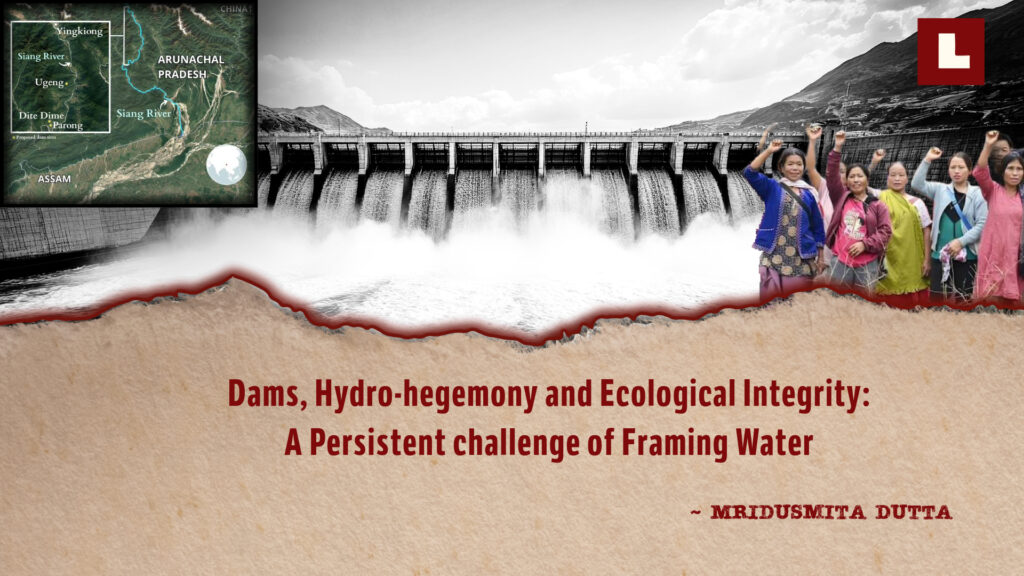
However, in a post-development society, the meaning of dams as state modernization process is ousted. Dams are now seen as critical infrastructures of coercion ,that have the potential to control, store, preserve and have access to water in such a way that it can provide leverage to one state over the other. Here, contextualizing the Brahmaputra that is shared by China, India and Bangladesh is pertinent. China, in its aspiration of creating Worlds’ biggest hydropower project has commissioned a 60,000 MW Medog Hydropower Dam System. Downstream, India’s Arunachal Pradesh is anticipated at highest risk since the engineering endeavor of China overlooks the geological morphology of the Brahmaputra, the seismic vulnerability of the Himalayas together with the tectonic alterations and massive landslide threats that this megadam possess. In response, India has been persistent in launching an 11,000 MW Siang Upper Multipurpose Project wherein the Adi community of Arunachal Pradesh is at the risk of submergence and complete displacement. What is appalling is that this persistent quest to have unequal control over the Brahmaputra downplays the very agency of the gigantic environmental entities and forecloses the imagination of how nature unsettles us in unanticipated ways!
Who benefits from Hydro-Hegemony?
Who decides for us is a political question. India’s Siang Upper Multipurpose Project has faced fierce opposition from the indigenous Adi community of Arunachal Pradesh. The indigenous Adi community is on the brink of severe environmental devastation, loss of lives and livelihoods, and loss of culture and identity amid the chaos of geopolitical power struggles between China and India.
The insistence and persistent protest and social movements that take place in response to dam construction are confrontations to the unequal political, economic, market-driven and epistemic views in framing water. Rivers are not only hydrological entities to be tamed but are an ecological entity with its own ecological properties linked to the ecological health of the flowing river as well as its basin. The mere assumption that hydrological entities are nonsocial and passive ignore/erase the cosmological worldviews with which these indigenous communities relate to the river. As for instance, any change in temperature of the flowing river provides an indication of change of seasons to the local communities. The river and the sanctity of its water are also reflected in the various religious practices of the local communities. The weather, the air, the sky above, the river flowing by is all active entities in the cosmology of local communities indicating dissolution of the nature-culture boundary inherent in technocratic approach in framing water. Increasing anti-dam demonstrations in Arunachal Pradesh draws attention to the unfair water crisis that is being created and distributed to indigenous groups, raising grave concerns about their survival, means of subsistence, and right to self-determination. Do they have their choice in this contest for hydro hegemony? The answer is No. Dams do not hold any accountability once the catastrophe strikes. The causalities in terms of lives lost and displaced only turn into mere statistics. The ecological disruption that is we have already unleashed cannot be anticipated by humans.
Is it time to persist for a Just Water Transition?
How water is framed, tamed, governed and allocated require serious deliberations on questions of indigeneity, care, justice and ecology. This requires a confrontation to the political-economic and technocratic/engineering approach to water governance. The oversimplified reduction of nature to unchangeable laws must be re-examined in order to understand how rivers are intertwined with hydrological and social history. Bruno Latour (2004) in ‘Why Has Critique Run Out of Steam? From Matters of Fact to Matters of Concern’ challenges people to learn, unlearn and relearn the social construction of how humans perceive the material world and give meaning to the social world around them. He claims that scientific knowledge itself lacks scientific certainty in the practice of science, citing his work on the “social construction of facts.” In other words, knowledge produced by science is nothing but premature naturalized objective facts, which are a construction in itself. This article benefits from Bruno Latour’s deliberation in highlighting the taken for granted indicators in science which objectify environmental entities as things to be harnessed. The continuous loop of objectification of environment and the counter criticism that arise in academia, civil societies and international forums and dialogues need revision from scratch in order to address the gloomy periods of instability in our society. We do not want more evidence to prove the disastrous effects of dam commissioning. Yet, dams continue to be commissioned in India, in present times, aggressively in North-East India. Henceforth, the central idea running through in this article is to sit with a critical spirit that entertains matters of concern, not matters of fact! Bruno Latour contends that critique takes us away from what needs to be addressed head on; rather than attending to the ‘conditions that made them possible’ (Latour, 2004, 231) In that critical spirit, taking the argument forward, he states that if scientific facts are a means of construction, then we need to get closer to the facts which makes these facts scientific and not in ‘fighting empiricism, but on the contrary, renewing empiricism’ (ibid).
Ecological Integrity and Justice for Rivers
Drawing inspiration from Bruno Latour (2004), revitalizing empiricism in the context of dam commissioning within the realms of development or geopolitics requires highlighting a perspective that considers the depletion, degradation, and management of water resources. Additionally, in light of climate variability, the urgency of addressing water-related challenges is paramount. In this context, the concept of taming water needs to be reconsidered with a fresh empirical approach to explore whether there are any limits to humanity’s imaginative ability to control nature. Such confrontation opens up space for critique, hope and justice for those marginalized communities and ecological entities- who do not have any say in questions of power and responsibility. Transforming landscape through scientific endeavors and engineering foreclose the vibrancy and emergent properties of environmental entities; turning them to be passive entities only. An illustrative example of this was pointed out by Naveeda Khan (2019) by evoking the discipline of geology in understanding environmental entities in relationality with time. She refers to the discipline of geology to understand how the event of earthquake in 1950 had altered the Brahmaputra basin, which has its temporality in present times as well. The scholar views the rise of the river bed as an extension of the earthquake that has increased the sediment deposit across the basin (2019: 338). The scholar argues the impact of the earthquake on the river basin is not a simplistic event in time and view that the temporality of the earthquake is now an inherent part of river’s ecosystem. According to her, ‘while every ecosystem is always changing and elements within it come and go, this particular element of the river seemed to me to be something else, an extrusion not of a material object but of a movement with its own internal temporality from below the surface of the earth’ (ibid, 338).
Therefore, we must consider and sit with the idea of training to stabilize the Brahmaputra River if we consistently think along the line of any environmental crisis in relation to time. The prediction provided by scientific and engineering exercises across the Brahmaputra may not adequately account for the enormous influence of environmental entities, hydrology, tectonic movements, geomorphology, seismic sensitivity, climate fluctuation, etc. Furthermore, it is impossible for humans to comprehend the irreversible alterations that anthropogenic causes unleash upon environmental entities and how they might develop over time. Therefore, there is ongoing concern over the development of dams that reduce these potent natural factors to mere objectification. I contend that there is a growing need to consider how and to what degree human activity has specifically impacted the internal workings of the rivers’ ecology rather than adopting an anthropogenic perspective. In other words, we need to acknowledge our individuality and acknowledge how we have appropriated the non-human river.
Ecological integrity and Justice for environmental entities:
Rohan D’Souza (2016, 222) reiterates, that there is a need to know the cardinal difference between ‘natural ecosystem’ that has the ability to self-organize in tandem to any fluctuations outside its ecosystem and to that of how it organizes when ‘managed’ by human intervention. He states that by recognizing this cardinal difference, it will be easier to acknowledge and rethink for an ecological baseline in order to ‘determine the impact and implications of the nature/society’ (ibid).
The concept of ecological integrity is pertinent to understand how and why we need to rethink to create an ecological baseline. The idea of ecological integrity is embedded in the belief that natural systems have their own mechanisms of adaptation, reproduction, regeneration, and nourishment. The concept of “integrity” pertains to the understanding that the collective functions and constituents of all natural systems, as well as the arrangement of natural forces among them, are valued in and of themselves, independent of our suitability (Westra et al., 1997, 11). Additionally, Rohan D’Souza (2016, 222) asserts that recognizing the “integrity” of the natural system does not imply that nature exists in a perfect condition, but rather comprehending that certain characteristics of natural systems are intrinsic to them.
Henceforth, including the idea of ecological integrity in framing the environment for developmental endeavors, there is an increasing need to recognize the integrity of the natural system of environmental entities. In the same tangent, the idea is not to find the pristine form vis-à-vis the river Brahmaputra but to step back and accept the velocity and veracity of this gigantic water body. The inherent tendency of institutions, market and economy to control the inundation of the Brahmaputra floodplains in Assam or tame its flow across North-east India through critical infrastructures of dams do not recognize the internal and complex environmental processes at play. The social construction of the ‘natural entities’ as the world out there to be appropriated by humans is a social construction strengthening the nature-culture divide. Moreover, construction of the discourse of disaster management, disaster mitigation, rehabilitation and resettlement are nothing short of construction of nature wherein the repercussions of environmental hazards can yet be anticipated, controlled and mitigated by humans.
Conclusion:
Scholars, activists, and scientists have a different conception of nature than the contemporary technocratic paradigm, as has been extensively documented. They contend that it is critical to highlight people’s traditional knowledge, comprehension, and behaviors in addition to their cosmological worldviews. However, from a nature/capital binary, the neo-liberal agenda, capitalism, market, and profit-oriented planning tend to dominate the knowledge practices of building infrastructure like dams, embankments, and bridges. They are eager to dominate nature using this scientific method. However, over time, several catastrophes have occurred all across the world as a result of scientific efforts failing to manage the intricate dynamics of natural forces.
So here at this point as conscious members of the society, it is reasonable for us to create a new or alternate paradigm through which we can provide an equal footing to people’s experience or knowledge where both modern scientific technology and traditional knowledge can have a conversation. Such paradigms are increasingly important in the face of ecological challenges we face because each ecological challenge is time and space specific. The role of history and geography is also equally important to consider the challenge of ecological perturbations. Therefore, I would like to suggest that instead of explicitly rejecting the distinction between nature and culture or evoking essentialism of nature, we need to first understand how nature functions so as that we can make informed choices of our future that are sustainable in the long run.
In this piece, Bruno Latour’s persistence in revisiting construction of social facts with renewed empiricism has allowed to bring forth the idea of ecological integrity to illuminate the idea that the environmental entities too have the right to be in existence beyond the limits of human interference. Moreover, persistent human ingenuity to control/train environmental entities on the logic of nature-culture divide requires a rethinking of an ecological baseline wherein the natural rhythm and integrity of environmental entities are not interfered with.
Let the river Brahmaputra flow!!!!
References:
- D’Souza, R. (2016). Colonialism, Capitalism and Nature. In M. Shah & Vijayshankar, P.S. (Eds.). Water: Growing Understanding, Emerging Perspectives (pp. 218-246). New Delhi: Orient Blackswan.
- Khan, N. (2019). At Play with the Giants: Between the Patchy Anthropocene and Romantic Geology. Current Anthropology, 60(20), 333-342.
- Latour, B. (2004). Why Has Critique Run out of Steam? From Matters of Fact to matters of Concern. Critical Inquiry, 30, 225-248.
- Westra, L., Miller, P.,Karr, W., Rees, W., & Ulanowicz, R. (1997). ‘Ecological Integrity and the Aims of the Global Integrity Project’. In Pimental, D., Westra, L & Noss, R.F. (Eds.). Ecological Integrity: Integrating Environment, Conservation and Health (pp.19-41). Washington D.C: Island Press.
Dr. Mridusmita Dutta is a faculty member in the Department of Sociology at Digboi Mahila Mahavidyalaya, Assam