Discourses From the East
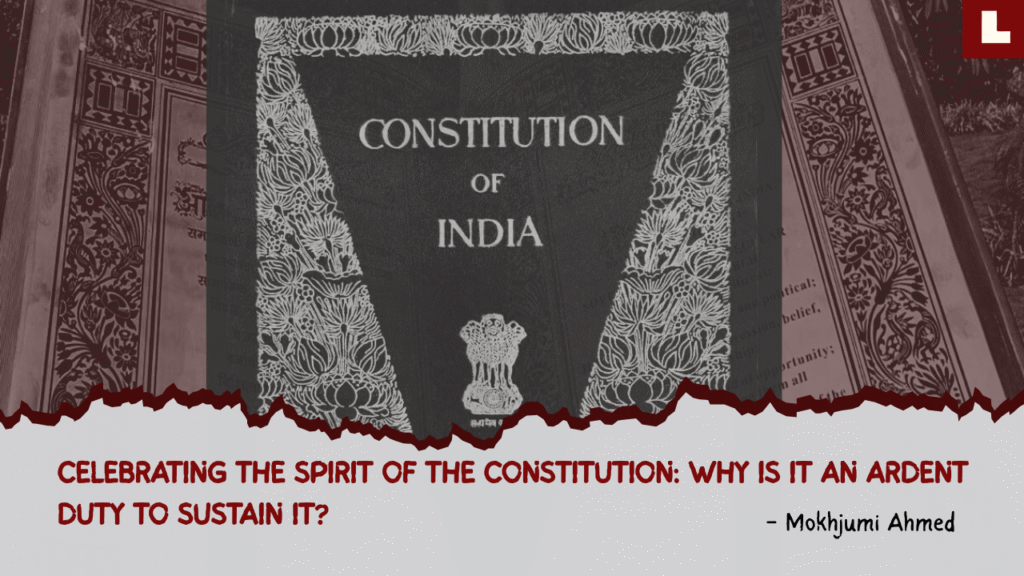

Today is the Constitution Day of India. On this day, 26th November in 1949, the Constitution of India was adopted by the Constituent Assembly. The Assembly was composed of an illustrious group of people from provincial assemblies, princely states, and the Chief Commissioners’ provinces. Initially, the number of members was 389 (292 from provincial assemblies, 93 from princely states, and 4 from chief commissioners’ provinces), which was later reduced to 299 (229 from British provinces and 70 from princely states) after Partition. Headed by Dr. Rajendra Prasad, it represented an eclectic group of people from all backgrounds.
It was a red-letter day for Indians, who after so much struggle were set to write their own Constitution: to be written by Indians, adopted by them, and implemented by them. It was a cherished dream for many at the time. They were the first generation who had experienced the atrocities of unjust rules and regulations framed and implemented by foreigners. Under such emotionally charged circumstances, the makers of the Indian Constitution ensured they handed their progeny a document that eliminated erstwhile discrimination, prejudice, and unfairness. The makers deliberately ensured the abolition of discrimination based on caste, creed, sex, religion, place of birth, etc.
As a result, India got a secular constitution based on Justice (Social, Economic, and Political); Liberty (of thought, expression, belief, faith, and worship); Equality (of status and opportunity); and Fraternity (among her citizenry). These principles were laid down to establish an India that is fair, just, and caring to her citizens, irrespective of caste, creed, sex, religion, or place of birth. The forefathers deliberately framed a Constitution that gives equal rights to everybody, unlike the newly established Pakistan, which from the very beginning discriminated among its citizenry. Pakistan’s constitution, in this sense, is all that India’s is not.
However, this very basis has been under attack from various quarters these days. Their logic is: If Pakistan is a theological state, then why should India be secular and not a Hindu Rashtra? If Pakistan can discriminate against its minorities, why should India appease its own? If minorities are converted and tried under Blasphemy law in Pakistan, then why should Indian minorities not be re-proselytized (ghar wapsi)?
Well, seemingly, these questions are logical. After all, both nations underwent similar colonial discrimination and achieved independence. Comparison between the two is understandable and looms in common people’s heads. However, to understand the whole point, one has to understand what the forefathers wanted India to be: an antithesis to what Pakistan is. They wanted India to stand out as a country that is unlike Pakistan. India, as they envisioned, would stand for everything that Pakistan is not.
It is this unwavering commitment to values of love, fairness, and justice that attracted people from the newly formed Pakistan to India. It is noteworthy that not only Hindus but also many peace-loving Muslims migrated from Pakistan or stayed back in India. Allured by the secular nature of Indian democracy, Taz Muhammad Khan, a young advocate and freedom fighter from Peshawar, stayed back in India after Partition, leaving behind his entire family in Pakistan. He later became famous as the father of successful Bollywood actor Shah Rukh Khan. Shahnawaz Khan had a more interesting story. After Partition, he stayed back in secular India and went on to become a Union Minister, while his son Mehmood Nawaz lived in Pakistan and joined the Pakistani army. During the 1965 war, when a controversy arose regarding his son serving in the Pakistani army, Shahnawaz Khan offered to step down. However, Lal Bahadur Shastri declined to accept his resignation.
These people were perhaps enticed by the vibrancy of Indian democracy, which was established as a rule of law and not at the mercy of someone’s whims and caprices, unlike Pakistan, where democratic rules have been crumpled upon time and again by the army. While in India, the state has the army; in Pakistan, the army has the state. It is because of the fundamental discrimination in the set rules that the army has time and again seized power there. Is this the kind of state the forefathers of the Indian Constitution would have wanted for her? Certainly not. Any deviation at the cost of the basic structure of the Indian Constitution would be an insult not only to the framers but also to people like Taz Mohammad Khan and Shahnawaz Khan, who desired to stay in an India that does not discriminate.
When discrimination is canonized, the very foundation of the state falters, giving way to cracks that eventually entail undesirable consequences. The prime job of the state is to keep her citizenry united without discrimination. The weak and emaciated should be taken care of so that they feel a sense of belonging even more. The framers showed their sagacity in uplifting weaker sections like women, Scheduled Castes (SCs), Scheduled Tribes (STs), and minorities, etc. Article 15 (3) and Article 15 (4) provide special provisions for women, Scheduled Castes, and Scheduled Tribes. It is this visionary statesmanship of the founding fathers that has kept the country together. This was time and again discussed in the debates of the Constituent Assembly. Dr. Ambedkar’s speech sums up why unity mattered to the framers of the Constitution.
In the debate of the Constituent Assembly on December 17, 1946, he said: “…So far as the ultimate goal is concerned,… None of us need have any doubt. But, my fear which I must express clearly is this. Our difficulty is I said is not about the ultimate future. Our difficulty is how to make the heterogeneous mass that we have today, take a decision in common and march in a co-operative way on that road which is bound to lead us to unity. Our difficulty is not with regard to the ultimate. Our difficulty is with regard to the beginning… in order to make a start, in order to induce every party, every section in this country, it would be in the act of greatest statesmanship for the majority party even to make a concession to the prejudices of people who are not prepared to march together and it is for that, that I propose to make this appeal. Let us leave aside slogans, let us leave aside words which frighten people. Let us even make a concession to the prejudices of our opponents, bring them in, so that they may willingly join with us on marching upon that road,… If we walk long enough, must necessarily lead us to unity… make some attempt whereby those who are not prepared to come, will come…”
As this statement reflects, the adoption of the constitution was the beginning of a long journey which would be successful only when people live united. It is high time we reflect on the values of the Constitution and ask: Can we sustain its spirit? People should leave aside slogans and march on the road that leads to unity. The Constitution has given Indians the right way; it is upon them to embrace and implement wholeheartedly the principles enshrined within. It is not a mere document but the living aspiration of her founding fathers, who envisioned an India that outgrows every aspect of human narrowness, parochialism, and hatred. Constitution Day, therefore, should not only be a celebration of the document but also the vivid principles it enshrines for the people of India. The makers of the Constitution are gone, but their aspirations still live on its pages, and the best tribute one can give is to uphold its values.
The writer’s newly published book:
Petals and Ashes: Songs of the Soul