
Discourses From the East
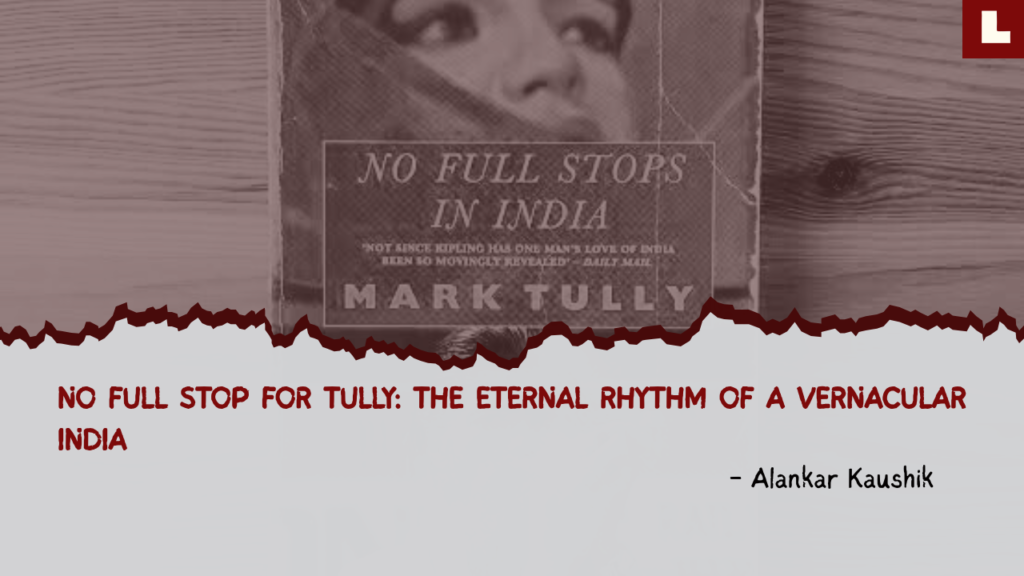

The Chronicle of a Correspondent
Sir Mark Tully is perhaps the most recognized foreign voice in the history of Indian broadcasting. Born in Tollygunge, Calcutta, in 1935, his life has been a literal and metaphorical journey back to his roots. After being educated in England at Marlborough College and Cambridge, Tully returned to India in 1965 to join the BBC’s New Delhi bureau. For nearly thirty years, his calm, authoritative baritone became the primary source of news for millions of Indians, especially during the dark days of the Emergency (1975–1977), when local media was silenced. Tully was the man who spoke the truth when the state would not, leading to his brief expulsion by the Indira Gandhi government.
His body of work spanning books like Amritsar: Mrs. Gandhi’s Last Battle, India in Slow Motion, and The Lives of Geary Street is a testament to a career spent in the dust and heat of the subcontinent. However, it is his 1991 masterpiece, No Full Stops in India, that remains the definitive map of his heart. Written at the dawn of India’s economic liberalization, the book serves as both a critique of the Westernized elite and a love letter to the “vernacular” India that exists outside the corridors of power.
The Architecture of the Text
No Full Stops in India is structured as a series of ten long-form essays, each a deep dive into a specific facet of Indian life. It is not a travelogue, but an anthropological and journalistic inquiry. To understand my personal reading of this work, one must first look at the factual anchors Tully uses to build his case.
He begins with the Kumbh Mela, describing the logistics of the world’s largest gathering not as a chaotic mess, but as a triumph of indigenous organization. He then moves to the Ramayan Phenomenon, analysing the 1980s television serialization of the epic. He observes how ancient mythology could hijack the most modern of mediums, proving that tradition and technology are not mutually exclusive. Finally, he uses the decommissioning of the North Eastern Railway’s steam engines as a poignant metaphor for the loss of a human-centric pace of life.
Tully’s central thesis is that the “English-speaking elite” have attempted to impose a “full stop” on the country, a definitive break from its past in favour of a homogenized, Western model of progress. He argues that this attempt is not only futile but harmful to the soul of the nation.
The New Colonialism: A Shadow Over the Soul
In the pivotal chapter, “The New Colonialism,” Tully dissects the institutional and psychological residue left by the British Raj. He argues that while the British physically departed in 1947, they left behind a “New Colonialism” administered by an Indian elite that is, in many ways, more detached from the masses than the original colonizers. This elite, Tully observes, treats traditional Indian culture with a mixture of embarrassment and condescension, viewing the “vernacular” way of life as an obstacle to be overcome rather than a foundation to be built upon.
Tully focuses specifically on the Indian Civil Service (ICS) and its successor, the IAS. He points out the factual reality that the administrative machinery was designed by the British to rule a conquered people, not to serve a free citizenry. By maintaining these rigid, top-down structures, the New Colonialism perpetuates a distance between the government and the governed. Tully’s critique is sharpest when he discusses education and language; he highlights how the obsession with English as the sole language of “intelligence” creates a glass ceiling for millions of talented Indians who think and create in their mother tongues. This chapter reveals the “Full Stop” as a tool of exclusion, a way for the elite to define progress so narrowly that only they can participate in it.
The Gospel of the Vernacular
When I first opened No Full Stops in India, I expected the observations of a detached journalist. Instead, I found the reflections of a man who had allowed India to change him. Tully’s writing suggests that the “beauty” of the country isn’t found in its progress toward a Western ideal, but in its refusal to get there.
The “Full Stop” is more than a grammatical metaphor; it is a philosophical one. In the Western tradition, we are taught that history is a line leading to a conclusion. In Tully’s India, history is a circle or perhaps a spiral. It is a run-on sentence that gathers momentum from its own contradictions. My reading of the book suggests that Tully was one of the first Western voices to validate the “vernacular” logic of India. He saw that the villager in Bihar or the pilgrim in Prayagraj possessed a profound, ancient wisdom that the “New Colonials” in Delhi had forgotten.
A Creative Tribute: The Man Who Listened
To write a tribute to Mark Tully is to write a tribute to the art of listening. In an era where “reporting” often means shouting over the noise, Tully’s career was defined by his willingness to sit in the dust, drink the tea, and wait for the story to reveal itself. He didn’t just report on India; he allowed India to speak through him. His approach was defined by observation over judgment, empathy over cold objectivity, and a profound patience that favoured the “long view” over the fleeting “hot take.”
For those of us who have grown up with his books, Tully is a permission slip. He gave us permission to love the “messy” India. He showed us that one could be a rigorous critic of the state as he was during the Emergency and Operation Blue Star, while remaining a devoted lover of the culture. He understood that the shadows of the New Colonialism still loomed large over the Indian psyche, and he spent his life trying to bridge that gap with humility rather than hubris.
The Unending Sentence
As I revisit the pages of No Full Stops in India today, the book feels more relevant than ever. In a world of fleeting digital outbursts and polarized headlines, Tully’s work is a radical act of patience. He reminds us that the “Real India” is not a monolith to be conquered or a problem to be solved, but a rhythm to be joined.
Mark Tully’s life and work are, in themselves, a sentence with no full stop. He chose to stay in India long after his retirement from the BBC, living in Delhi, continuing to write, and continuing to walk the streets of the country he calls home. He became a part of the very tapestry he spent decades describing.
Sir Mark Tully taught us that as long as there is breath in the people and faith in the heart, the story will go on. We are all characters in this vast, unending narrative, and we owe it to Tully to keep the sentence running without a full stop, without an end, just a beautiful, magnificent “and then…” He didn’t just chronicle the nation; he became a guardian of its spirit. And for that, there is no conclusion only a deep, resonant gratitude that continues into the next chapter.


[…] Also Read: No Full Stop for Tully: The Eternal Rhythm of a Vernacular India […]