Discourses From the East
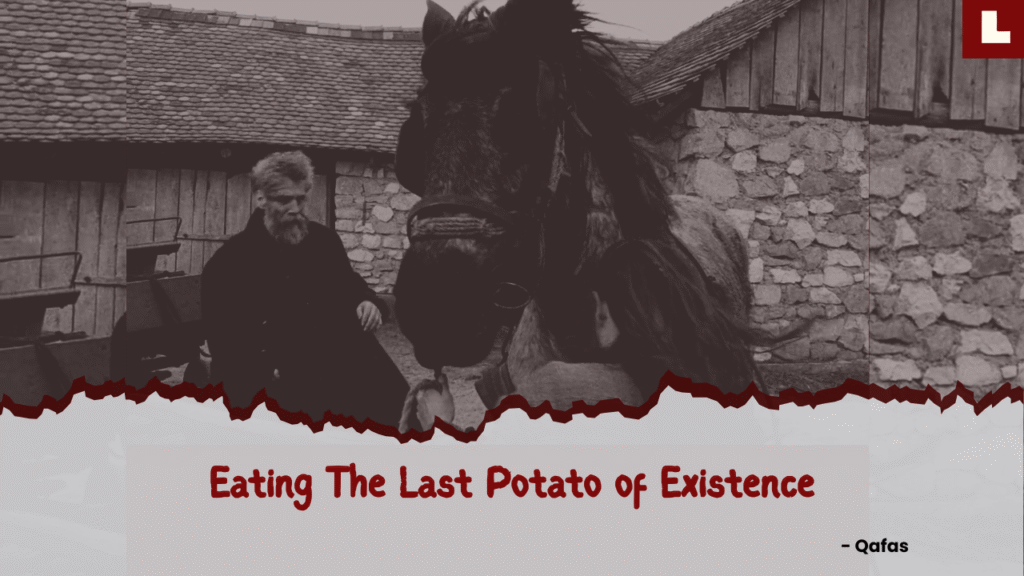

The wind in The Turin Horse does not relent. It scrapes the earth. It rattles timber. It carries grit until even the sky seems weary of being seen. Inside a small, dilapidated house, an old man and a daughter enact the same day: dress, fetch water, boil potatoes, look out at nothing. The horse, once a force, stands still. The lamp fails. The dark remains.
And still, they breathe.
When the Nobel Committee honoured László Krasznahorkai in 2025, “for his compelling and visionary oeuvre that, in the midst of apocalyptic terror, reaffirms the power of art”, the announcement felt less celebratory than clarifying. The terror the work contemplates is no longer distant. It hums beneath daily life, in heat that lingers, in news that grinds, in that drained, over informed fatigue. Krasznahorkai’s books have been walking beside us for years, not to console, but to persist.
For readers new to him, Krasznahorkai is a Hungarian novelist whose work drifts between prophecy and despair. His sentences stretch across pages, dense and hypnotic, building slow storms of thought. In “Satantango” (1985), a decaying village waits for a savior who never truly arrives. In The Melancholy of Resistance (1989), a traveling circus brings a dead whale and moral collapse to a small town. In “War and War” (1999), a desperate archivist carries a manuscript that he believes will outlast the world. His novels are about ruin, yes, but also about the stubborn pulse that beats beneath it, the will to continue when continuation seems impossible.
The seed of The Turin Horse was a question Béla Tarr posed to Krasznahorkai: what became of the horse Nietzsche embraced in 1889, the day he broke under the shock of another creature’s suffering? There is a fracture in modernity there, a person who declared the death of God undone by ordinary, unbearable compassion. Tarr and Krasznahorkai follow what arrives after such seeing.
In their telling, the horse survives, but only barely. Life narrows to habit and residue. No revelations, no rescue. The end comes by erosion rather than explosion. Yet within that repetition, something persists, a modest, stubborn gesture. Tend the fire. Lift the bucket. Frame the shot. Write the sentence. Perhaps hope is simply endurance, slowed to human speed.
Step outside the film and the same wind is present now. It presses through our summers, thins patience, wears down attention. The ritual of the feed is its own liturgy: thumb. refresh. sigh. repeat. People are not motionless from indolence, but from exhaustion. The world’s engine turns by inertia while meaning leaks away.
Krasznahorkai has inhabited this terrain for a long time, in Satantango, in “War and War”, where towns collapse, histories burn out, and wanderers move through the ruins with sentences that refuse to break. He does not allow the ruin of the last word. The sentence holds. The breath continues.
There is a moment in The Turin Horse after the lamp goes out. The daughter reaches for a match anyway. The flame dies at once, yet the reach matters. That is Krasznahorkai’s faith, not in salvation, but in fidelity to the act. Art here is not a light that defeats darkness; it is the memory of light kept alive by the hand that reaches, again and again, even when it fails.
To affirm the power of art amid catastrophe is not to deny despair. It is to say that making, a sentence, a shot, a melody, a meal, still honours something human when meaning has thinned to thread. Beauty may sit beside futility. Dignity may live in one careful line. In an age that demands speed and certitude, Krasznahorkai’s long, sinuous pages take on the aspect of resistance: slow down. Look longer. Breathe.
I return to a spare image: the still horse and the wind that does not give up. The film offers no answer; it offers a posture. Shoulders set. Head bowed. Work done anyway. A life can be held together by small, faithful acts that mean nothing and everything at once.
Perhaps this is why the Nobel citation lands as it does. We do not need art to save us in the heroic sense. We need it to keep us company. To witness. To steady the rhythm of breathing when the world feels thin and loud. A sentence can shelter. A film can pray, not to be answered, but to be said.
The wind continues across Tarr’s black and white plains. It moves through glass towers and across bright screens. It strips away slogans and leaves gestures. Somewhere in that noise, a writer keeps writing. A reader keeps turning pages. An artist keeps making.
Perhaps that is enough, for now.
If there is a lesson in Krasznahorkai’s work, it is not how to escape darkness, but how to live within it without surrender. No miracle promised. Only care. Only attention. Only the fragile, persistent rhythm of breath, ours, together, refusing to stop.