Discourses From the East
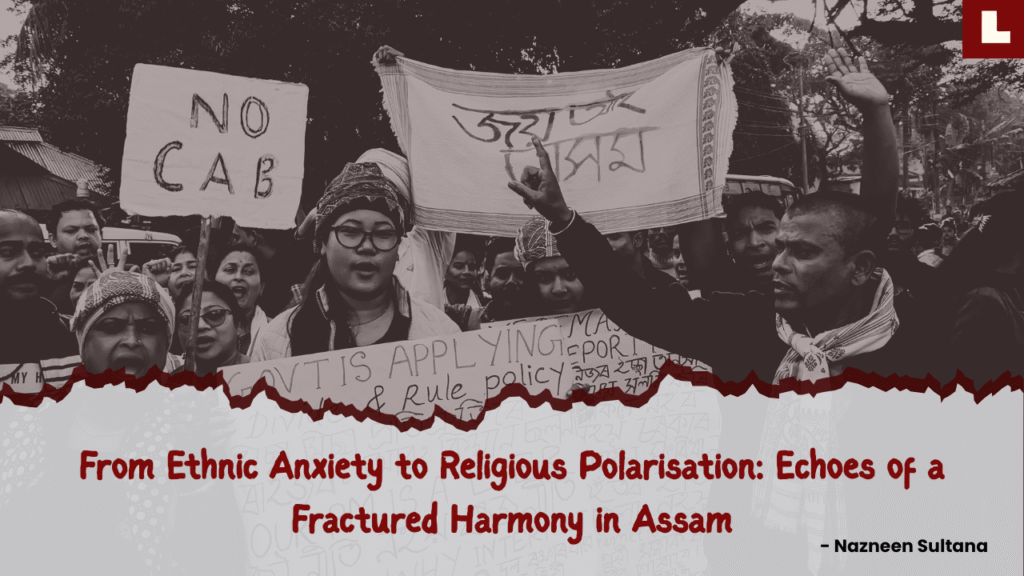

What is unfolding in Assam today is deeply unsettling, particularly for those familiar with its long legacy of cultural coexistence and political assertion. This is the land of Srimanta Shankardev and Azan Fakir, spiritual figures who embodied inclusivity, syncretism, and reform. For decades, Assam’s social fabric reflected this spirit of shared belonging. The memories of the Assam Movement, for instance, were not confined to historical retellings but lived on in the collective consciousness of Assamese society, often recalled as a struggle to safeguard cultural and linguistic identity.
Yet, the Assam of today tells a different story. The anxieties that once revolved around language, culture, and indigeneity have been subtly reimagined through the prism of religion. What appears at first glance as a transition from ethnic nationalism to religious polarisation is, in fact, a more complex process—one where religious divisions are carefully woven into the very language of ethnic protection. The defence of culture and the fear of loss have become vehicles for a politics that privileges exclusion over coexistence.
This transformation, however, cannot be understood solely through the lens of recent political shifts. Assam’s history reveals how anxieties around identity, belonging, and migration have long simmered beneath its politics. Even before the rise of the Bharatiya Janata Party (BJP), electoral parties and regional movements often drew upon these anxieties, alternately invoking ethnicity, language, or religion to define who counted as Assamese. The seeds of today’s polarisation were not planted overnight; they were nurtured through decades of selective silences, compromises, and unresolved questions of justice. The silence surrounding the Nellie Massacre of 1983, for instance, was not merely an administrative omission but a moral failure that allowed the wound of communal violence to fester unacknowledged in Assam’s political memory.
In recent years, however, this latent tension has acquired a new ideological vocabulary. Over the past decade, the BJP, working in close alignment with the wider Sangh Parivar, has pursued a systematic strategy of expanding its foothold in the Northeast. Unlike its earlier limited presence, the party sought to assimilate itself into Assam’s cultural and political ethos, presenting itself as a custodian of regional concerns, particularly the long-standing fear of illegal infiltration from Bangladesh. The BJP and the Sangh Parivar did not invent these anxieties but skilfully rearticulated them within a national ideological framework. By aligning Hindutva’s religious majoritarianism with Assam’s older fears of cultural extinction, they transformed what had once been a regional issue of identity into a tool of national political consolidation.
The party’s success lies in its ability to appropriate the language of local nationalism while infusing it with the symbolism of Hindutva. What Akhil Ranjan Dutta (2021) explains as a Rainbow Coalition aptly captures this project—an attempt to bring diverse ethnic groups under a shared political umbrella. By aligning local cultural aspirations with broader ideological goals, the BJP has expanded its influence, reshaped debates around identity, and cultivated loyalty across communities. Yet, this inclusivity is selective. While the rhetoric speaks of unity, it redefines who belongs within that imagined community, marking Muslims, especially Bengali-speaking ones, as perpetual outsiders.
The twin moves of the National Register of Citizens (NRC) and the Citizenship Amendment Act (CAA) reveal this dual strategy most clearly. The NRC, ostensibly a neutral bureaucratic exercise to identify undocumented immigrants, created widespread fear and uncertainty across communities. Its pairing with the CAA, which offers citizenship to non-Muslim migrants, exposed the religious fault line beneath the ethnic discourse. Together, they reconfigured the idea of Assamese by introducing faith as a criterion for belonging, transforming a once civic question of indigeneity into a religiously charged one.
The consequences have been profound. Right-wing narratives, once peripheral in Assam, now operate with unprecedented visibility. Groups that claim to defend Assamese culture increasingly police interfaith relationships, target cultural practices, and amplify exclusionary rhetoric. At the same time, the communalisation of public life has triggered a defensive consolidation within the Muslim community, particularly among Bengali-speaking Muslims, who now face marginalisation on both ethnic and religious fronts. This double burden has given rise to a politics of reactive identity which, though understandable, inadvertently strengthens the binaries set by majoritarian forces.
The emergence of the Miya identity movement among Muslims of Bengali origin has further complicated this terrain. While the movement represents an effort to assert dignity and belonging, Hindutva groups have strategically exploited it, portraying it as separatist or anti-Assamese. This framing deepens fear among the Assamese community, presenting the movement as a threat to cultural unity and thus legitimising exclusion in the name of safeguarding heritage. In this way, the old ethnic discourse of protection is not abandoned but repurposed, its emotional charge redirected toward religious targets.
The everyday language of politics has been reshaped by cultural campaigns like the discourse on Love Jihad, the vilification of religious conversion, and the state-led crackdowns on madrasas. These campaigns, often justified as protecting culture or ensuring security, serve in practice to stigmatise Muslim life and practices. The extension of beef restrictions to Assam, far beyond the so-called cow belt, further illustrates how a wider Hindutva agenda has been grafted onto the region’s terrain, turning dietary customs into markers of loyalty and difference.
What we see, therefore, is not a disappearance of ethnic nationalism but its transformation into a more insidious form; one that legitimises religious polarisation under the guise of protecting cultural identity. This is the politics of othering at its most sophisticated, where the language of belonging is mobilised to exclude. Social media has accelerated this process, enabling disinformation, hate speech, and targeted harassment to spread unchecked. Mainstream media, too, has played its part, amplifying communal tropes and linking Muslims to demographic threats or terrorism, thereby hardening public attitudes.
Assam’s present moment represents a critical juncture. The older anxieties of ethnicity and language have not vanished; they have simply been repackaged, giving religious polarisation a culturally acceptable face. In aligning regional insecurities with national majoritarianism, Assam risks eroding the delicate balance that once defined its identity. The danger lies not only in communal violence or political manipulation but in the quiet normalisation of prejudice; the slow erasure of Assam’s pluralist ethos.
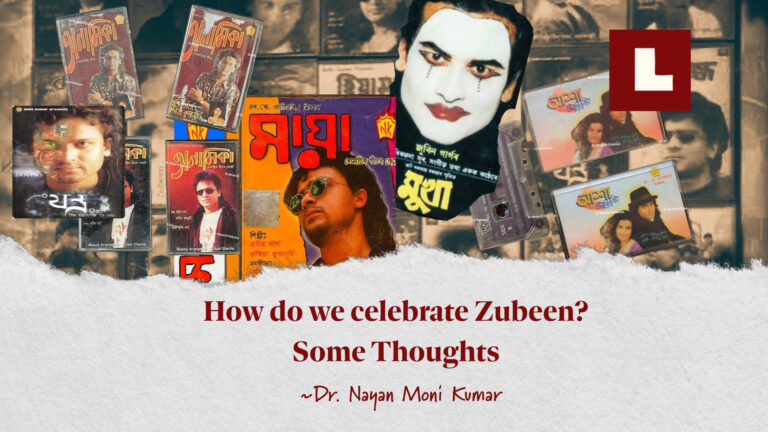
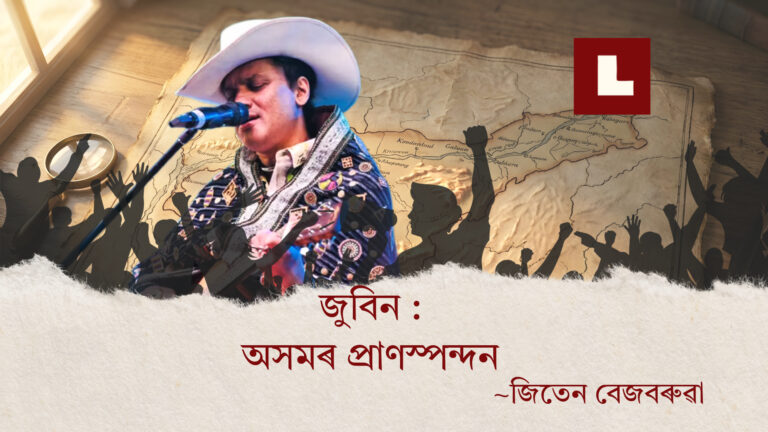
The recent passing of Zubeen Garg, one of Assam’s most cherished cultural icons, arrived amid this atmosphere of uncertainty and fragmentation. His death evoked a rare moment of collective emotion, cutting across political, ethnic, and religious boundaries. Crowds gathered in mourning across towns and villages, singing the songs that had once bound generations together in shared pride and nostalgia. For many, Zubeen’s voice had long embodied an Assamese identity that thrived on inclusivity rather than exclusion, on emotion rather than ideology. The public response to his passing revealed the persistence of a cultural consciousness that continues to resist easy politicisation. For a political establishment accustomed to scripting identity through majoritarian frameworks, this spontaneous unity served as a quiet reminder that belonging cannot be engineered through fear—it endures through shared memory, language, and feeling.
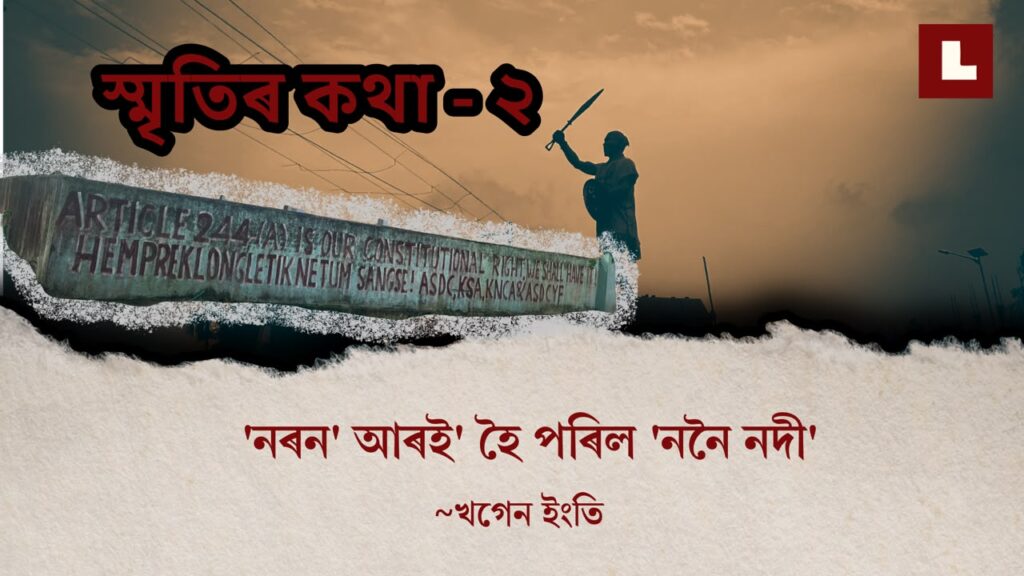
Yet, even as moments of collective grief rekindle a sense of shared identity, the undercurrents of unresolved history continue to unsettle Assam’s present. The recent tabling of the long-suppressed Nellie Massacre report, more than four decades after one of India’s worst episodes of communal violence, has reignited questions about truth, accountability, and collective memory. While the move is being read by some as an overdue step toward transparency, it also invites reflection on why such a disclosure comes at this political moment. The massacre, which unfolded at the height of the Assam Movement, had long remained unaddressed in public memory; a silence that reflected the unease of confronting how ethnic mobilisation had begun to take communal forms. Its resurfacing today, therefore, carries layered implications: it not only exposes the unfinished business of justice but also reanimates older anxieties about identity, belonging, and exclusion. The ghosts of Nellie remind us that the rhetoric of protection, once used to preserve cultural distinctiveness, can easily blur into narratives that other and divide. Whether the report’s tabling leads to a deeper reckoning or merely becomes another episode in the region’s contested political memory remains to be seen.
The changes unfolding in Assam today are more than political; they ripple through the daily lives of communities that have long coexisted in harmony. The path forward lies in recalling the lessons of our shared history, prioritising dialogue over division, and fostering a society where differences are respected rather than feared. Just as past generations celebrated unity within diversity, Assam’s future depends on nurturing empathy, understanding, and mutual respect; keeping the richness of its culture and the humanity of its people at the centre of its journey.