Discourses From the East
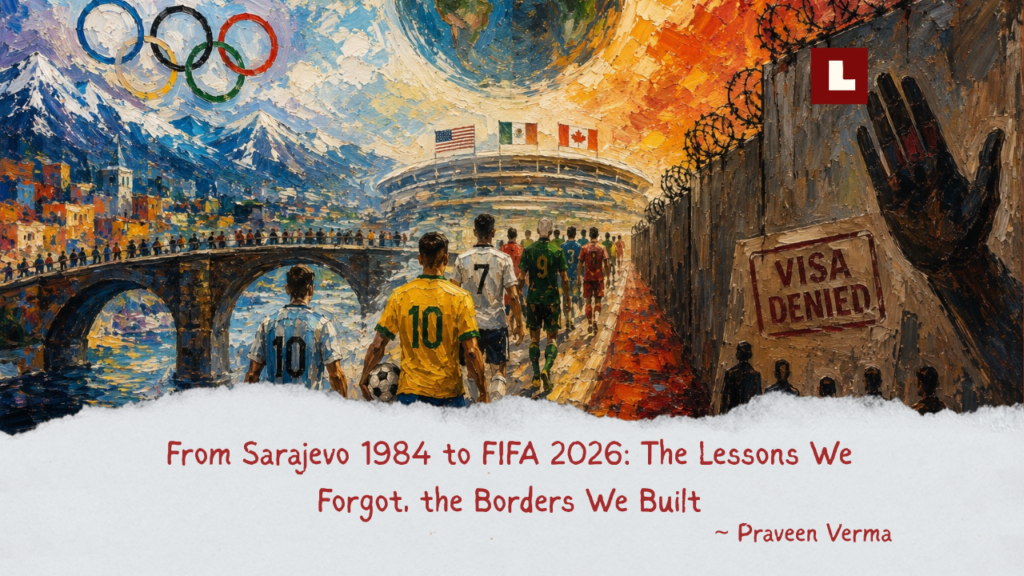

FIFA 2026 is exposing how politics is building borders where sports should be building bridges. Sarajevo 1984 proved otherwise, and we are choosing to forget.
When Sarajevo, in the former Yugoslavia, hosted the Winter Olympics in 1984, the world was deeply divided. The Cold War had frozen diplomacy, nuclear tensions were high, and ideological rivalry shaped almost every aspect of international politics. Only four years earlier, the Moscow Olympics had been boycotted by much of the Western bloc following the Soviet invasion of Afghanistan. Four years later, the Soviet Union and its allies would retaliate by boycotting the Los Angeles Olympics. Sport had become another battlefield of geopolitics.
Yet Sarajevo offered a different vision. In the heart of socialist Yugoslavia, athletes from rival political systems competed on the same slopes, shared the same Olympic Village, and celebrated the same spirit of competition. For a brief moment, sport succeeded where diplomacy had failed. It reminded the world that sports could transcend ideology and that human interactions could soften political divides.
Sarajevo was no historical accident. It was built upon the diplomatic legacy forged in Belgrade two decades earlier. There, the Yugoslav capital hosted the founding conference of the Non-Aligned Movement, bringing together newly independent states determined not to become instruments of either the American or Soviet blocs. This was not pure idealism; Yugoslavia also sought material and diplomatic legitimacy. Yet the outcome was still a deliberate creation of space where dialogue could survive when ideological confrontation had become the global norm. Sarajevo carried that philosophy into international sport. It transformed an arena of potential confrontation into a meeting place for humanity, proving that even during the Cold War, sport could build bridges where politics had erected walls.
Forty‑two years later, the world approaches the FIFA World Cup 2026 under very different geopolitical circumstances but with surprisingly familiar political tensions. The tournament, jointly hosted by the United States of America, Mexico, and Canada, should have stood as a powerful symbol of international cooperation. Instead, preparations have been clouded by concerns over immigration restrictions, visa delays, and the unequal treatment of some participants and supporters in the United States, where the majority of tournament matches are scheduled to be played. However, the problem is not unique to one government but reflects a continental system of control. Delayed visas, obstacles faced by national delegations, and the ‘ICE‑nisation’ of security measures have exposed the extent to which the universal ideals that international sport claims to defend have given way to political expediency. If access to the world’s biggest sporting event is shaped by political relationships rather than sporting merit, the promise of football as a truly global game is inevitably weakened.
The travel restrictions imposed by the Trump administration have also prevented many supporters from participating nations from travelling to the United States, Mexico, or Canada to watch their teams, with nationals from 39 countries facing additional entry barriers or outright bans.
For athletes, uncertainty begins long before the opening whistle. Delays in travel documents, difficulties affecting medical teams and technical staff, and complicated cross-border arrangements have disrupted preparation and recovery. A participating country’s nutritionist was denied a visa for 60 days over a clerical error, while a European counterpart received approval in 48 hours. The contrast captures the disparity. That is not bureaucracy, but hierarchy. Such delays are not random but reflect a system where applicants from African consulates wait up to seven months for an appointment, while European applicants often clear within days. A football team is far more than eleven players. Coaches, physiotherapists, analysts, nutritionists, and support personnel are indispensable to every national squad. When some delegations face barriers that others do not, equality on the pitch begins to erode long before kick‑off. If the Cold War weaponised sport through boycotts, the new weapon is exclusion. The former was a refusal to participate, the latter is a refusal to permit.
The problem, however, extends beyond logistics. It is philosophical. International sport was founded on the belief that fierce competition could coexist with mutual respect. Stadiums and sporting arenas have long been among the few places where geopolitical rivalries are expected to fall silent if not disappear altogether. Yet when political disagreements determine who may travel, who faces additional scrutiny, and whose supporters can enter the host country, sport ceases to transcend politics and instead becomes another arena in which geopolitical rivalries are played out.
Sarajevo understood a different principle. During one of the most dangerous periods of the twentieth century, it demonstrated that sport could create common ground where politics had created barriers. It offered the world a temporary ceasefire from ideological confrontation and showed that dialogue could begin not only in conference halls but also on ski slopes, sporting arenas, and Olympic podiums. Sarajevo was no utopia. The Soviet boycott of the Los Angeles Olympics came just months later, proving that state rivalries did not dissolve. But Sarajevo was a conscious pause, an intentional ceasefire, and that act of will is precisely what 2026 seems unwilling to attempt.
That lesson appears increasingly forgotten. More than ever, international sport should challenge political divisions rather than mirror them. If football is truly the world’s game, every qualified team, every athlete, every member of a delegation, and every supporter should be able to participate with the same dignity and respect, regardless of the political relationship between governments.
History remembers Sarajevo not simply because it staged a successful winter Olympics, but because it defended the universal idea that sport belongs to humanity before it belongs to states. Belgrade built a diplomatic bridge; Sarajevo widened that bridge into the world of sport. FIFA 2026 now faces the same test.
The tournament will ultimately be remembered not only for the champion who lifts the trophy, but also for whether it upheld the ideals that make international sport worth celebrating. FIFA’s slogan proclaims that ‘Football Unites the World’. A slogan, however, is measured not by the words printed on banners, but by the principles reflected in practice. If politics determines who may travel, who waits at borders, and who competes under unequal conditions, football no longer unites the world; it merely reflects its divisions.
Sarajevo demonstrated political foresight; FIFA 2026 risks being remembered for political myopia. In 1984, Sarajevo asked, Can we compete without conflict? In 2026, we are answering, only if you arrive from the right country.