Discourses From the East
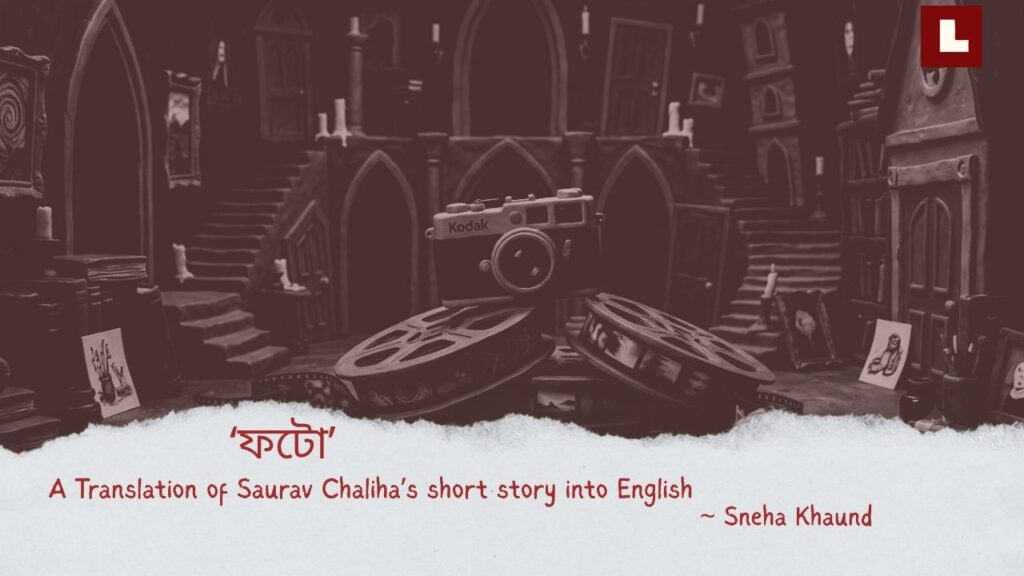

Introductory translator’s note: This is yet another incredible short story from Saurav Kumar Chaliha’s impressive oeuvre. His unique punctuation style is defined by long sentences, and generously sprinkled with commas, semi-colons, and em dashes. The translation preserves Chaliha’s style by retaining these punctuation and sentence structures. These techniques–constituting a “stream-of-consciousness” method– draw comparisons to James Joyce. This translation shows that Chaliha’s expansive creative field is much wider than previously imagined, including experiments with photography and film.
Evening at a wedding. The wondrous decorations of the tent-house—they have created the illusion of a palace in the space made by combining the front yards of two houses. A beautiful reception. Soft cushions on the ground, flowerpots, artificial walls, moonlight, bouquets of flowers here and there, decorative lamps and the bright glow of tube-lights; guests sitting in the decorated plastic chairs placed at various points, greeting each other, low laughter and a sense of exuberance, the murmur of many conversations; the expensive, rustling silk of the ladies’ mekhela sadors and saris, the sparkle of unique hairstyles and heavy jewellery, a familiar happy occasion. Inside, the bride sits on a small stage decorated with flowers and aluminium leaves, a xorai in her hands, accompanied by two female friends. At the entrance are a couple of people to greet the guests and take them to meet the bride—my maju uncle’s son, Ajay’s elder daughter Jonali.
I am walking around with a Kodak camera in my hands. Our Bhuyan family and its many branches are spread far and wide, the venue is nearly half-full with just our clan, some have even travelled for the wedding. The enthusiasm of meeting each other after a long time echoes loudly, faces aflush with joy; Dhuburi’s Ranu-mahi pulls Duliajan’s Madhabi into an embrace, I was about to pass them, almost immediately I clicked the camera’s button, they turned to see when the brightness of the flash hit them, their faces burst into smiles, Ranu-mahi said, ‘Oh Bapu! We didn’t see you—’; Trying to sort out her unruly mekhela, little Dimpy is walking around with a betel nut-paan bota, I shouted, ‘Dimpy—halt! Look this way—please smile—click—aah, that’s great, your photo is ekdom firstclass’; ‘Oh Borbora, please come, come (to Mrs Borbora: ‘how do you do?’)—Oh, is that Rinki—goodness, you are all grown up! Rini, I am Baap Khura, do you remember—bah you look like the bride herself—may I take a snap—oh, alright, Rinki, come a little closer—hold your mother’s hand—please smile, okay—click—aah, great—’
A wave of tinkling laughter—I saw that Joya, Joba, Junjuni, Biroja-baidew, Monima, Baby-bou and Nabanita were sitting by the left-hand corner of the entrance , bowls of ice-cream in each of their hands, they were nearly falling over each other with laughter over some tale—I stood in front of them, focused the camera, they looked at the camera without a pause in their laughter—just as I was about to click the flash on the camera I saw through the corner of my eye that Nilu was about to enter—I stopped in my tracks, said, ‘One minute—I’ll be right back,’ and hurriedly went towards Nilu—Nilu comes in as if with some hesitation, a gift in his hands, he looked around with slight unease, his eyes fell on maju mami who was speaking with another woman—mami looked slightly surprised and left the woman to meet him, she placed a hand on Nilu’s shoulder, said, ‘Oh Nilu, you’ve come? That’s very good—you didn’t bring them? Come, come, meet Jonali first,’ so saying she took Nilu to the bride, the look of unease in Nilu’s face was replaced by a smile, he looked towards me and said, ‘Oh, Bapu-da?’ and Jonali with some surprise—but with a smile on her face—burst out saying ‘Oh, Nilu-da, you’ve come? It’s really so good—,’ mami said, ‘look your mama-aita are sitting there, go meet them—’
Actually, nobody expected Nilu to be at the wedding, because it has been nearly a year and a half since Nilu has been out of our Bhuyan family. He was good at studies and a pleasant boy until his Matric, after that he probably fell into bad company, he would return home late, would apparently be passed out drunk, appeared for half of his exams and missed the rest, failed his B.A. twice (I don’t know if he passed eventually). Bhebeli-bai used to go to their house to work, with her used to be her 14-15 year-old daughter Prabha, she roamed around the house while her mother worked, only baidew-bhinti were at home at that time, often Nilu too—god knows what happened, suddenly one day he announced that he will marry Prabha—everyone was shocked, bhinti said, you are not old enough to get married, and you cannot bring a servant girl into my house—actually of course Prabha was not exactly a servant girl, Bhebeli sometimes hurriedly swept a room or two or washed a couple of clothes, that’s all—he said, no, he will definitely marry her, bhinti said, you want to get married, do whatever you want, die wherever you want to die, get out of my house—that’s what he did, he rented a shack in a poor and dirty part of the city, that’s where he married Prabha—don’t know where he got the money, most probably his ‘yaars’ helped him out—then before it was even eight months Prabha gave birth to a girl—so prematurely? Does that mean—? Did Nilu feel obliged to marry because he could foresee this inevitable event? A new element in the whole affair. Of course nobody outwardly said ‘chi chi’ or ‘tch tch,’ but it pierced everyone’s minds like a thorn. Gradually the scandal subsided, but Nilu was completely separated from the Bhuyan family, nobody met the beloved, sweet-faced Nilu anymore—but when it was time for Jonali’s wedding mami remembered him, mama also said, ‘Okay, whatever has happened has happened, but he is still family, it is our duty to invite him to a happy occasion in the family,’ she sent Ajay to find him—
*** *** ***
Placing a hand on Nilu’s shoulder I took him away from the bride, as if just in casual conversation I asked him, ‘Oh what are you up to these days, Nilu?,’ ‘Oh nothing much, Sachin and I had opened a photography store, but that closed a long time ago, you know about it certainly—actually the police arrested him because they thought he was stocking heroin in the studio—actually they did not find any heroin-teroin there—but the police put a false case on us and took a lot of money from us—the studio closed. Right now I am trying to start it back again—Studio Ajanta—’ (Oh, I quietly thought, Nilu has started doing drugs, we had of course heard a rumour like that, but I said) ‘Oh—is it doing well?’
‘No, I haven’t been able to begin, the new equipment is very expensive—wondering if I can get a loan from State Bank, I’m trying—’
‘Oh, nowadays you can get all sorts of bank loans—keep trying, you will get it—Hmm, alright then, there’s Baby-bou and the others sitting there, come, say hello—’
We came to Baby-bou and the gang’s laughter corner, Nilu stood in front of them with that old, pleasant smile of his, they stopped laughing in surprise, they looked at each other quickly, within a moment they reaching a consensus between them, probably that essentially “if someone has come to an auspicious and happy occasion, don’t hurt him”—all together they got busy greeting him, laughter flushed their faces again, ‘Oh, Nilu, you’ve come—,’ ‘Oh, Nilu-da, you don’t even think about us anymore—,’ ‘Oh, Nilu-mama! There’s no seeing you nowadays—.’ Biroja-baidew said, ‘Ei Joba, go to the chair there—Nilu, come, sit with me—Oh, Bapu, didn’t you want to take a photo, take one with all of us now—’I focused the camera—Between Biroja-Baidew and Nabanita was Nilu, behind Nilu and on either side of him were Joba and Baby-bou…
‘…Joya, sit closer a little bit more—Nilu, look this way—Aah, everybody keep smiling like this, okay—steady—ready—click—’
*** *** ***
After the wedding, now, I am looking at the photos that I got printed—the pictures are beautiful, the expressions on faces have come out nicely, light and shade have fallen in the right places—I am looking at the photos one by one—this one, the group photo with Nilu and the others, it has turned out great, everyone’s face has a joyful smile (only Junjuni’s face is slightly cut off—)—
But some kind of a doubt pricks my mind. Sitting with his own people, Nilu’s face carries that old sweet, pleasant smile—can it be? He too knows that he is now outside the Bhuyan family, but no resentment or bitterness seem to colour his smile, even he knows that although he sits surrounded by those who love him, the easy sense of comfort is no longer there, that realization must certainly be hurtful and pain him, but there is no indication of that in this photo! The familiar proverb says, ‘A picture expresses more than a thousand words’, but where, can you see any sign of sorrow and misery in this picture?
We probably don’t realize that in this age our mannerisms, thoughts, and behaviours are subtly influenced by cinema. We imitate the ways of our favourite actors and actresses infinitely, the way we walk, the way we look at the world, hairstyles, the twirls moustaches, the experience of joy and sorrow, clothes and appearance, how we conduct ourselves. (A hilarious example of this is when the old-time star of Hollywood—so the world—the rebellious and ‘heartthrob’ Clark Gable took off his shirt in a scene in It Happened One Night, it was noticed that he was not wearing a vest underneath—immediately hundreds of young American men stopped wearing undershirts, the prices of vests came crashing down, there was a crisis in the American stock market!). Humphrey Bogart and Gary Cooper narrow their eyes and slowly light a cigarette, a shudder passes through us in still anticipation, that act remains in our subconscious. Young girls unknowingly imitate the expressiveness of Sophia Loren’s face and the minute mannerisms and the youthfulness of Ava Gardner. Hot-blooded young audiences watch enthralled how with his back turned to us, face looking downward, a young Marlon Brando murmurs something and turns around to punch someone in the face and throw him to the ground—
And when a new set of circumstances presents itself in our life, perhaps then too our memory pulls out an action or a similar scene once seen in a movie, it comes to our mind, what did the characters in the film do then, how did they move the plot forward? In this matter—in the matter of the incredible smile on Nilu’s face—a movie I had seen a long time ago came flooding back to my mind—Michelangelo Antonioni’s inscrutable but absorbing movie Blow-Up: a photographer one day suddenly sees a couple locked in an embrace—instantly he clicked a photograph— a series of events follow— later he develops the photo and notices a look of great terror on the girl’s face—as is she is trying to spot something far away with her fearful eyes. When you follow her gaze, you can see that she is looking towards the park’s fence in the distance—all kinds of bushes and shrubs fill up the gaps in the fence— what is there, what does she see? The photographer sat down and thought deeply, then he went to his dark-room and enlarged the photograph to look closely at it, a couple of stumps in the fence can be seen clearly, some leaves and shrubs appear too—but there is nothing that would provoke such a look of fear—he enlarged it again—and enlarged it once again—finally it could be seen that through gaps in the bushes it could be clearly seen that—but no, it would not be appropriate for me to reveal that, otherwise for those who will watch Blow-Up for the first time, their sense of expectation and ‘suspense’ will be destroyed—
I do not know anything about photography (only how to press the button on the camera), nor do I have a dark-room, but looking at the photo with Nilu’s smiling face even I thought for a while—I closed my eyes—I imagined that I too enlarged the photo—you can see a couple of white hairs among Nilu’s black hair, his eyes and brows are in clear focus, some ‘details’ emerge in Biroja-Baidew and Nabanita’s jewellery and clothes, but in the background Joba and Baby-bou’s faces blur— I enlarged it again, I removed Biroja-baidew and Nabanita from either side of Nilu, I enlarged only Nilu’s face. Joba and Baby-bou’s faces disappeared entirely, only Nilu’s face became larger, there is a fly or something like that on his shirt collar and one of his buttons is broken in half, the photo is breaking up or ‘grains’ start to appear on it, it cannot be enlarged any more—even so, I enlarged it just slightly—the photo is grainy, but there, now it can be clearly seen that in the corner of his eye glimmers a tiny teardrop—