Discourses From the East
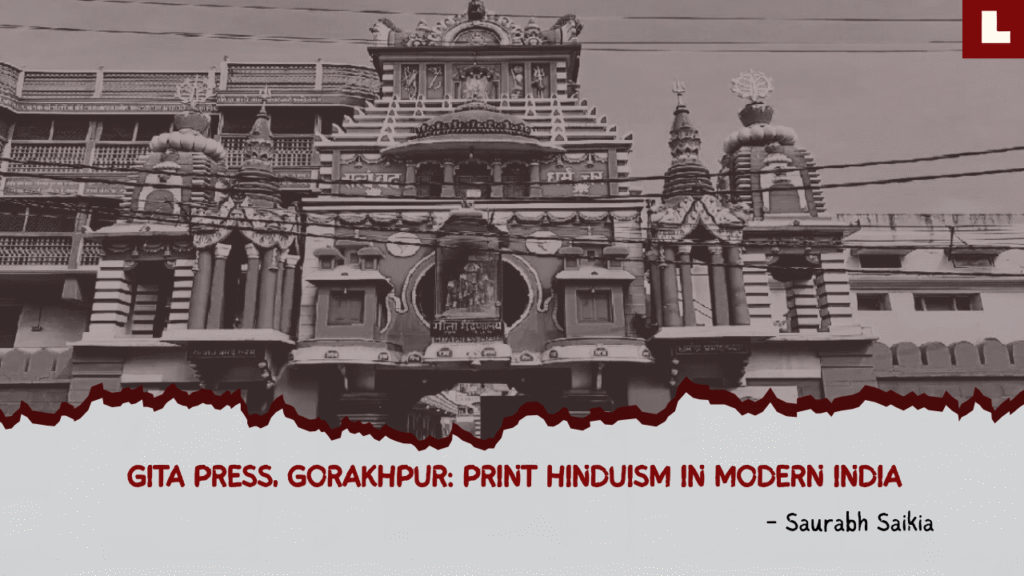

The Indian Council for Historical Research (ICHR) initiated a project titled “Contribution of Gita Press, Gorakhpur to India’s Cultural, Educational, National, and Spiritual Journey” in 2023 on the Press’s centenary. As a historian in training, the topic immediately drew my curiosity. I had come across Gita Press on many occasions, especially at book fairs, and had always seen it as a religious publishing house. I never imagined that its contribution would become the subject of historical research, and that too through an ICHR project. Its publications are available everywhere, including government-allotted rent-free stalls and even within the Central Secretariat in New Delhi, the symbol of democratic and secular India. Looking into its history, this short article examines how Gita Press democratized access to scriptures, standardized orthodoxy, and rejected pluralism within India and within Hinduism, becoming a cultural engine of Hindutva.
Since 2014, history has been one of the most targeted academic disciplines in India. Historical distortion and communal politics are now deeply connected to public life. History has the capacity to rationalize ideology in any society, which is why it is constantly used by both rulers and the ruled, by the powerful and the marginalized. It plays an important role in shaping nationalism.
Although widely absorbed through popular narratives, history is a discipline of method, training, and a particular style of writing. Institutions therefore play a major role in either strengthening its democratic and secular potential or weakening it by undermining scientific inquiry. This is where the role of the ICHR becomes significant.
ICHR began its journey in 1972 as a respected institution supporting rational and high-quality historical research. Its first chairman was the historian Ram Sharan Sharma. Scholars such as Irfan Habib, Tapan Raychaudhuri, and Barun De have been associated with it. In recent years, however, the institution has invested in projects shaped by communal agendas and has compromised the quality of historical research. It now sponsors work aimed at rewriting Indian history by deliberately Hinduising the past, reflected in projects like the one on Gita Press.
In trying to understand the links between institutional frameworks, printing culture, and the rise of Hindutva, I turned to Akshaya Mukul’s important book “Gita Press and the Making of Hindu India” (2015). It offers a detailed historical account of how Gita Press became one of the most influential religious publishing houses in modern India and how it shaped Hindu identity and nationalism. Mukul shows how the Press built a Hindu consciousness through its periodicals Kalyan in Hindi and Kalyan-Kalpataru in English. Using archives, correspondence, and the papers of its founders, he explains how Gita Press connected the Hindutva project with print capitalism and political activism, laying an early ideological foundation for modern Hindu nationalism.
Gita Press was founded in 1923 by Jaydayal Goyandka, a Marwari businessman turned spiritualist, and Hanuman Prasad Poddar, a businessman and former revolutionary who became its editor and main ideologue. Both belonged to the Marwari mercantile community whose philanthropy often intersected with Hindu reform movements. Their aim was to strengthen sanatan dharma at a time when colonial modernity, social reform, and the freedom struggle were reshaping Indian society.
The Press launched Kalyan in 1926. Written in accessible Hindi and priced cheaply, it soon reached a large readership. It combined spiritual guidance, translations, commentary on social and political issues, and a steady emphasis on moral purity, discipline, and Hindu unity. Mukul argues that Gita Press was more than a publishing house. It was a movement. By printing inexpensive editions of scriptures and countless conservative and propagandist texts, it made text-based Hindutva available to ordinary households. This created a Hindu public sphere where religion and nationhood merged. It helped build an emotional idea of a Hindu nation that stood in contrast to modern secular India. Much of the moral universe of Hindu India today can be traced back to what the Press began a century ago.
Through Kalyan and Kalyan-Kalpataru, the Press promoted a devotional nationalism based on piety, purity, patriarchy, and propaganda. Its imagined audience was the Hindu household, where women were seen as guardians of moral virtue and men as protectors of dharma. It opposed westernization and secularism and described Muslims, Christians, and liberals as threats to Hindu society.
Although Gita Press claimed to be apolitical, its ideology strongly influenced political Hinduism. Mukul documents the Press’s connections with the Hindu Mahasabha, the RSS, and later with the Bharatiya Jana Sangh and the BJP. Its leaders exchanged letters with figures like Madan Mohan Malaviya, G. D. Birla, and Mahatma Gandhi. The relationship with Gandhi was complex. While they admired his religiosity, they rejected his stress on Hindu Muslim unity and his critique of caste discrimination. The Press contributed to anti Muslim mobilization in the interwar years. Hindu Panch, one of its weeklies, played an active role in this. It also engaged in cow protection campaigns, opposition to conversions, and the promotion of Hindi over Hindustani. In the 1940s, Poddar used Kalyan to argue that Partition resulted from excessive concessions to Muslims and from a betrayal of Hindu interests. Pakistan was described as a pure Muslim state while India was dismissed as a mixed nation rather than a Hindu one.
Brahmanical Hinduism and patriarchy were central to the Press’s worldview. It idealized a patriarchal family system in which women’s dharma was defined by chastity, obedience, and motherhood. Publications such as Nari Dharma, Dampatya Jivan Ka Adarsh, and Striyon Ke Liye Kartavya Shiksha reinforced conservative gender roles. Women were praised but not given freedom. The Press strongly opposed the Hindu Code Bill, which sought to expand women’s inheritance and marriage rights. It also carried writings that defended sati and argued that women were not capable of independent freedom.
The Press was equally hostile to secularism after independence. In the 1950s and 60s, Poddar and figures like Swami Karpatri Maharaj accused the Indian state of minority appeasement and moral decay. They saw secularism as a Western idea that weakened Hindu unity. Kalyan published calls for dharmayudh against secularism and supported the idea of a Hindu nation.
Mukul’s research uncovers a broad network of collaborators ranging from industrialists such as Birla, Dalmia, and Goenka to politicians and sadhus. The establishment of the Vishwa Hindu Parishad in 1964, with Poddar as a trustee, created a direct institutional link between the devotional world of Gita Press and formal Hindutva politics. The overlap between religious revivalism, business capital, and nationalist politics blurred the line between spiritual and political work. Even within the Congress, conservative leaders like Sampurnanand and K. M. Munshi maintained cordial relations with Poddar.
By tracing the evolution of Gita Press from a spiritual venture to a cultural engine of Hindutva, Mukul’s work shows the deep historical roots of contemporary majoritarian politics. The history of modern India cannot be understood without recognising the role of this printing movement in constructing Hindu nationalism. The involvement of Marwari industrial capital and upper caste leadership also shows how economic interests supported this ideological project. In such a climate, institutions like the ICHR can either uphold rigorous historical research or contribute to its distortion.