Discourses From the East
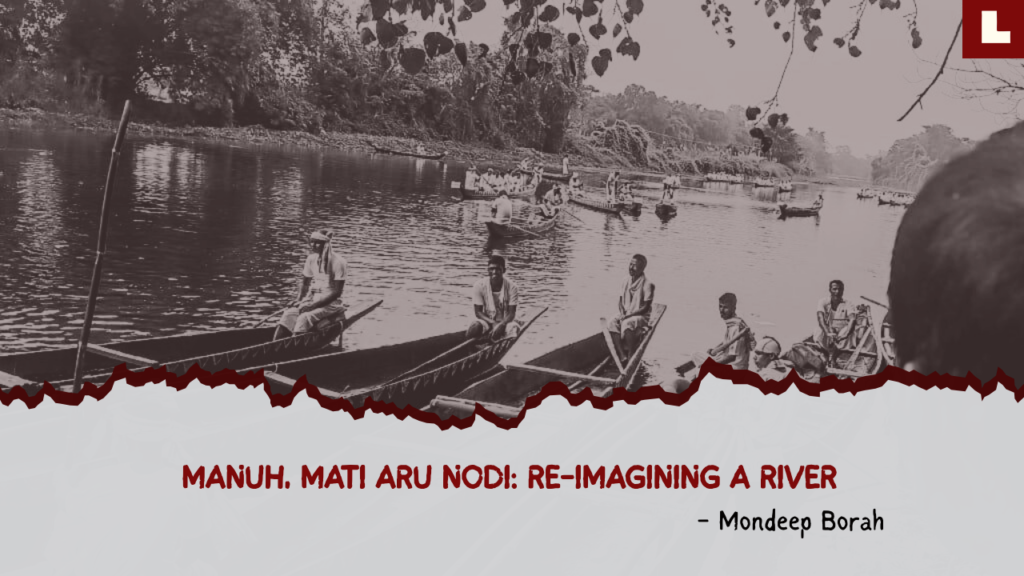

Standing on the bridge over the Tuni river, connecting two of the easternmost villages of the Majuli island, the villagers gaze with awe at the JCB clearing the water hyacinth from the river that has long been choking it to death. They are both amused and anxious at the prospect of a river, dead for more than two decades now waking up to a new dawn.
“There was never a dearth of fish in this region; we in fact sold them in the market nearby.”, says one of the villagers who is from the Kaivarta community, traditionally engaged with fishing as an occupation. “How times have changed now!” he adds with a sigh. “Now we have to buy fish at 400-500 per kg. It is now a luxury only of the well off.” “Besides the different varieties of fish, the river was habitat for such a huge tortoise population.”, an elderly gentleman, also the founder headmaster of the only higher secondary school in the area joins the conversation. He goes on to add how the river was connected to the Bhakati beel, one of the most historically significant wetlands in the island, enriching the latter’s aquatic lifeforms. The fish from the beel exported out of the island attained a remarkable reputation in the markets of the adjoining districts.
All these seem to be melancholic remembrances of the times long past. The villagers tell us that a few tortoises can be seen even now, as the river is being cleared of the hyacinth and other weeds, standing as the relic of the remote past.
The Tuni river is the only tributary of the Brahmaputra originating within the island. It emerged from the confluence of two water channels named Sukansuti and Dighalisuti, which have been traced to be parts of one of the Brahmaputra’s southern tributaries, the Dikhow. The latter along with other tributaries of the grand old river like Disang, Disoi and Dhansiri had once been flowing through Majuli, when this landmass was connected to the undivided Sivsagar district, the Brahmaputra flowing in its north. Flowing from the island’s northeast to the southeastern end, the river acted as the spinal cord of its delicate riverine ecology, with the cultural and economic life of its rural population attuned to the rhythms of the river. The river was crucial to the intricate wetland ecology of the island which is a “network of a wide variety of water bodies, locally known asbeel, jan, suti, erasuti, dubi/doba, hola, ghuli, pitoni, noloni, doloni, and hokona, among others.” (Baruah,2023) This bonhomie of “manuh, mati aru nodi” (people, land and river), however, came under the onslaught of technocratic flood control measures and the bureaucratic reimagination of rivers when in the early 90s and early 2000s, the river’s natural flow was blocked by the construction of two embankments in its two ends. It was a major blow to the entire ecological configuration of the island, with drastic changes in the livelihood patterns of the rural masses.
Now that the prospect of a new life for the river looms on the horizon, the riverine people anticipate possibilities of various kinds. While they await with hope, there is also a pervading sense of anxiety borne out of the violent breach of their age-old relation with the river in the intervening period of more than twenty years. A sense of disconnect and a deep-seated disillusionment, therefore, characterize the villagers’ anticipation about the possibilities surrounding the river in the coming times. Dr. Rajen Chandra Borah, who teaches Economics at Majuli College and presides the Tuni Nodi Punorujjibitokoron Committee tells us, “The relationship between the people and the river has been so gravely disrupted that It will take some time for them to believe that it can be rebuilt anytime soon.”
This, therefore, is the story of a violent loss and an anxious recovery, which comes with the overlapping complexities of post-colonial state’s inheritance of colonial hydraulic despotism and the resistant voices of alternative imaginations. In the centre of it all, however, lies the memories, desires and fears of the people intimately linked to the life and loss of the river.
Hegemonic imagination of a “modern river”
“Potharot jodihe uthise dhol
Heruwai nidibi monore bol
Raije bandhibo ukhokoi bheta
Dhole eri jabo poloshor etha.”
(Even if the field swirls with floodwaters,
Do not lose hope,
People will make a huge mound,
The flood would leave its gluey silt”)
Folk maestro Khagen Mahanta in one of his most popular songs “Kauri pore”, written by prominent littereteur Keshab Mahanta sings these verses, narrating the longing of a postman living in a faraway place for the cultivable land he left behind in his village. Addressing his wife, he urges her not to lose hope even though their field is ravaged by the annual flood. He says that the villagers would make tall mounds and the flood would in fact leave behind fertile silt.
It conveys well the age-old popular imagination of a river, where it is not pictured in terms of a binary with land. Contrary to that, here the land and the river form a continuum to shape the varied ways of life of the riverine population. The river is imagined not just as a “stock” expressed in terms of “volume of water” but as a continuous flow of which silt and mud are key components. Moreover, the “river as pulse”, a habitat for aquatic lifeforms is a key component of such an imagination. The colonial policies geared at increasing revenue, imagined land and the river as contrasting binaries, framing measures to safeguard the former from the latter. The colonial fetishization of flood control made rivers into ever-present threats. The modern construction of the river in South Asia, as Rohan D’souza argues, is the triumph of the “river as stock” over “river as flow and pulse”. (D’Souza 2021)
In such an understanding, where the land needs constant protection from the river, the colonial state came up with embankments as the most convenient mode of “controlling” and “taming” rivers. Particularly since the introduction of jute and tea plantations in the Brahmaputra valley in the early twentieth century, there arose an urgency on the part of colonial administration to bring the Brahmaputra and its various tributaries under its control. There followed a flurry of embankments. Majuli did not see such construction of embankments during the colonial period “presumably because it was not considered as prominent a place as many other parts of the Brahmaputra floodplain for agricultural revenue”, as Mitul Baruah argues in his book Slow Disaster:Political Ecology of Hazards and Everyday Life in the Brahmaputra Valley, Assam. In the post-independence period, however, they became the most prominent tools of flood control in the island.
Choking a river to death
Following the 1950 earthquake that drastically changed the geography of the Brahmaputra valley , the island became more vulnerable to catastrophic flood events and erosion in the flood-plains. The post-independence Indian state, instead of innovating novel ways, utilizing indigenous knowledge, easily adopted the technocratic measures of the colonial state and embankments were considered the only ways to deal with floods. These were built in different parts of the island, with radical changes to its ecology, culture and politics. As Baruah from his case studies in the island notes these statements by a high-ranking engineer in the Water Resource Department, “ I would argue that there are actually two Assams: one before the 1950 earthquake and one after. The post-1950 Assam owes its sanskriti and sabhyata to the embankments, and by extension, the Water Resource Department”. Majuli is the starkest case of it. The embankments, in many complex ways aggravated the geographical vulnerability of the island while also threatening its ecological balance.
The twin processes of catastrophic flood-events and erosion, and the technocratic interventions of the state to control them turned the island into an extremely volatile space. Add to this the horrors of the 80s-90s Assam, when insurgency and counter-insurgency movements characterized its everyday with violence and fear. And it is in the year 1991, in order to safeguard the southeastern part of the island called Kamalabari that an embankment was constructed across one part of the Tuni river flowing through that region. This was the first major blow over the natural flow of the river. On the other hand, the construction of the embankment at one end of the river aggravated the intensity of floods in the middle part of the island (Madhya Majuli). Every year the farmers had to face the brunt of havoc unleashed by flood, the nature of which had radically changed. And faced with such circumstances which could not be foreseen by the technocratic-bureaucratic regime, the river was again blocked in a region called Potia gaon.
Now the river was completely devoid of its natural flow and there was no inflow of freshwater into it when the Brahmaputra flooded. It in due course of time came to be filled with water hyacinth and various other kinds of weeds. It was virtually dead, taking on the name “Mori Tuni” (Dead Tuni) among the communities living around it. And with it died the entire network of wetland ecology which was mentioned in the beginning of the piece. The major beels of the island are connected to the Tuni river. As the yearly flow of flood water into it stopped, there was a simultaneous depletion of the beels. AroundSukan Suti, the major constituent part of the river lie five major beels namely,Bhakati beel, Jotha beel, Panikhati beel, Mudoi beel, and Sengamari beel. Readers are already acquainted with the Bhakati beel that one of the villagers refers to. All these beels which were once repositories of rich aquatic life, mainly different varieties of fish, are almost dead now. There was no arrival of any new population of fish that came with floodwater.
This was accompanied by a threat to the livelihoods of communities which were dependent on fishing as their traditional occupation. The island in recent times has seen major shifts in the patterns of livelihoods of mostly the marginalized communities. Its fish markets are abound with imports from other states, turning it into a “luxury of the well-off”. Aggravating this crisis was the stagnation of rainwater during the monsoons in the fields. The“poloshor etha” (silty glue) left behind by flood water that Khagen Mahanta sang of was unimaginable now. The waterlogging, in fact, worsened the quality of the soil. Thus, the defeat of the “river as flow and pulse” was complete. With it was let loose a whole package of ecological disaster.
A people’s movement to revive the river
The disastrous effects of blocking the river were felt soon by the islanders. Under many individual and collective efforts, public opinion was mobilized to rejuvenate the river. Dr Borah, whom we mentioned earlier tells us, “ I have grown up by the river and its death was a personal loss at a deeper emotional level. Moreover, I was deeply disturbed to see the ecological disaster that it pushed us into. If the river was harnessed well, it could also prove to be of great economic potential for the rural masses. Taking all these into consideration, I in my personal capacity made written appeals to the people to begin a movement for the river’s rejuvenation.” Finally, under his leadership a committee named “Tuni Nodi Punorujjibitokoron Dabi Committee” (Committee Demanding the Rejuvenation of the Tuni River) was formed in 2015.
The committee was composed of members mostly from the Kaivarta community and the Mishing tribe who have always been associated with the river for their everyday survival. Instead of seeking technocratic expertise from experts of hydrology, it sought ideas from the traditional knowledge of the local population in order to find ways to bring the river back to life. Meanwhile, Borah led another committee named“Madhya Majuli Tuni Nodi Jol Nirgaman Sangram Samiti” which steered the demand for the construction of a sluice gate at the point of the second blockage of the river. Under public pressure, the government conceded to the demand.
Although the sluice gate brings in different technical and political complexities, for the time being it could help the outflow of the stagnant water from the fields. Nonetheless the larger demand for the rejuvenation of the Tuni river went on. Public meetings were held in different parts of the island. The views of villagers inhabiting the river were sought. The members made a complete plan of action, which was submitted to the local district administration and then to the state government. They also submitted written appeals to the Prime Minister of India. The public was mobilized for the cause and in 2020 the government finally released the funds.
As the initial step of the project, the river has been cleared of all the water hyacinth and other weeds. It is to be followed by the release of new fishseeds into it. Catching and trading of those fish would be governed by the locales. Along with it, clearing the beels and restoring their connection to the river is one of the primary goals of the project supervised by the committee. It is being carried out under the supervision of the committee, guided by the general people, instead of deploying bureaucratic expertise.
Majuli has emerged as a major tourist destination in recent times. The committee aims to turn the river also into a major tourist spot with the governance of revenue generated through it by the locales. River boating has been planned to be introduced. In the annual Rash Mahotsav last year, the district administration held a boat procession “Boikunthor Horinam, Tuni-yedi Ujai Jam”, with locals singing the compositions of the two gurus, Srimanta Sankardev and Madhavdev. Different varieties of trees are being planted along the river. What is noteworthy is that the committee has been making demands to somehow open up the embankment at one end of the river. But it comes with existential risks to the island as its survival has already been made dependent on embankments. Nonetheless, it represents an alternative imagination of the river where people, land and the river are an interconnected whole. The people are again rediscovering their kinship with the river. But it comes with anxieties of its own kinds. This is therefore more than an attempt to bring back a river to life but to forge a reconciliation between “manuh aru nodi” (people and river) and thereby, reimagine the idea of the river as a living entity.
Reference:
- Baruah, M. (2022). Slow disaster: Political ecology of hazards and everyday life in the Brahmaputra Valley, Assam. Routledge.
- D’Souza, Rohan. “Floods and the Making of Modern Rivers in Colonial South Asia.” YouTube video, October 28, 2020. https://youtu.be/r_Oo51VuT3I