Discourses From the East

Our family was political, with relatives holding political positions since my father married into a political family. My father also held an official position, so I grew up in a political environment. My elder cousin, practically our eldest brother, was a rebel from his youth and contested elections before joining college, putting my father in a very difficult position. My parents died before I finished high school. So, joining Cotton College in Pre-University (Science) in 1973 felt like drifting at sea without a navigator. Joining Union Christian College in Barapani (present-day Umiam), Meghalaya, in 1975 for Pre-University (Arts) brought tranquillity and composure to my life. Then, seeking meaning in life, I enrolled in the Philosophy (Honours) Degree Course at Cotton College in 1977. But I was disillusioned within a few months. Those were the days of political turmoil in Assam at both the national and state levels. Those were the days of the Assam Movement.
1977-79 marked my political initiation. Cotton College, as a centre of political discussion among the youth, helped me become familiar not only with the seemingly predominant and resurgent “Assamese nationalism” but also with other “progressive” left ideologies. We had intense debates on the burning issues of the day, as well as prevailing national & international socio-political-economic issues. I became more interested in these matters than classroom teachings. I attended more “political classes” than classroom academic classes. These two years shaped my worldview. I learnt to see society and the world in a rational, scientific manner.
After finishing my degree, I joined the anti-foreigner movement in Karbi Anglong, leading the Karbi Anglong Gana Sangram Samity with the Karbi Anglong Students’ Union. We led the movement in the hill district in conjunction with the All Assam Gana Sangram Parishad and the All Assam Students’ Union. But the movement slowed after 1981 and ultimately fizzled out. Then I joined a public-sector company in Guwahati and later another in Delhi. But the situation in Assam tensed up in 1983; I left my job and came back home. I got busy with social activities, organising Karbi Youth Festivals and establishing the first private college, Rangsina College, in Karbi Anglong, second only to the Diphu Govt. College. I also organised a youth organisation, Karbi Riso-Nimso Asong (KRNA), in Dongkamukam, with an office near the ARO office, where the ASDC office is now located. The 10th Karbi Youth Festival, held at the KASA stadium in Diphu in 1984, was truly memorable. I was the Committee President, and Dhonsing Rongpi was the General Secretary.
THE MAJOR TURNING POINT OF MY LIFE
1985 was an important year: the Assam Accord was signed, the AGP was formed, and we also formed the People’s Democratic Front (PDF) in Karbi Anglong, with me as one of the General Secretaries. It was also the year when the Assembly election was held in Assam. The PDF fielded three candidates in Karbi Anglong, and I was the only one to win from the Baithalangso constituency. The PDF had an agreement with the AGP before the polls, agreeing to stay together regardless of the result. But when the AGP formed the govt., I was not included in the ministry. This created political turmoil in Karbi Anglong, and feelings of betrayal and neglect came to the fore in the hill districts. The hill-plains divide, the tribal-nontribal divide surfaced once again in the region.
The Autonomous State Demand Committee (ASDC) was formed in May 1986 by bringing together several students, youth, social, cultural, literary, and community organisations. PDF also became part of it. The ASDC launched a series of mass agitational programmes and became a popular mass movement that reached every section of society, with participation from almost all communities. I was not initially included in the ASDC. There is a story behind it.
The ASDC is led by underground members of a radical left political party, the Communist Party of India (CPIML-Liberation). All important ASDC leaders belonged to it. I was also a member. But I was not in the ASDC. The reason is that after the AGP and the PDF signed a pact before the 1985 election, I was made to join the AGP, and thereafter I became a member of the AGP, at least nominally. I was the only one to do that from the PDF, and the PDF leadership decided it. With no clear information from the PDF leadership, people in Karbi Anglong and within the PDF believed I had left the PDF and joined the AGP, abandoning the original party.
After becoming MLA, I was confined to the Assembly premises and the MLA hostel. I had to be with the AGP MLAs and move around with them, and I didn’t like it at all. I couldn’t identify with the ASDC, let alone disclose my secret identity as a CPI-ML member. The CPI-ML used to call me to secret meetings outside the MLA hostel with party leaders. There, we discussed strategy for activities within and outside the Assembly. I had to attend AGP Legislature Party meetings to maintain the appearance of being a member. As a novice member of the ruling party, I could not raise issues in the Assembly even though I wanted to.
Then in 1986, ASDC was formed, and a mass political movement for an Autonomous State began in Karbi Anglong. The state government started repressing the agitation, and there were confrontations with the police, arrests, firings, etc. I raised these issues in the Assembly and in the media. The movement gained popularity, and when elections to the Karbi Anglong Autonomous Council came in 1989, ASDC decided to join the fray. With confrontation with the state authorities and the long-established Congress, ASDC would face a tough challenge in the elections. Samsing Hanse of the KAPC was already a minister and was aligned with the AGP. So he would definitely try to defeat ASDC. This was when CPI-ML decided I should become a minister in the AGP government, at least to make ASDC’s election campaign a little smoother. Then, soon after the election, when ASDC captured the Karbi Anglong Autonomous Council, I resigned from the ministry, protesting against the rape of tribal women by Assam police personnel in Bhumka in the present Bodoland. I distanced myself from the AGP and was free to join the ASDC and the movement for an Autonomous State.
AUTONOMOUS STATE MOVEMENT AND THE MoU
The mass movement for an Autonomous State was in full swing, and ASDC was running the Councils in Karbi Anglong and later in N C Hills as well. ASDC captured all five MLA seats in the two districts and the lone MP seat too. Negotiations with the Central and State governments went on alongside the agitational programmes. At one point, the Assam government dissolved the ASDC-run Karbi Anglong Council. ASDC fought back with mass agitation and also filed a case in the High Court. Ultimately, the Council was restored.
Taking the issue of an Autonomous State to the Central Government and getting their attention was not easy. Drafting a memorandum and getting appointments with the Prime Minister or the Home Minister was quite tough. We had to work hard and overcome obstacles to present the matter to the Union Govt. But the issue wouldn’t move forward unless the government considered it pressing. Therefore, alongside agitational programmes mobilising public opinion in favour of the movement at both the state and national levels, cultivating media support became crucial. Having MLAs in the Assembly helped at the state level, and having an MP, along with CPI-ML support, helped generate publicity at the national level as well. We had to take meetings with different sections of the media and intellectuals seriously, along with interactions with social & political forces. Negotiating with bureaucrats who were supposedly brilliant was not easy. We had a lot of homework. We met with top legal minds for advice and prepared our case. We had to study the Sixth Schedule of the Constitution, Article 244(A), the State Re-organisation Acts, and many other documents thoroughly. We discussed and debated the issues amongst the leadership. The matters also had to be placed, discussed, and debated on movement platforms, ASDC, KSA, KNCA, etc. After these deliberations, decisions on tactics and strategy were taken. The signing of the Memorandum of Understanding (MoU) in 1995 between the Govt. of India, Govt. of Assam, the ASDC, KSA, DSU, & the NCHSF culminated these collective efforts. It was not an Autonomous State, but the MoU amended the Constitution, giving the Autonomous Councils substantive legislative and executive powers.
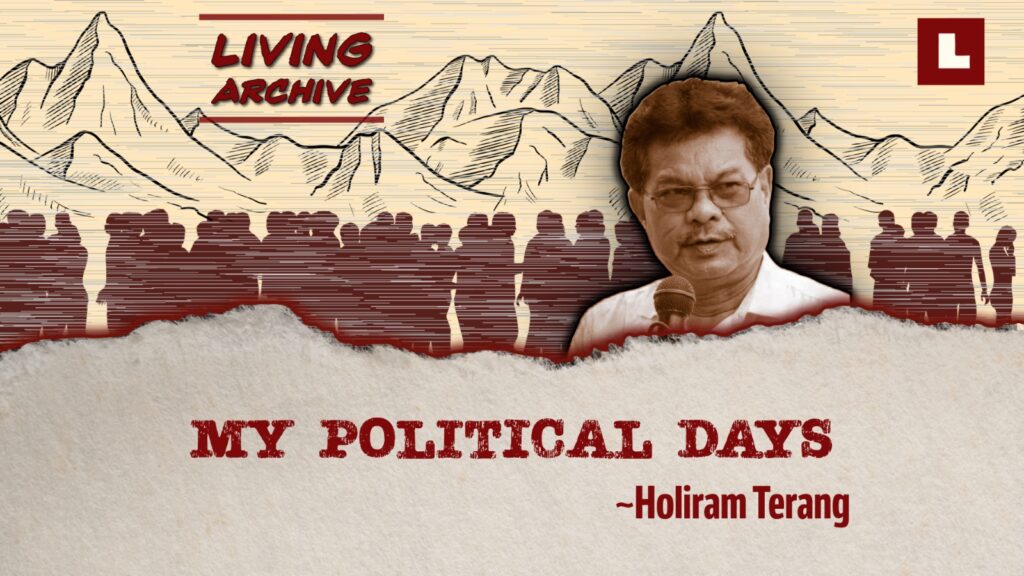
Holiram Terang is a veteran politician from Assam, known for his involvement in the political movement for greater autonomy for the Karbi people of Karbi Anglong. He has served as a Member of the Assam Legislative Assembly and as a minister in the state government. His political career has been closely associated with regional identity, indigenous rights, and the demand for greater political autonomy in Assam’s hill districts.