
Discourses From the East
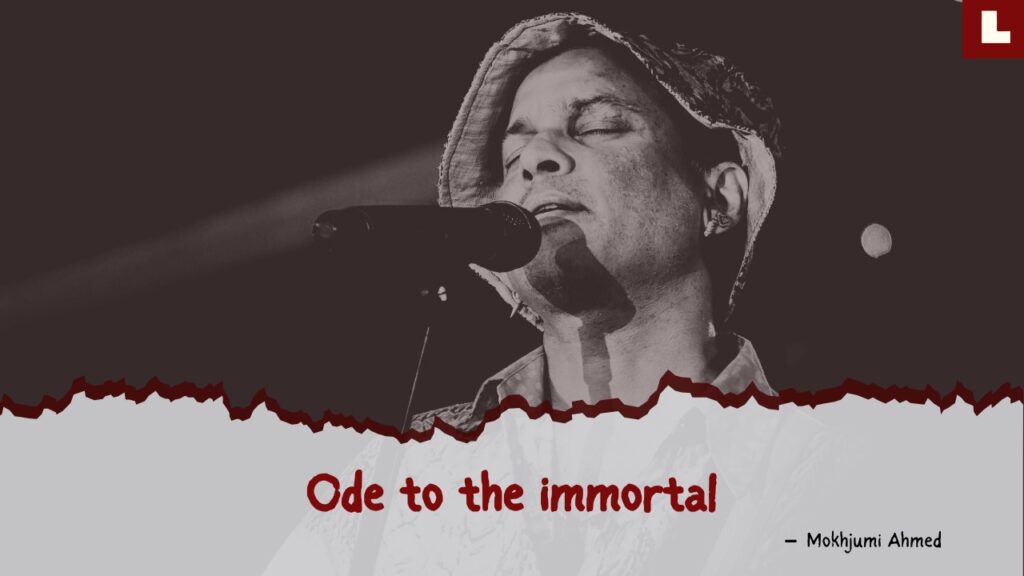
On the fateful day of 19th of September, 2025, a devastating news came from distant shores of Singapore. It was about the man who danced with the storms many a lifetime and who had the desire to sleep in the depths of the sea. Alas! This dramatic prophecy turns out to be true.
The news of his passing away had a stormy impact on the lives of people in Assam. Nobody could control his/her tears. Broken hearts suddenly started feeling palpitation while beating heart suddenly paused in shock. After all, Assam has lost her most beloved son.
As soon as the mortal remains arrived in the Gauhati International Airport, people started flocking on the streets and in a moments time a huge throng of more than 15 lakhs people gathered from Guwahati International Airport to his Kahilipara residence. Such a gathering is unusual and unheard of in recent times. Many in the national media were taken aback by the kind of hysteria on the streets of Assam. Many were bewildered by the curiosity of who the person was. Some in the national media know him as a singer, many for his ‘Ya Ali’ song but not the personality in its grandeur.
Zubeen Da was a great singer. He sang more than 38000 songs in over 40 languages, which in itself is a record. His songs comprise languages including Assamese, Hindi, Tamil, Telegu, Kannada, English and almost all tribal languages of Assam. He sang in several genres including Assamese classical, Indian folk, Indian pop, rock, devotional, Sufi etc. A versatile instrumentalist, he had his ability to play on as many as 12 instruments including guitar, drums, tabla, dhol, harmonium, percussion etc. His musical versatility did not remain confined in singing and playing on instruments but also on song writings. Zubeen Da was a lyricist in his own right. He had written ample number of songs whose relevance would remain across centuries.
Also Read: Not Yours to Wear, Not Yours to Mourn
His writings had deep undertones of philosophy and love for human beings. His songs were commentary on contemporary social issues. He was not a mere performer on the stage, rather a master poet, caustic social critic and intrepid, guiding spirit of the counter culture generation. A heretic in its true meaning, he never succumbed to any dictate of any authority, whether political or social. He was a free man in the constrained world who sang his song to liberate human beings from sufferings. He rendered his voice to inspire them who have lost hope, to cuddle them who are devastated and to comfort them who are wounded. Alas! This voice of the voiceless has been taken away by a devastating storm.
His song ‘Xonere Xojoa Poja Johi Khohi Jay’ (The house made with gold is collapsing) was written at a time when the state of Assam was passing through a tumultuous time in 1990s. It was a haunting tribute to the disappointment of a generation that grew amidst violence, unrest and uncertainty. When anti CAA protest happened, he wrote ‘Politics Nokoriba Bondhu’ (Don’t do politics, my friend.’). Albums such as Xixhu and Mukti also contains theme of dissent and opposition towards socio-political elites.
His iconic track Jontro talks about alienation caused by capitalism and how people have become like machines in the capitalist world. His voice was not merely for entertainment but also for social change. His recent song Unnmon Aabeli was dedicated to raising awareness and providing support for kids with special needs and disabilities, serving as a source of motivation.
His simpleton style and lucid language took deep philosophical contents to the people in easy, accessible way. He had rendered many philosophical songs with deeper meanings. His song Ei Prithvi explores themes of life, existence and human emotions with philosophical undertones, prompting listeners to reflect on deeper meanings. His song Pakhi (Feather) explores themes of freedom versus confinement, with the feather symbolizing the human struggle for a sense of belonging and meaning.
However despite all the talents, he was not a mere singer, song writer, composer, actor or director. Above all, he was a human being of utmost honesty, integrity and probity. He said whatever he did and not the other way round. His actions spoke louder than his words. He said only whatever he believed in. At a time when people are afraid of authorities, he would rebel against them. When the government wanted to cut trees at Dighalipukhuri, he said, “ Don’t do it…I don’t protest, I speak and you have to listen to me…It’s wrong…” Time and again he stood by the people when needed. He famously said, “ Shilpi raijor babe hoy rojagharar babe nohoy.” (Artist should stand for the people and not for the government). He called out any injustice he saw in society even if it cost him personal loss.
Zubeen da was an artist of the people, a true troubadour of the masses who could feel their pain, agony and suffering. Every time he would see a destitute, he would help in every possible way whether financially or otherwise. People would throng his residence every morning with the expectation of help from Zubeen da and he would not disappoint them. There are stories about his magnanimity. He would often give away his entire remuneration to his fans and followers.
Zubeen da could never put up with human sufferings. A recent video going viral shows him saying to a boy with broken legs, “ Tok moi thio koramei. It’s my challenge.” ( I will make you stand. It’s my challenge). In another video, a Bengali producer says that while working on particular Bengali song he got some remuneration and while coming back from the studio, he distributed the entire money among people on the street in every town square.
He was a man of the masses who would connect with them instantly. Despite being a superstar he would often be seen on the streets, in roadside dhabas and restaurants, without being guarded like VIPs. He sang for the people, lived for the people and worked for them in every possible way. He loved not only human beings but also animals and plants. His Kharguli studio is an abode for wild animals. He even did not put light so that birds can come.
Also Read: Speaking Burmese in Assam: Notes from the Trans-Patkai Borderlands
Although a rooted Assamese, his nationalism was not tinted by parochialism. A humanist in the true sense, he would embrace everybody alike irrespective of caste, creed, religion or ethnicity. When ULFA criticised Assamese singers singing Hindi song on Bihu stage, he would defy them courageously. When Marmita Mitra controversy happened, he supported her. On an open stage, he said, “ …artists do not have a definite location. An artist can work in any place…”
It is this zenlike attitude that has made him the person he is. Unbounded by the boundaries of human parochialism and unrestrained by societal narrowness, he belonged to the sundry. Like his song, he will remain in the hearts of millions. Adieu dear Zubin da.


[…] Also Read:Ode to the Immortal […]