Discourses From the East
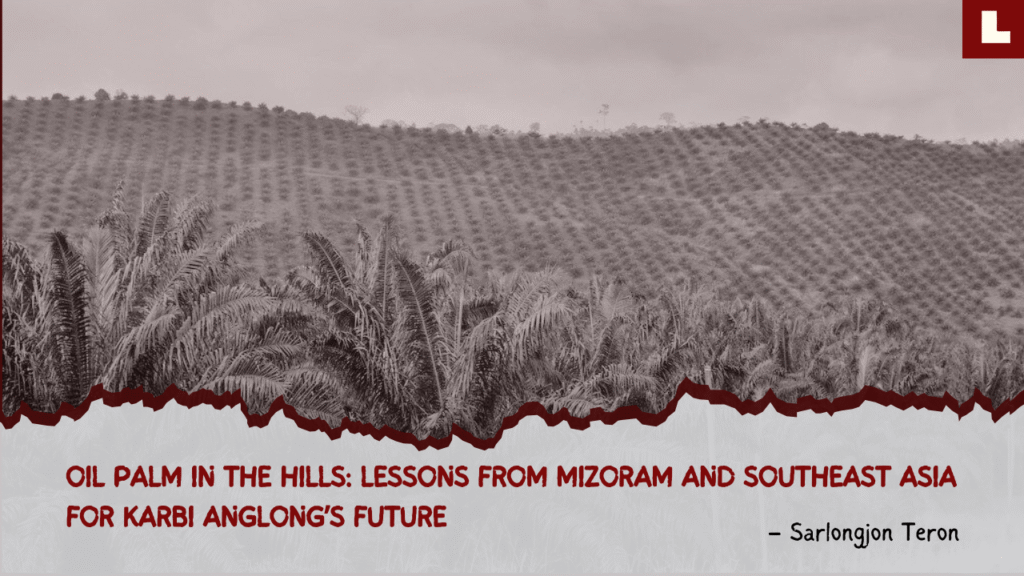

As the Karbi Anglong Autonomous Council (KAAC) pushes forward with plans to promote oil-palm cultivation, the move has triggered renewed debate across Assam’s hill districts. Proponents see an opportunity to reduce India’s dependence on imported edible oil and create long-term livelihood options. Critics, however, caution that the hilly terrain, forest-linked livelihoods, and fragile ecosystems of Karbi Anglong may make the region a poor fit for a water-hungry, monoculture crop like oil palm.
Beyond agronomic feasibility, there is also a deeper ethical and governance question: Have Indigenous communities been properly informed, consulted, and given the right to consent or refuse such initiatives? Under global and national frameworks, including the UN Declaration on the Rights of Indigenous Peoples (UNDRIP), the principle of Free, Prior and Informed Consent (FPIC) must guide all interventions on Indigenous land.
To understand what’s at stake, it’s worth comparing Karbi Anglong’s landscape and livelihoods with other regions where oil palm has already taken root — or struggled — such as Mizoram, Telangana, and Southeast Asia.
The Landscape: Karbi Anglong and Mizoram — More Alike Than Different
Karbi Anglong, with its rolling hills, rich biodiversity, and predominantly Indigenous population, shares more with Mizoram than with the plains of Telangana or the plantations of Malaysia. Both regions are marked by steep slopes, heavy monsoon rainfall, fragile soils, and traditional jhum (shifting cultivation) systems that rely on periodic fallows for soil renewal.
In such ecosystems, water and soil management are naturally delicate. Introducing large-scale monoculture perennials like oil palm alters hydrological balance, demands consistent soil moisture, and restricts inter-cropping — all of which may erode the ecological and economic resilience that jhum has historically provided.
By contrast, Telangana’s landscape — largely flat, irrigated, and supported by canal and borewell systems — is structurally more suited to water-intensive plantation crops. And in Southeast Asia, the world’s oil-palm hub, vast lowland areas, deep alluvial soils, and industrial processing networks have helped the crop achieve high productivity and global market dominance. The terrain alone, therefore, gives a strong clue: Karbi Anglong’s hills are closer to Mizoram’s struggles than to Telangana’s success story.
A Look at Mizoram’s Experience
Oil-palm cultivation in Mizoram was first introduced in the early 2000s under the Centrally Sponsored Oil Palm Development Programme (OPDP) and later the National Mission on Edible Oils–Oil Palm (NMEO-OP). Initial expectations were high. But two decades later, the enthusiasm has dimmed.
Farmers in several districts of Mizoram — Kolasib, Serchhip, Lunglei — have reported disappointing yields, drying streams, declining water tables, and limited income returns.
Most plantations were established on hill slopes or old jhum fields where soil depth and moisture are limited. Palms in these conditions struggle to bear fruit comparable to those grown in lowland estates. According to field observations, yields have averaged 5–6 tonnes of Fresh Fruit Bunches (FFB) per hectare per year, far below the 15–20 tonnes reported in Telangana or 18–25 tonnes in Southeast Asia.
Worse, the procurement price of palm fruit has often remained fixed and low. At times, farmers in Mizoram received ₹5–₹6 per kilogram of fresh fruit, leaving many unable to recover costs. Because palm fruit must be processed within 24–48 hours, farmers far from the lone processing mill faced additional transport costs and spoilage losses.
In some areas, disappointed farmers have cut down or abandoned their palms, reverting to mixed cropping or forestry. Several local NGOs have also raised concerns that oil-palm plantations have worsened water scarcity and soil erosion. Streams that once sustained jhum fields and village use have reportedly dried in some catchments.
These conditions are strikingly similar to what could emerge in Karbi Anglong’s fragile hill systems if plantations expand without hydrological and social safeguards.
Telangana: The Contrasting “Success Story”
In Telangana, the picture looks very different. Here, oil-palm cultivation is expanding rapidly, supported by irrigation projects and government subsidies.
According to NABARD and Telangana government sources, well-managed plantations under irrigation can yield 20–25 tonnes of FFB per hectare, translating to 4–5 tonnes of crude palm oil annually once trees reach maturity (7–8 years).
Farmers in Telangana reportedly receive ₹17,000 to ₹19,000 per tonne of FFB — nearly three times Mizoram’s price — thanks to assured procurement by processing companies located within reachable distance.
However, even here, concerns persist. Oil palm is estimated to require up to 265 litres of water per tree per day during dry seasons, straining groundwater in semi-arid zones. But with efficient drip irrigation and flat terrain, Telangana still remains a far better candidate for such intensive agriculture than the steep, rain-dependent hills of the Northeast.
Southeast Asia: Scale, Infrastructure and the Hidden Cost
Across Malaysia and Indonesia, oil palm covers more than 11 million hectares, producing around 85% of the world’s palm oil. Yields often exceed 15–20 tonnes of FFB per hectare. The reasons are structural: large, contiguous estates; fertile lowlands; abundant rainfall; and dense processing networks.
But the ecological cost is severe. Vast tracts of rainforest have been cleared, peatlands drained, and biodiversity decimated. In Borneo and Sumatra, orangutan and hornbill habitats have vanished. Carbon emissions from peat oxidation and burning have turned the industry into a global environmental controversy.
While the Northeast’s plantations are small in scale, similar trends — forest fragmentation, species loss, drying streams — are already visible in Mizoram. Karbi Anglong’s forests, home to elephants, hoolock gibbons, and countless endemic species, could face the same trajectory if monoculture plantations expand unchecked.
Debunking the West Karbi Anglong Income Myth
Recent statements from the District Agriculture Office (DAO), West Karbi Anglong, published in The Sentinel on 12 July 2025, that the projected incomes of ₹40,000–₹70,000 per bigha after four years from oil palm plantations. However, this estimate lacks any scientific or field-based validation.
In Mizoram, where oil palm has been cultivated for two decades, farmers rarely earn more than
₹25,000–₹35,000 per hectare per year due to low yields (5–6 tonnes/ha) and high maintenance costs. If these are the real returns from Mizoram’s more established plantations, it is implausible that Karbi Anglong’s hilly terrain could generate two to three times that figure without irrigation, infrastructure, or processing facilities.
To attract participation, authorities and corporate promoters under NMEO-OP are offering short-term financial incentives of ₹3,000 per hectare for plot clearing, ₹6,250 for intercropping,
₹4,000 for bio-fencing, ₹15,000 for vermicomposting and ₹10,000 for cattle rearing. These figures appear lucrative on paper but are grossly inadequate in practice. The cost of clearing hilly land alone often exceeds the provided amount, and intercropping is not viable once palms mature and block sunlight. Similarly, Rs. 4,000 for fencing and Rs. 15,000 for composting fall far short of actual needs.
Such inflated claims and schemes function as enticement traps, luring smallholders with quick cash risk creating a false narrative of prosperity to lure farmers into long-term contracts with private companies. Once land is converted to oil palm, it becomes locked for decades, leaving smallholders unable to revert to food crops or traditional systems. This pattern, as observed in Mizoram, amounts to a slow form of land capture—benefiting large corporations rather than farmers.
Also Read: WILD FLOWERS OF EAST KARBI ANGLONG
Corporate Interests and Policy Gaps
Large corporate players such as Patanjali Foods and Godrej Agrovet are the key private partners in India’s oil palm expansion. Under NMEO-OP, they are allotted specific zones, including parts of Assam and the North East. However, Godrej Agrovet failed to meet its own production targets in Mizoram despite two decades of operation. Farmers in Mamit and Kolasib districts have reported irregular procurement and long delays in payments.
This track record raises serious doubts about whether similar ventures in Karbi Anglong would yield different outcomes. Without strong local monitoring, transparency, and farmer safeguards, such projects could result in corporate monopolies over land and market access— further marginalizing small growers.
Comparative Snapshot
| Region | Typical yield (FFB t/ha/year) | Farm-gate price (approx.) | Terrain & conditions | Outcome |
| Telangana | 20–25 | ₹18,000– ₹19,000 per tonne | Flat, irrigated | High productivity; moderate success |
| Mizoram | 5–6 | ₹5–₹6 per kg (₹5,500– ₹6,000/t) | Steep, rainfed | Low yield; environmental stress |
| SE Asia | 15–20 | Global export- linked | Lowland estates | Economically strong, ecologically fragile |
| Karbi Anglong (potential) | Likely <7 | Unknown | Steep, jhum- based | High risk; uncertain viability |
- FPIC, Indigenous Rights and Informed Decision-Making
Beyond agronomic and ecological feasibility, there lies a fundamental rights issue. Karbi Anglong is constitutionally protected under the Sixth Schedule of the Indian Constitution, granting local autonomy to Indigenous councils and communities over land and natural resources.
Any developmental or plantation initiative must therefore comply with the Free, Prior and Informed Consent (FPIC) principle — a global standard under the UN Declaration on the Rights of Indigenous Peoples (UNDRIP) and recognized by several international environmental and development agencies.
FPIC ensures that communities:
- Are informed beforehand about the nature, scale, risks, and benefits of a project;
- Have the freedom to accept or reject proposals without coercion; and
- Participate actively and continuously in decision-making processes.
In the context of oil-palm promotion, this means the KAAC and implementing agencies must first conduct a willingness and awareness assessment among farmers. Communities need clear information about:
- Long gestation periods (4–5 years before returns);
- High water and nutrient demands;
- Possible soil degradation and loss of biodiversity;
- Dependence on mills and fluctuating prices;
- Potential livelihood displacement or land-use conflicts.
Only with such transparent and participatory processes can plantation expansion be considered legitimate and socially sustainable.
Imposing a top-down scheme — even if economically incentivized — without thorough consultation would risk violating Indigenous rights and long-term trust in local governance.
Ecological and Social Red Flags
1. Water stress:
Oil palm is a water-intensive crop. In hill terrain without irrigation, palms compete with local water needs and forests. Mizoram’s reports of dried streams mirror the
likely fate of Karbi Anglong’s catchments if large-scale plantations take hold.
2. Soil and slope degradation:
Planting on steep slopes accelerates erosion and landslides. Once the canopy closes, no undergrowth survives, exposing soil during heavy rain. Mizoram’s farmers have reported more frequent top soil loss and degraded fertility.
3. Biodiversity loss:
The dense monoculture of palms displaces native flora and fauna. In Mizoram,
villagers report a surge in snake populations around plantations — likely a symptom of disturbed forest-edge habitats. Karbi Anglong, being part of a vital wildlife corridor, would see far greater consequences.
4. Financial vulnerability for smallholders:
Oil palm requires a 4–5-year gestation before yielding fruit. For small tribal farmers who rely on seasonal income from jhum, this lag period is unsustainable without
alternative earnings. Once palms are planted, the land is locked for decades, reducing flexibility to adapt to food or market changes.
The Bigger Picture: Is Oil Palm Viable for Karbi Anglong?
The comparative evidence paints a clear picture. Karbi Anglong’s topography, ecology, and livelihood systems make oil-palm cultivation inherently high-risk for smallholders.
Large corporate or government-backed estates on suitable gentle slopes with guaranteed irrigation and processing might succeed in limited pockets. But promoting oil palm as a blanket solution for hill farmers is environmentally and economically precarious.
Instead, the district should view Mizoram’s experience as a cautionary mirror: a policy meant to bring prosperity instead produced water stress, biodiversity loss, and community disillusionment.
What Could Work Instead?
If the goal is to enhance livelihoods while conserving ecology, alternatives exist — and they are better aligned with Karbi Anglong’s landscape.
1. Agro-forestry models:
Combining native timber and fruit trees (Magnolia champaca, Gmelina arborea,
mango, jackfruits etc) with shade-tolerant crops such as black pepper, ginger, turmeric, or coffee etc. can create income diversity while protecting soil and water.
2. Bamboo plantation with mixed crops:
Bamboo grows well in degraded lands, controls soil erosion, conserves water, and offers diverse economic uses—from construction and handicrafts to paper and biochar industries. When combined with ginger, turmeric, black pepper, banana, and
traditional vegetables, bamboo-based systems can create year-round income opportunities while enhancing ecological resilience. Such systems also align with Indigenous knowledge traditions and forest restoration goals.
3. High-value forest products:
Karbi Anglong’s Indigenous farmers already know the potential of non-timber forest produce — wild edibles, broom grass, wild honey, medicinal herbs, edible fungi etc.
Strengthening these value chains offers sustainable growth that builds on local knowledge.
4. Community forestry and watershed plantations:
Instead of replacing forests with plantations, restore degraded slopes through native species and community-managed plantations. Such efforts enhance water retention and biodiversity while still producing saleable biomass.
5. Local processing and cooperative marketing:
Whatever crops are grown — fruits, spices etc — community-owned micro- processing units can ensure that value addition stays within Karbi Anglong.
6. Promotion of Eco-Tourism
Karbi Anglong’s scenic waterfalls, forested hills, and vibrant cultural heritage hold
vast eco-tourism potential. Developing community-run trekking routes, cultural food trails, and homestay programs can bring sustainable income while showcasing Karbi cuisine, handicrafts, and traditional festivals. Emphasizing site-seeing around natural springs and waterfalls—such as Kangthilangso falls, Paklongkam falls, Kaipholangso falls, Koka Falls, and Amreng—can make conservation economically rewarding. Eco- tourism preserves forests and cultural identity, offering jobs in guiding, hospitality, and local crafts without degrading ecosystems.
The Road Ahead
India’s push for self-reliance in edible oils is legitimate. But one-size-fits-all models rarely work in ecologically diverse regions like the Northeast. The oil-palm story of Mizoram offers a living lesson: high hopes can wither if local realities are ignored.
For Karbi Anglong, the wiser path may be diversified green livelihoods, not monoculture plantations. With its mosaic of forests, hills, and Indigenous knowledge systems, the district has all the ingredients to become a model of climate-resilient agro-forestry, not another casualty of misplaced industrial agriculture.
Before planting a single palm, authorities must uphold the FPIC protocol, ensure informed community consent, and base actions on willingness assessments — not directives. Only a fair, participatory, and transparent process can make development both ethical and enduring.
Because the real seed to plant is not oil palm — it’s trust, knowledge, and consent.
References
- Government of Mizoram. (2022). Annual Report on Oil Palm Development in Mizoram. Department of Agriculture (Crop Husbandry), Aizawl.
- Ministry of Agriculture & Farmers Welfare, Government of India. (2023).
- National Mission on Edible Oils – Oil Palm (NMEO-OP) Guidelines. New Delhi.
- Centre for Science and Environment (CSE). (2023). Oil Palm Expansion in India: Environmental and Social Implications. New Delhi: CSE Publication.
- Down to Earth. (2023, August). Farmers in Mizoram Cut Down Oil Palms after Streams Dry Up. Retrieved from https://www.downtoearth.org.in
- The Hindu. (2023, Jun). Oil Palm plantation proves to be a disaster in Mizoram. Retrieved from https://frontline.thehindu.com/the-nation/oil-palm-plantations-prove- to-be-a-disaster-in-mizoram/article66879953.ece
- The Caravan. (2021, Sep). Mizoram shows why centre’s palm-oil plans will be disastrous for farmers, environment. Retrieved from https://caravanmagazine.in/agriculture/mizoram-shows-why-centres-palm-oil-plans- will-be-disastrous-for-farmers-environment
- ICAR–Indian Institute of Oil Palm Research (IIOPR). (2021). Oil Palm Area Expansion and Productivity Report. Pedavegi, Andhra Pradesh.
- UN Permanent Forum on Indigenous Issues (UNPFII). (2008). United Nations Declaration on the Rights of Indigenous Peoples (UNDRIP). United Nations, New York.
- TERI (The Energy and Resources Institute). (2022). Agroforestry as a Sustainable Livelihood Model in North East India. TERI Policy Brief.
- Ramakrishnan, P. S. (1992). Shifting Agriculture and Sustainable Development: An Interdisciplinary Study from North-Eastern India. UNESCO–Parthenon Publishing.