
Discourses From the East
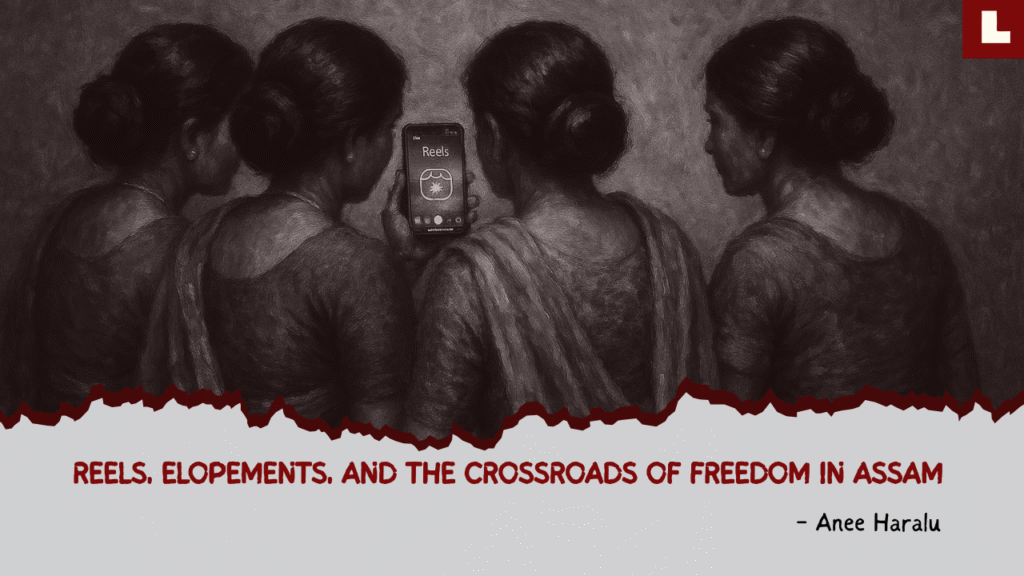

In the villages of Assam, a new archetype is being born not from myth, but from meme: the buwari lover. The term buwari (referring to a young bride or daughter-in-law) has taken on a new, charged meaning. Last April, a local news portal gave this figure a name when it reported on a housewife in Fakirganj, a mother of four, who ran off with a goat-seller. The trader, Raju, “had his eyes more on the buwari than on the goats.” One day, the woman left her husband, took her son and eighty thousand rupees in cash, and vanished. The portal’s headline captured the mood: “Buwari Lover Goat-Seller! Came to buy goats, eloped with Jahangir’s beautiful wife.”
The archetype has since entered Assamese pop culture. It now circulates in rap parodies and Instagram jokes, as gossip and as warning. It condenses two anxieties into one label: brides stepping out of the disciplinary order of marriage, and men daring to romance them openly.
Village Stories, Public Stages
Such stories now spill freely from the villages. In Nagaon, a married woman reportedly eloped twenty-five times in ten years with different men, always returning home to her husband and in-laws, who, half-resigned and half-forgiving, took her back each time. In Nalbari, a man went viral this summer after bathing himself in forty litres of milk to celebrate divorcing his wife, who had eloped twice. “I am free from today,” he declared, posting the clip that quickly drew millions of views.
Elopement is not new to the rural landscape of Assam. It has always been a part of village life, though traditionally spoken of in hushed tones and quickly swept from view. What has changed is not its existence but its visibility. While comprehensive data on elopement remains, by its nature, elusive, the relentless visibility of these cases on regional news and social media feeds signals an undeniable shift in the public sphere. Today, these stories are witnessed, replayed, and judged through the algorithm.
It is also worth remembering that elopement is not always read as rebellion, and its meaning shifts with the woman’s position in the family. For a jiyori, an unmarried daughter, it can be a pragmatic shortcut. Families sometimes quietly encourage it, sparing themselves the prohibitive cost of a full social wedding. More often than not, such an elopement brings a kind of unspoken relief, one that is immediately suppressed under a single resigned phrase: upai nai, ki karim aru—”there is no option, what else can we do.”
But for a buwari, a daughter-in-law already integrated into her marital household, elopement carries a different, heavier charge. It is not a financial workaround but a direct rupture of the disciplinary order. Her flight is not a quiet solution; it is a public scandal that shatters the family’s honour. The same act that brings relief when a jiyori leaves, creates crisis when a buwari escapes.
Scandal, heartbreak, and comedy converge here. What would once have been whispered in lanes and fields is now staged online for the world to consume. A husband performs his humiliation as spectacle; a wife escapes repeatedly, testing the tolerance of her family. Village life, once bound by surveillance and shame, has cracked open under the force of digital attention.
Breaking the Disciplinary Society
Michel Foucault called modern societies “disciplinary.” In Assam’s villages, discipline meant the watchful eyes of mothers-in-law, neighbors, and the gossip exchanged at village ponds while women washed clothes, at grocery shops, in the fields while gathering greens or firewood, and in the chatter of self-help group meetings sponsored by the state or NGOs.
That order is weakening. Smartphones create private spheres that kinship cannot fully monitor. And access is no longer a privilege. There is a thriving market for second-hand and stolen mobiles in rural and semi-urban Assam, and small shops routinely sell low-end smartphones on easy EMI. Almost every household today owns at least one device with an internet connection. The phone, once a luxury, has become the new dowry, the new window, and the new secret.
A wife with an Instagram account can perform herself beyond the family’s eyes. A reel is more than play. It is also a stage where women flaunt flesh, hint at intimacy, and test boundaries that the courtyard once kept under strict watch. What was once hidden under veils of silence now circulates as performance, both desired and condemned. Every elopement, every viral post, punctures the old panopticon. The very fact that Assamese media casually headlines buwari lover stories shows the taboo has shifted: transgression is no longer erased, it is visible, memefied, and debated.
From Escape to Exhaustion
Yet, this rupture of the disciplinary society does not lead to pure release. As philosopher Byung-Chul Han warns, it often leads into a subtler trap: the burnout society. Here, individuals are no longer coerced but compel themselves, constantly performing, optimizing, proving.
The short video or reel is its emblem. A village woman escapes the scrutiny of kin, only to enter the algorithm’s demand for desirability and visibility. The husband in Nalbari turned his divorce into content because content is the new currency. Liberation slides into fatigue, a self-exploiting cycle of views and likes.
This performance of burnout, however, is not exclusive to women. If lovers like Raju embody rebellion, husbands like the Nalbari man who bathed in milk represent a different masculine response: the public reclamation of agency through spectacle. This man, celebrating his divorce after his wife’s two elopements, turned private pain into viral content. His act, drenching himself in forty litres of milk for millions of views, is both comedic and tragic, a performance that mirrors the women’s reels but speaks to a distinctly masculine struggle.
In Assam’s villages, a husband’s honour is tied to his ability to “control” his household. An elopement, especially one broadcast online, is a public wound that strips men of patriarchal authority. The milk-bathing husband’s response is telling: rather than retreat into silence, he leans into the digital gaze. His video is not only a celebration of freedom but a refusal to be defined solely as a victim. By staging his divorce as spectacle, he wrests back narrative control, transforming humiliation into a kind of performative liberation.
Yet, this performance comes at a cost. Han’s notion of the burnout society applies here as well: the husband, like the women filming reels, is caught in the same cycle of self-exploitation, compelled to optimize his image for the feed. Was his act cathartic, a genuine release from a painful marriage? Or was it a mask for deeper hurt, a way to deflect gossip by embracing it on his terms? The emotional toll remains unspoken. In the disciplinary village order, men were rarely allowed vulnerability; in the digital order, they must perform strength even in defeat. The milk-bathing husband, then, is not just a jilted spouse but a man navigating a new masculine script, one where freedom is proclaimed through excess, yet tethered to the algorithm’s relentless gaze.
Women are improvising autonomy through reels and elopements, men are improvising dignity under the same digital gaze.
Choosing Oneself
If burnout describes where escape collapses into performance, another path becomes possible.
Simone de Beauvoir insisted that liberation is not only escape from control or submission to new demands. It is the act of choosing oneself, of becoming a subject rather than an object.
Seen this way, the Nagaon woman who eloped twenty-five times was not simply reckless. To be clear, this is not a romanticisation of instability. Her actions may have been born of desperation as much as desire. Yet the very way the story is told, with scandalized awe rather than swift erasure, signals a shift. However inconsistently, she was acting as a subject in her own drama.
Similarly, the teenage girl in Hojai who eloped with a Bengali Muslim lover and later posted a Facebook video defending her choice, pregnant and defiant, was not merely a victim or rebel. In the current climate, such elopements are quickly branded as Love Jihad, a conspiracy theory where the Muslim man is cast as a predator and the Hindu woman as a dupe. It was in this charged atmosphere that she insisted, “I have committed no sin by eloping.” Her statement was not just a defence of love but a political act, reclaiming choice against both patriarchy and communal paranoia.
Even social posts, often dismissed as vanity, can embody this authorship: a woman filming herself singing an old Assamese folk song may be courting likes, but she is also curating herself on her own terms. In that fragile act lives a trace of Beauvoir’s existential autonomy.
The Crossroads, Not the Road
Too often we imagine a straight road: from Foucault’s discipline to Han’s burnout. But Assam’s young buwaris and jiyoris today stand at a crossroad. Their specific path is further fractured by class, tribe, and community, shaping the stakes and resources available for every choice. One path indeed leads to exhaustion, to content that demands constant self-display. Another, however frail, leads toward Beauvoir’s becoming: refusing to be defined solely by others.
The figure of the buwari lover condenses this tension. To elders, it signals collapse; to youth, it signals play; to women, it may signal possibility. The scandal is no longer contained; it is re-narrated, memefied, and sometimes claimed as release.
Darker Shadows
And yet there are cases that fall outside this triangle of discipline, exhaustion, and becoming. In these moments, the digital sphere does not enable choice but becomes a weapon.
In Dibrugarh, the “Babydoll Archi” scandal revealed how digital space can become a weapon. A man used AI tools to build a seductive persona based on a real woman’s likeness, amassing over a million followers and monetizing her stolen image. Here, the video was not liberation or self-exploitation but predation, supercharged by technology.
This case is a reminder: the digital stage is not neutral. It is also a field of violence where women’s images can be weaponized. Liberation, exhaustion, and becoming are not the only possibilities; violation remains a persistent fourth.
The Great Unsettlement
What is unfolding in Assam’s villages is not progress or decline, but a great unsettlement. Elders lament discipline’s collapse; youth remix scandals into rap and memes; women navigate between release, fatigue, and danger. The buwari lover is simultaneously a scandalous figure, a punchline, and a symbol of shifting possibilities.
This unsettled phase is confusing, but it forces conversations that the old order kept hidden.
What is undeniable is that something irreversible has begun. The village is no longer sealed by gossip and shame. A goat-seller’s affair becomes a headline; a divorce becomes a viral performance; a bride’s rebellion becomes a parody song.
Closing Reflection
The question is not whether short videos or reels and elopements are good or bad. It is what they reveal: that Assam’s villages are entering a new regime of visibility, where women’s choices, however controversial, are harder to suppress.
A clip filmed in a mustard field may look like play. But in that brief performance lies a struggle between surveillance and release, between exhaustion and becoming. Liberation here is not a settled promise. It is a crossroad, walked one trembling step at a time, with the eyes of the village, the algorithm, and the self all watching.



Nice analytical post of recent time.