Discourses From the East
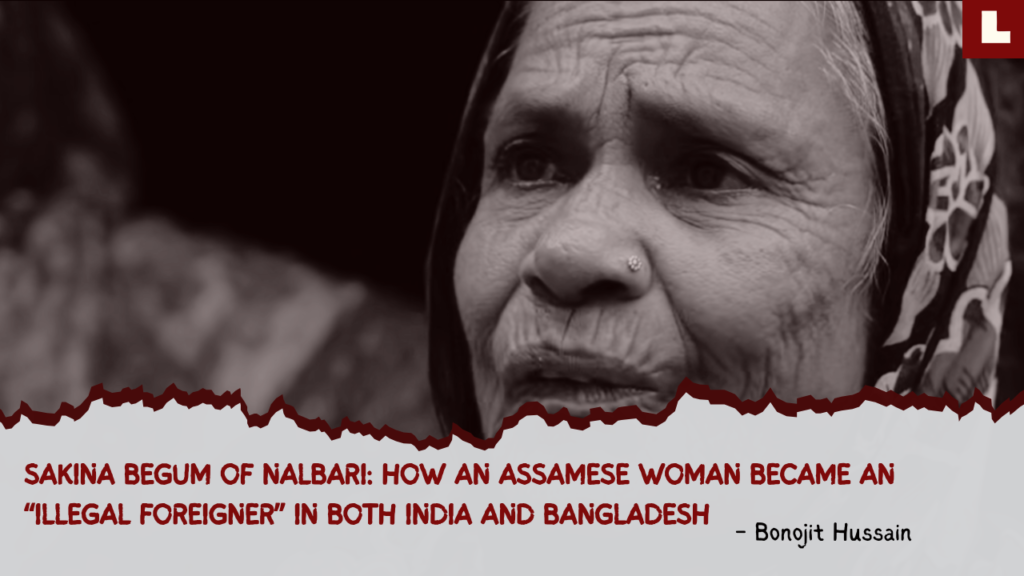

On the afternoon of 25 May, 2025, three police personnel in plain clothes arrived at a house in Burkura village in Nalbari and asked for a 68-year-old woman: Sakina Begum. She had returned there only a few hours earlier from her younger daughter’s home in Sawkuchi. The police personnel told the family that she had to come with them to give her thumb impression, the same weekly procedure she had been following since her release from the Kokrajhar detention camp.
The family protested. It was Sunday. She had already reported at the Nalbari police station on Thursday, 22 May. They told the police that she would go again the following Thursday, as required. The reply was brief and reassuring: there was nothing to worry about, she would be brought back home later.
Sakina Begum left with them.
She was not taken to the police station. She was taken to the office of the Superintendent of Police. When family members reached the SP office, they were not allowed to meet her. The police asked them to bring her blood-pressure medicines and water. They handed the medicines over and waited outside until late evening.
Around 10 pm, they were asked to leave. She would be sent home, they were told.
She never returned.
In the days that followed, the family moved between the police station and the SP office, trying to find out where she was. No one gave them an answer. There was no written order, no acknowledgement that she was in custody, no explanation.
Then the information arrived in fragments.
Sakina Begum had first been taken to the Matia Detention Camp in Goalpara district. From there she was taken to Dhubri, handed over to the Border Security Force at Panbari.
What happened to her in May did not begin at the border. It began years earlier, inside the slow administrative machinery of Nalbari — in a Foreigners Tribunal case, an ex parte order, and a chain of informal intermediaries that turned a khilonjiya Axomiya woman into a “foreigner” on paper.
This account is based on field reporting across several weeks. I, along with Iftikar Hussain, an activist and youth organiser from Barigaon village in Nalbari; Amrapali Basumatary, Associate Professor at Delhi University; Khagen Kalita, Managing Editor of The Crosscurrents; and video journalist Sonmoni Baishya, made multiple visits to Burkura village and spoke with Sakina Begum’s brothers and their families there. We also met her eldest daughter, Rasia Begum, in Darrang; her middle daughter, Khadiza Begum, in Kardoitola village in southeastern Nalbari; and her son, Taznur, in Nalbari town. Their accounts were reviewed alongside the family’s copies of electoral rolls, NRC legacy records, Foreigners Tribunal and High Court documents, and police reporting registers.
To understand how Sakina Begum, a woman rooted in Assam across generations, was turned into a foreigner in both India and Bangladesh, one must begin with a simpler question: Who is Sakina Begum?
Family History and Rootedness
Sakina Begum’s story does not begin with a notice, a case file, or a Tribunal order. It begins in the agrarian interior of undivided Kamrup, in a landscape of villages where kinship, language, and work tie people to place across generations.
Her grandfather, Alim Ali, was a farmer in Laopara village in Ghoga. The household economy was anchored in cultivation. There was no history of riverine displacement, no record of movement across borders, no char migration. This was an interior settlement, not a frontier belt.
Alim Ali’s youngest son, Makbil Ali, moved to Nalbari town in the late 1950s to work as a mason — part of a wider pattern of movement from village agriculture to small-town construction labour. Soon after, he married Khatun Nessa of Haripur village near Nalbari town. Their lives moved within a narrow local circuit: Laopara, Haripur, Nalbari town.
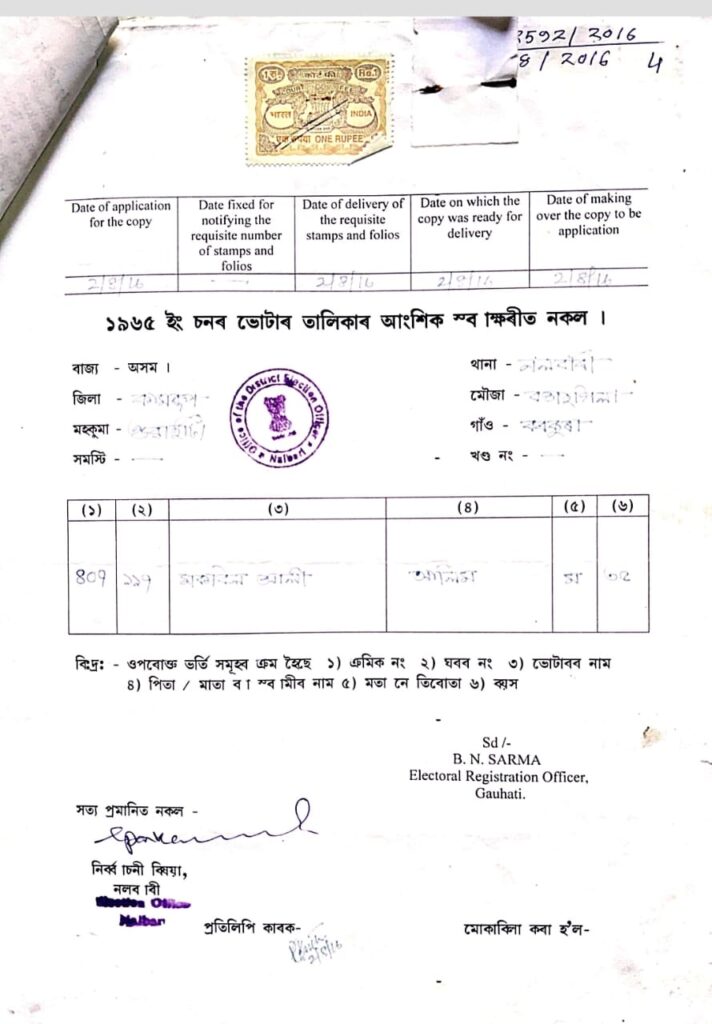
Makbil Ali’s name appears in the 1965 electoral roll of Burkura village near Nalbari town. The family preserves a certified copy of this record. It predates the 1971 cut-off that would later acquire decisive legal meaning in Assam.
Makbil and Khatun had four children, two daughters and two sons. Sakina Begum was the eldest. Her younger sister married into a family in Lakhimpur, Uttar Pradesh. Sakina herself married a young mason who had come to Nalbari for work. He was from Athiabari in Barpeta district and belonged to a Muslim community of East Bengal origin. Their marriage connected a khilonjiya Axomiya family with a Miya Muslim man within Assam’s complex social landscape. It did not, however, alter her own rootedness as a khilonjiya Axomiya woman, speaking Kamrupi Assamese, belonging to the indegenous Goriya community, and living a life marked by daily-wage labour, household responsibility, and extended family support. Nothing in her life marked her as an “outsider”.
When we visited Burkura with her brothers and neighbours, they took us to the village public graveyard. They showed us the graves of her father, Makbil Ali, and her mother, Khatun Nessa — names carved into local memory, situated in the same soil the Tribunal would later declare unconnected to her.
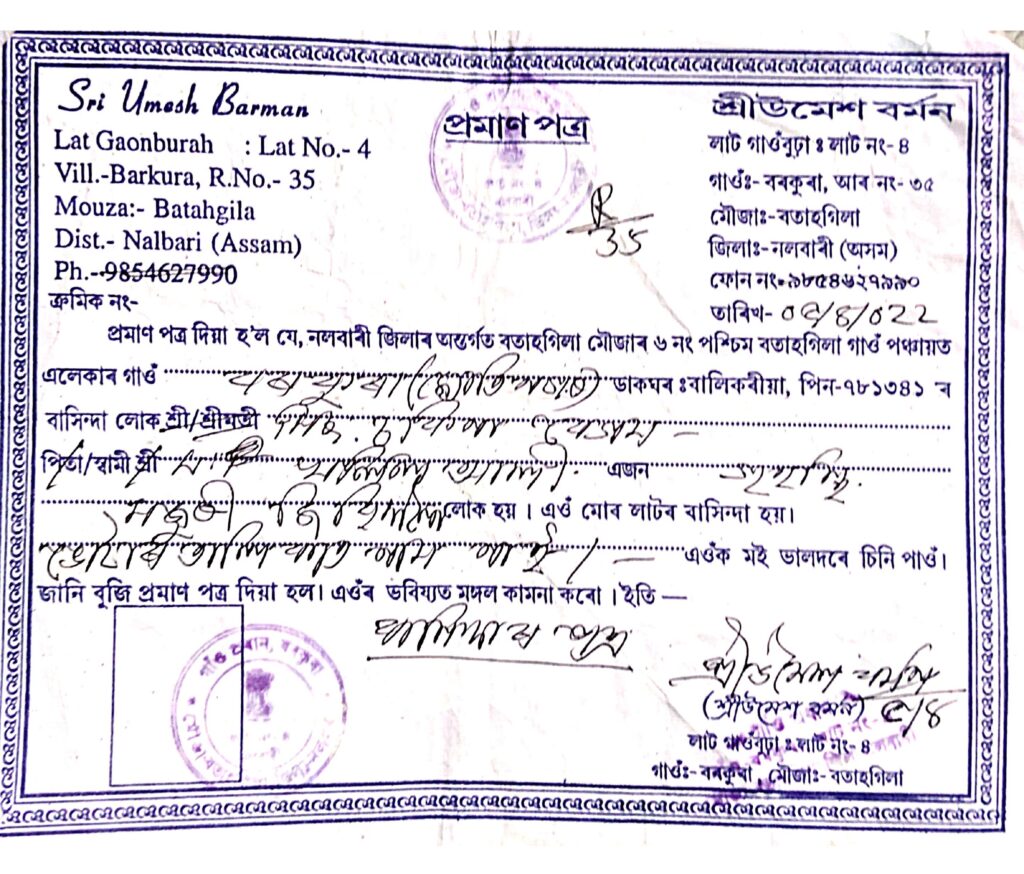
Decades later, during the National Register of Citizens process, Sakina Begum’s NRC legacy traced her ancestry to both Alim Ali and Makbil Ali. The family holds copies of this legacy data. On paper, as in lived life, her lineage runs unbroken across generations and across the historical period that citizenship law made decisive.
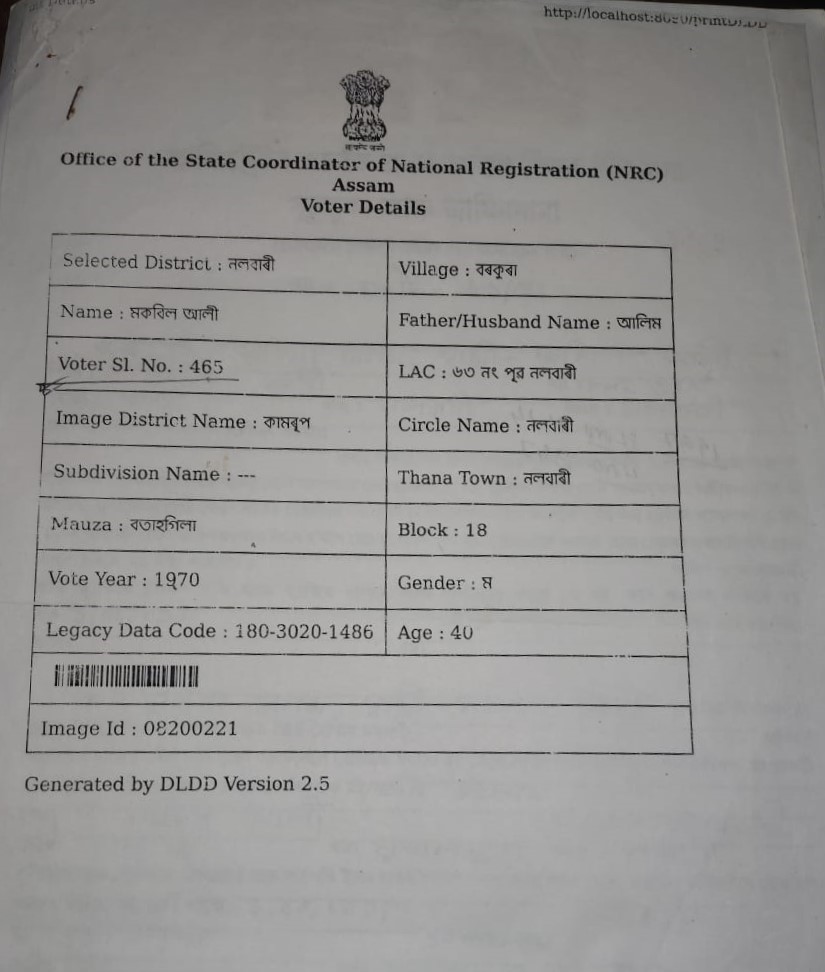
This history shaped the family’s response when the first notice arrived. They believed their documents and family records would speak for themselves, and that once they were placed before the right authority, the matter would settle.
They did not yet know that, in the process that followed, continuity of life would count for less than continuity of paperwork.
The First Notice and the Entry of Informal Law
The family says the first notice from the Border Police arrived while Sakina Begum was working as a domestic help in Sonpur, Nalbari town. She was employed in the household of a lawyer named Taizuddin Ahmed. For her, the job meant proximity to people who were educated and familiar with legal procedures. It gave the family a sense that the matter would be handled safely.
When the notice came, she did not understand its implications. The language was not accessible to her. The idea that her citizenship itself could be questioned did not make sense within her world or within her family’s experience. They believed that the matter required someone who “knew the law”.
The case was taken up by Nur Alam, the brother-in-law of Taizuddin Ahmed. He came through an existing relationship of trust and began to “handle” the case informally. From time to time, he asked for small sums for paperwork, travel, and processing — five hundred rupees, fifteen hundred, two thousand. There was no fixed fee, no written agreement, no receipts.
Sakina Begum’s brothers, Shahnur and Tabser of Burkura village, later told me that over time he must have taken around twenty thousand rupees in total. Tabser’s wife, Muni Begum, who accompanied Sakina to the Foreigners Tribunal on several occasions, recalled that at one stage they had to beg from house to house in Nalbari town to raise money.
Whenever a notice from the Foreigners Tribunal arrived, Sakina Begum and her husband travelled to Nalbari. Sometimes Muni Begum accompanied them. At other times, her eldest daughter, Rasia Begum, came from Darrang district, near the Kamrup border close to Baihata Chariali.
At the Tribunal, a peskar (a court bench assistant) would simply tell them to come back on another date. On one occasion, according to the family, the peskar said that if two thousand rupees were paid, the case would be “dismissed”. They paid believing the matter had ended. No order was shown, and no written communication followed.
Much later, Nur Alam informed them that the case had been lost and that they would now have to approach the Gauhati High Court. This was when they first came to know that Sakina Begum had already been declared a foreigner.
By then, the Foreigners Tribunal had passed an ex parte order.
On paper, Sakina Begum had appeared once before the Tribunal and then “remained absent”. In lived reality, she and her family kept returning, kept paying, and kept being told to come back on another day.
When Absence Became Guilt
The Foreigners Tribunal case against Sakina Begum was registered in 2006 before Foreigners Tribunal No. 1 in Nalbari. The case moved slowly. Notices were issued. Dates were fixed. On 30 November 2007, Sakina Begum appeared before the Tribunal and sought time to file her written statement.
After that entry, the character of the record changes.
The Tribunal’s order states that fresh notice was issued and served, and that Sakina Begum did not appear again. On that basis, the Tribunal proceeded ex parte — the case was decided without her presence, without her testimony, and without her documents being considered.
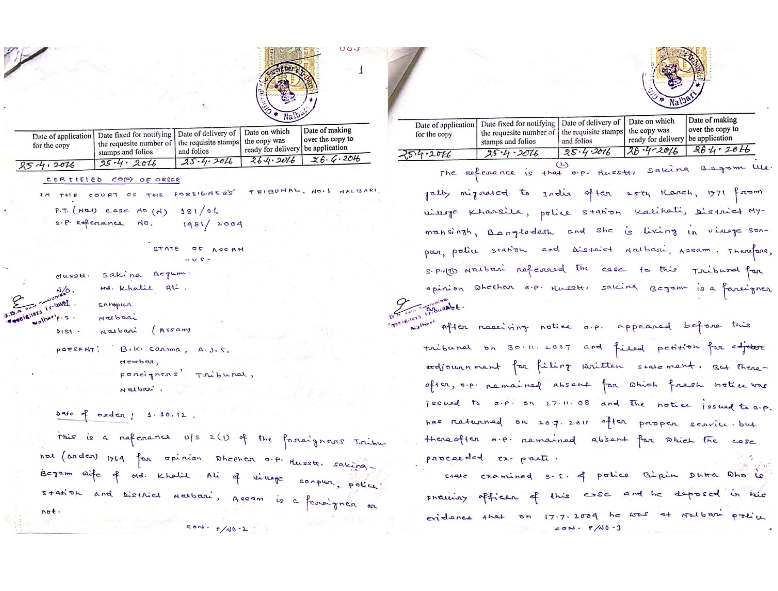
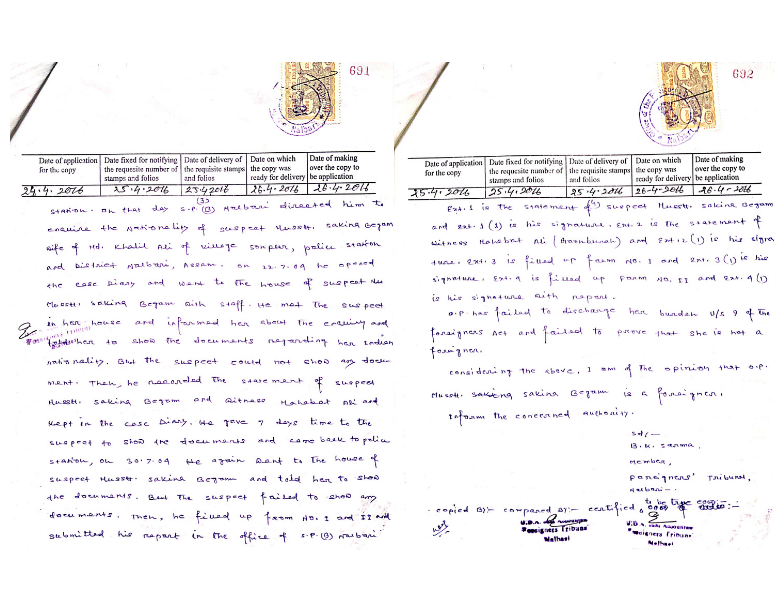
From that point onward, the issue before the Tribunal was no longer who she was, or where her family came from. It became whether she had discharged the legal burden placed upon her under the Foreigners Act. Because she was recorded as absent, she was treated as having failed that burden.
The State examined one witness: Local Verification Officer Bipin Dutta. He deposed that he had asked her to produce documents and that she had failed to do so. No cross-examination took place. No further witnesses were examined. No family lineage was tested. No electoral or residency record was discussed.
On 1 October 2012, the Foreigners Tribunal declared Sakina Begum a foreigner.
The order did not dispute her family’s existence or their records. The declaration rested entirely on procedure: she was not present when the case was taken up; the documents were not placed at the right moment; therefore she was held to have failed.
For the family, the order came as a shock. They had believed the matter was over after paying the peskar, unaware that their repeated appearances has been recorded as absence.
What the Tribunal recorded as absence, the family experienced as participation without comprehension.
High Court Phase: Procedure Without Understanding
The family came to know about the Foreigners Tribunal order only after it had already done its work. By then, Sakina Begum existed on paper as a “foreigner” who had failed to appear and failed to produce documents. The Tribunal’s record had absorbed her into that category. For the family, the only thing they were told was that the next step now lay in the Gauhati High Court.
By this time, she was already inside the detention camp in Kokrajhar jail. Both the writ petition in 2016 and the review in 2017 ran while she was in custody, not before it.
It was in this situation that a man named Safiuddin entered the story. He introduced himself as a lawyer who could handle a High Court case. The family remembers his name as Safiuddin. He came from Simalubari near Baihata Chariali and ran a timber shop in Bezera, but he spoke with confidence, knew the names of places and assured the family the case could be “managed”.
Money began to move.
The payments were made in three rounds: forty thousand rupees, then thirty thousand, and finally twenty thousand. To raise that amount, the family sold the small agricultural plot that Sakina Begum’s husband had inherited in Athiabari, Barpeta. They even had to sell their handpump.
The family was called to Guwahati once to sign some papers. They went, signed, and returned. They were not told when the case would be listed, whether their presence was required, or what exactly was being argued in Sakina’s name. Their contact with the High Court ran through one man who spoke on their behalf, collected money, and did not treat explanation as part of his work.
The High Court record presents a clean parallel version.
A writ petition was filed in 2016, challenging the Foreigners Tribunal’s order of 1 October 2012. The Court heard the matter and dismissed it on 27 March 2017. A review petition followed and was dismissed on 19 July 2017.
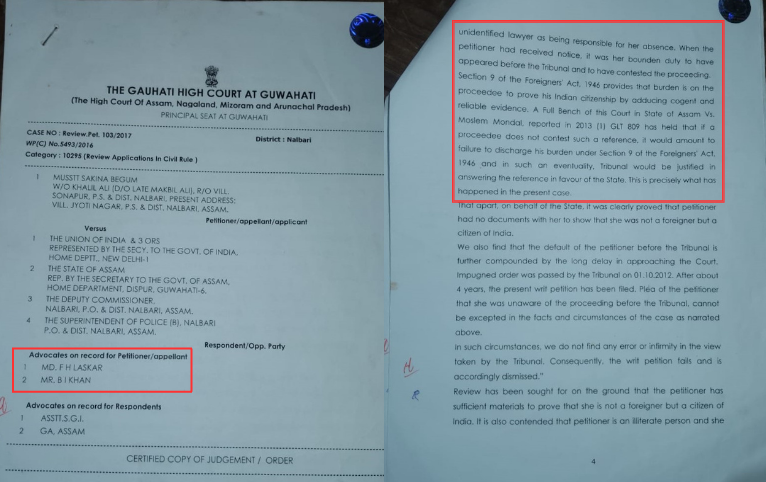
In its order, the Court noted that Sakina Begum had appeared before the Tribunal once, on 30 November 2007, and had sought time to file her written statement, but had thereafter remained absent despite further notices. On that basis, the Tribunal proceeded ex parte. The Local Verification Officer deposed that he had asked her to produce documents, but that she had not done so. No witnesses from her side were examined. No other material was placed.
The High Court did not reopen the question of who Sakina Begum was or where she came from. It confined itself to asking whether there was any legal error in the Tribunal’s procedure. It found none. The argument that she was illiterate, that she had relied on intermediaries, that counsel had failed her, was rejected. The Court also took note of the delay in approaching it.
The High Court records show that the writ petition and the subsequent review were filed and argued through counsel whose names appear in the proceedings, but the family says they never met or spoke to these lawyers. Their only engagement with the High Court process, they recall, was a single visit to Guwahati to sign papers at Safiuddin’s instruction. They insist that their interaction throughout this phase remained limited to Safiuddin, whom they believed to be a lawyer, and recall no meeting or guidance from the counsel of record.
The review petition repeated the submission that Sakina Begum had become a victim of circumstances beyond her control, that she did not understand the proceedings, and that the earlier absence should not be fatal. The Court said that there was no error apparent on the face of the record and refused to interfere.
The family only pieced together this legal narrative later. When they went to the High Court seeking answers, they say Safiuddin saw them and left on a motorbike, the last time they saw him. Only then did they learn he was not a lawyer but a mahari, a court-side fixer without formal responsibility.
What the legal record treated as absence and non-compliance, they had experienced as effort and participation, filtered through a mahari who knew the corridors but never translated the system into language they could understand.
By the time the High Court upheld the Foreigners Tribunal’s order, the question of who Sakina Begum was had been reduced to whether she had complied with procedure at specific points in time. The law had reached its conclusion. The family had never been allowed to catch up with it.
Detention: Five Years in Kokrajhar
Sakina Begum was taken into custody a few years after the Foreigners Tribunal declared her a foreigner in 2012. The family does not recall the exact date. What they remember clearly is that by the time the writ petition was filed in the High Court in 2016, she was already in the detention camp inside Kokrajhar jail. The High Court phase ran over a life already confined.
For the family, this was their first encounter with incarceration. Sakina Begum had not been convicted of any crime. She had not been accused of violence, theft, or fraud. Yet she now lived behind walls, in a separate enclosure marked out for “foreigners”.
The journey from Nalbari to Kokrajhar became part of the family’s new routine. They travelled long hours to meet her. The cost of each trip cut into already thin incomes. Meetings were brief. Conversations took place under watch and ended quickly. They brought food, medicines, and news from home. They returned with worry.
Inside the camp, Sakina Begum’s health declined. She had high blood pressure and other age-related ailments. Medical care reached late and in limited form. From the family’s account, detention did not appear as a temporary administrative measure. It felt like a slow shrinking of her life.
Time in Kokrajhar did not move in court dates or hearing numbers. It moved in seasons and visits. Months blurred into years. In the end, she spent five years there.
In 2019, following directions of the Supreme Court that allowed conditional release for certain detainees, Sakina Begum was granted bail. After five years in Kokrajhar, she stepped out of the camp.
Freedom did not come as an end to control. It came with new conditions. She had to report every Thursday at Nalbari police station and give her thumb impression. She had to remain within the jurisdiction. She had to be available and traceable at all times. The form of custody changed. The need to prove compliance did not.
After her release, she did not return to a normal life but moved between the houses of relatives and neighbours in Nalbari district. Every decisions about where she would sleep or how long she could stay in one place was made with Thursdays in mind. She lived carefully. The memory of Kokrajhar was never far. Every Thursday meant the police station, a thumb impression, and a silent acknowledgment that her status had not changed. For five years, the state had confined her body in a camp. After her release, it confined her movement and time through a weekly ritual that never led to closure.
Life After Release And The Long Wait
After Sakina Begum was released from the Kokrajhar detention camp on conditional bail, she did not step back into the life she had known before. Five years inside had altered her body, her confidence, and her place within the household economy. She was older now. She tired easily. She depended on others in ways she never had earlier.
Her life became structured around a single. weekly obligation: reporting every Thursday at the Nalbari police station to give her thumb impression. They planned all movements, within the short window between one Thursday and the next.
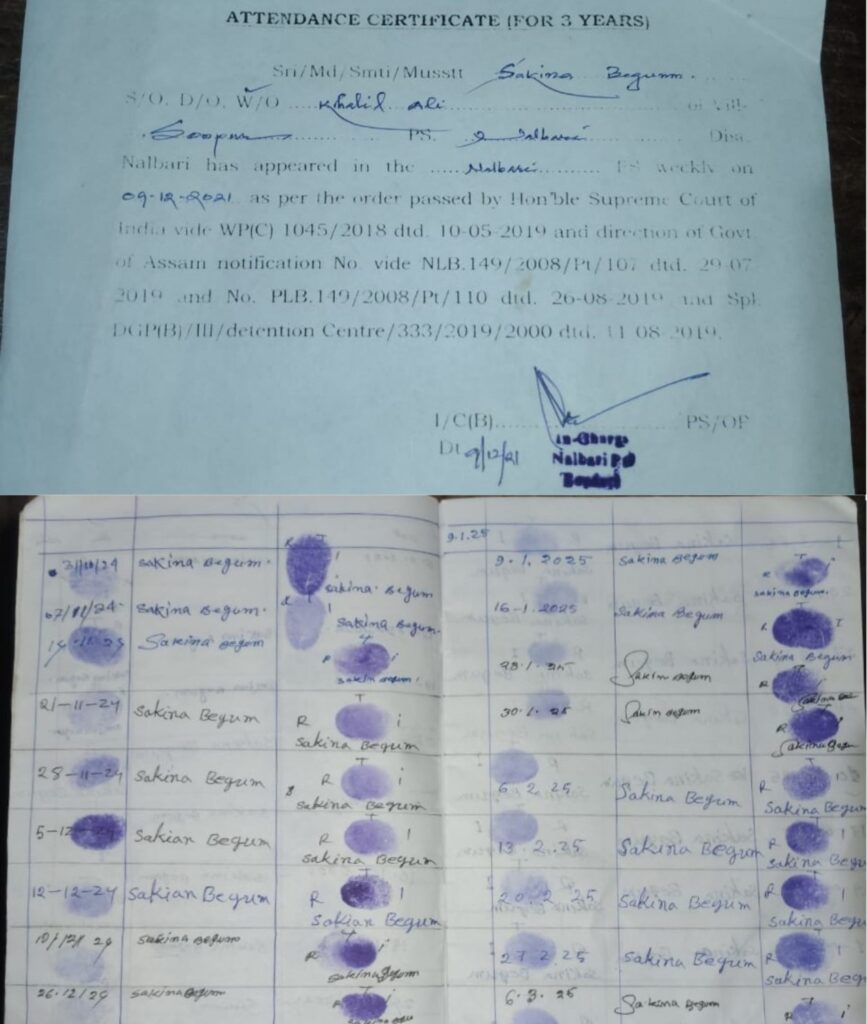
The police station became a familiar space. The act of pressing her thumb onto the register became mechanical. There were no conversations about her case, no sense of where the matter stood, no explanation of what lay ahead. Reporting did not take her closer to resolution. It simply confirmed that she remained bound to the system.
In the eyes of the law, Sakina Begum continued to exist as a declared foreigner out on bail. There was no timeline for review. There was no stated pathway back to ordinary life. The uncertainty that had begun with a notice years earlier now settled into a permanent routine.
Nothing in this rhythm suggested what was to come in May. There was no warning, no summons, no allegation that she had failed to comply. Week after week, year after year, Sakina Begum did exactly what was asked of her.
It was within this suspended state that she was taken again.
For days after 25 May, the family moved between the police station and the SP office, trying to find out where Sakina Begum was. There was no written order, no acknowledgement that she was in custody, and no explanation. The silence itself became the only official response.
Later, through local channels and fragments of information, they learnt she had been pushed across the border into Bangladesh. The family was not informed before this happened. They were not allowed to be present. They were not given any chance to object or seek legal recourse.
At the time, the Assam government was publicly claiming that it was deporting undocumented Bangladeshi nationals. In social and linguistic reality, Sakina Begum did not fit that category. She was a khilonjiya Axomiya woman from Nalbari, rooted in an interior Assamese landscape, made deportable by an administrative label attached to an old Tribunal order.
Across the border, in Bangladesh, she did not know where she was or what had happened to her. She was elderly, unwell, and alone in an unfamiliar city. She was eventually found in a vulnerable condition by a woman named Jakia, a domestic worker living in the Bhashantek area. Jakia took her into her home and sheltered her.
For months, the family in Nalbari did not know where she was or whether she was alive. Their first confirmation that she was alive came through a BBC investigation that traced her presence in Dhaka and connected her, over video call, with her family in Assam.
The matter might have ended there, inside a small circle of private care, had it not been reported by the BBC. After the report drew public attention, the Bangladesh authorities took cognisance of her presence. On 25 September, a case was registered against her for entering Bangladesh without passport or visa. She was arrested and sent to prison.
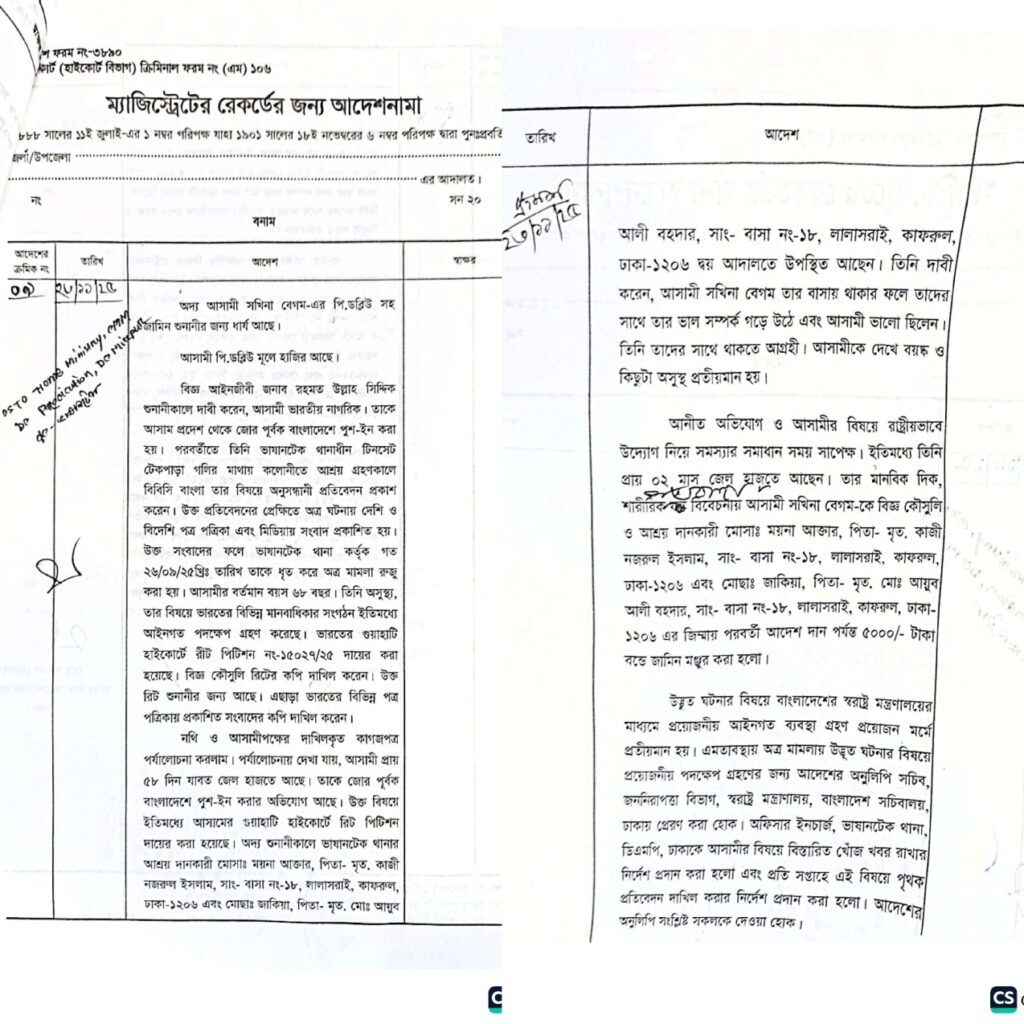
Jakia applied for bail on her behalf several times, spending her own money to pursue the case. The first applications were rejected. Eventually, bail was granted.
When Sakina Begum was produced before a Dhaka court, the order described her as elderly, sick, and dependent on the woman who had sheltered her. Bail was granted on humanitarian grounds, but under strict conditions of supervision and monitoring. Two local guarantors stood surety, including Jakia. Sakina Begum was required to remain traceable to the police and court authorities, not leave the jurisdiction, and continue under the supervision of those who had given her shelter, while the authorities kept up correspondence with Indian agencies regarding her identity.
After the bail order, Sakina Begum was not free in any meaningful sense. She now reported every week to the Bhashantek police station. Her days in Bangladesh settled into another routine of appearances, signatures, and uncertainty.
After Kokrajhar, she had done the same in Assam: every Thursday, thumb impression, police station, return home, wait for the next week.
She had followed every rule.
Reporting had not protected her.
It had only widened the perimeter of control, stretching the same condition of suspended belonging across two countries.
What Sakina Begum’s Case Reveals
Sakina Begum’s case does not turn on a disputed crossing, a contested nationality, or a movement across a border. It turns on procedure, and on what happens when procedure enters the lives of people who cannot navigate it directly, who do not fully understand its consequences, and who must rely on those who speak in its name.
At no point did any authority establish that Sakina Begum entered India from Bangladesh after 1971. The Foreigners Tribunal did not make such a finding. It declared her a foreigner because she was recorded as absent, because she was found to have failed to produce documents at the right moment, because the file recorded non-appearance where the family remembered repeated presence.
In her case, the legal process did not fail with spectacle. It failed quietly. Notices were issued. Hearing dates were fixed. Files moved forward. But understanding did not travel with the paperwork. The family believed they were participating. The Tribunal recorded non-participation.
Between these two versions stood a small economy of informal legal mediation, payments without receipts, the reassurance that the matter was “being done”, and a hope that documents, once shown, would speak for themselves. None of this appears in court orders. Yet without it, the orders cannot be understood.
The High Court phase did not reopen these questions. It reproduced the same structure in a harsher form. A man who introduced himself as a lawyer took large sums that forced the family to sell land and household assets. He asked for signatures. He did not communicate dates. When the family tried to seek clarity, he vanished. For a family with limited cash and limited legal literacy, the court did not arrive as an institution one could walk into and understand. It arrived through intermediaries.
Once the ex parte declaration of the Foreigners Tribunal had hardened into a judicially affirmed position, the system closed inwards. Later documents, family history, electoral records, NRC legacy, neighbourhood knowledge — all of it receded. The law no longer asked who Sakina Begum was. It asked only whether she had complied earlier, at a moment she did not understand to be decisive.
Detention followed as an administrative consequence, not a fresh judgement. Her release required weekly reporting, a compliance that prolonged uncertainty rather than restoring safety.
What happened in May revealed how fragile that conditional freedom was. A woman who had complied every week with police reporting was taken from her family on a stated pretext of a routine thumb impression, denied access to her relatives, moved out of the district, and removed from the state without prior notice. No new order was required. The old marking on paper was enough.
Sakina Begum’s case shows how citizenship can be lost without being argued, how confinement can follow without conviction, and how poverty magnifies the cost of misunderstanding. It shows how informal mediation becomes fatal when the law later demands formal compliance. Above all, it shows that once a person is marked as a foreigner on paper, every subsequent act of the state treats that marking as sufficient, even when it carries a life across a border.
After the Paperwork
For Sakina Begum, the loss of citizenship did not arrive as a single rupture. It came as a long sequence of small dislocations: a notice written in a language she could not follow, dates she believed she had attended, money handed over without receipts, years spent inside a detention camp, a weekly ritual of thumb impressions that led nowhere, and finally a knock on the door that took her away.
This is not a borderland story. It is the story of a khilonjiya Axomiya woman from Nalbari, rooted in an interior landscape of villages, courtyards, paddy fields, construction sites, weekly markets, kin networks, and small-town movement between work and home. In this world, belonging is carried in language, in neighbourhood memory, in graves in the local kabarsthan, in labour histories that stretch across generations.
The state never asked who she was, only whether she had complied at the right time, in the right form, before the right authority. Once the answer recorded on paper became no, everything that followed moved mechanically: declaration, detention, reporting, surveillance, removal.
Today, Sakina Begum remains separated from her home. Her family waits across a border they had never imagined would matter in their lives. They still do not have an official explanation for why she was taken, why they were denied access when she was in custody, or why she was removed from the state despite years of compliance.
The question that remains is not only whether Sakina Begum will return to Nalbari. It is whether the system that produced her case will ever account for how easily a life rooted in one place can be erased on paper, and how quietly that erasure can be enforced.
For now, Sakina Begum exists in records as a foreigner. In Burkura and Nalbari, she remains what she has always been: a mother, a sister, a neighbour, a khilonjiya Axomiya woman, waiting to come home.