Discourses From the East
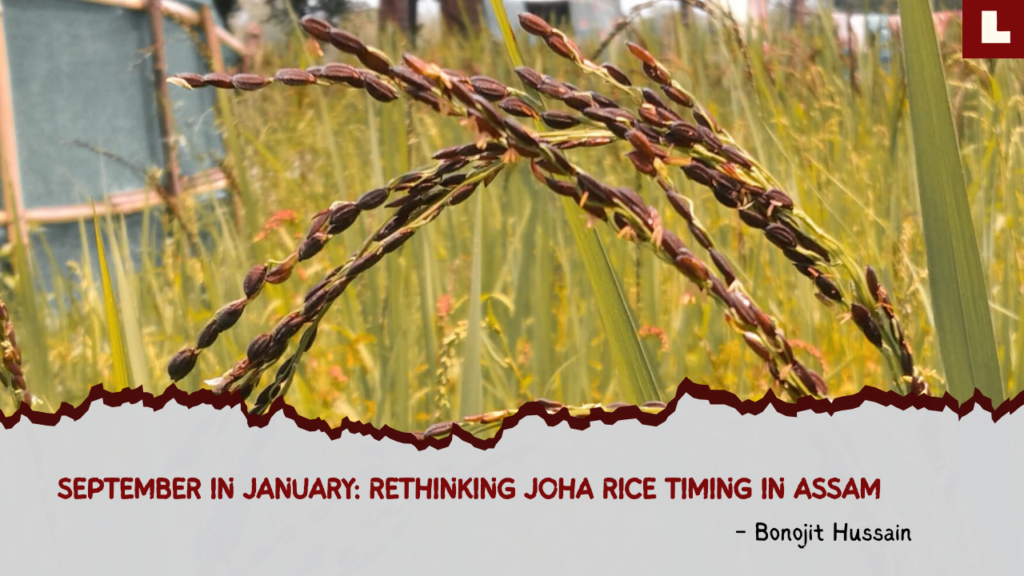

For a few years now I have been sitting on a small observation that did not make sense to anyone except me, my friend Tarun Bhartiya, and my field. I dedicate this piece to Tarun, who passed away last year. In one of our phone conversations I told him about a tiny joha rice experiment I had done in 2021. He got excited in the way Tarun always did, and pushed me to write a piece called ‘Paddy cultivation for Urban Dummies.’ I never wrote it. Those who knew Tarun will understand what I mean.
In Assam we once had three rice seasons. Ahu was the spring paddy, usually broadcast rather than transplanted, and is now almost gone. What remains as the main frame is two cycles. Kharif (Sali) is the monsoon crop. Boro is the winter crop, and traditionally it was grown without irrigation in very low lying land where winter water remained. Today most boro depends on irrigation and is usually harvested in April or May. Many traditional rice types are photoperiod sensitive, meaning day length helps decide when they flower. If you miss the right window, the plant may keep growing leaf and stem and refuse to set grain on time, no matter how much water you give it.
Kola joha, our famous aromatic rice, is traditionally a late summer and autumn sowing crop. In Assam’s floodplain villages, joha was never just a variety. It was an ecological rice. Farmers learned to match it to temperature, water, and day length long before seed companies or agricultural universities existed. Joha thrived where monsoon floodwaters slowly receded, where nights cooled gently in September, and where flowering happened as days shortened and humidity dropped. Its fragrance, grain shape, and cooking quality were not laboratory traits. They were products of a specific seasonal rhythm.
That rhythm has not vanished. What has changed is our ability to place joha inside it. In my low lying Nalbari fields, joha no longer behaves as it once did, not because the rice has changed, but because the calendar around it has. Harvest time is ruled by stray cattle. If your field stands alone with unripe grain after others have harvested, you lose it. So Kola joha has to be forced to mature along with Ranjit and other high yielding kharif varieties. That means sowing it early, in June or July, instead of the traditional late August to late September window. The result is always the same. Too much foliage, tall soft plants, weak panicles, and yields stuck at 4 or 5 maunds per bigha even in a good year. When joha sold for Rs 900 or Rs 1000 per maund (40 kg), it was almost charity farming.
I learnt this lesson slowly, and not only through joha. When I came back to the village to farm in December 2018, I had very little inherited field knowledge to fall back on. I had books, PDFs, and a lot of misplaced confidence. My first crop was boro rice on nearly twenty bighas using System of Rice Intensification (SRI). SRI treats rice not as a permanently flooded crop but as a plant that needs air, space, and careful timing. You transplant very young seedlings, one or two per hill, at wide spacing. You keep the soil moist rather than continuously flooded. You weed mechanically to aerate the roots. The aim is to build strong root systems and productive tillers rather than soft leaf.
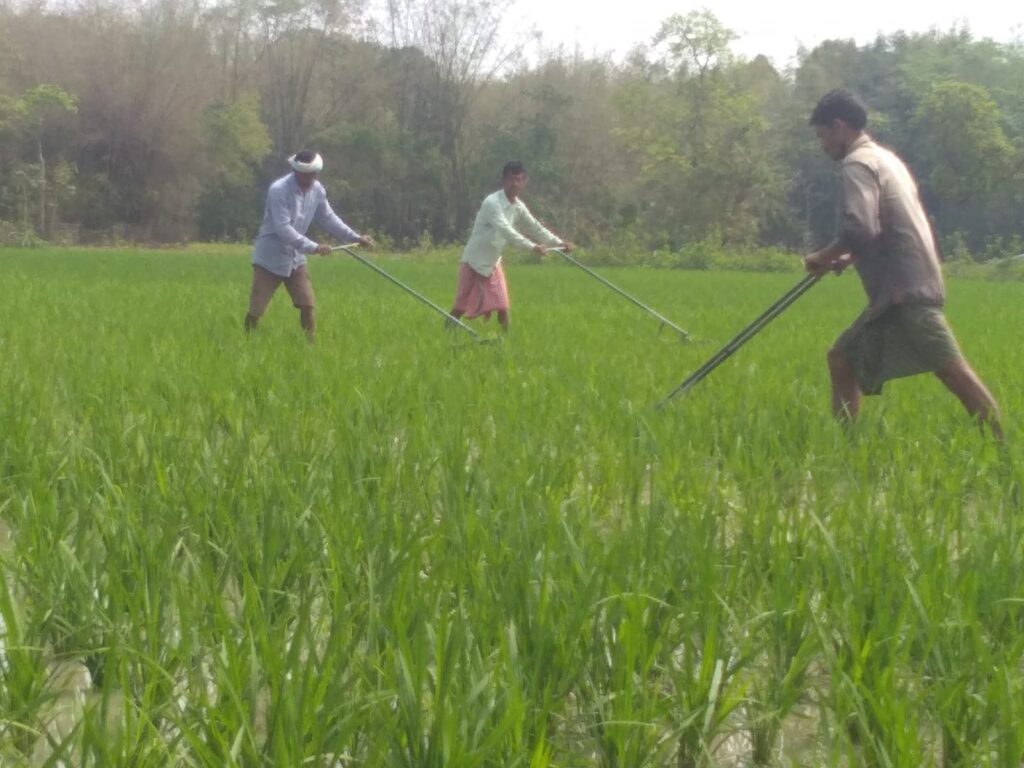
The crop itself did not fail. I got around 20 maunds per bigha, which for a novice was respectable. But the economics were brutal. In 2019 the official MSP for boro paddy was around Rs 780 per maund. I never got anything close to that. I had to sell at around Rs 300 per maund. In a place where traditional, unirrigated boro had already vanished, traders had all the power. That was my first hard lesson. Yield does not equal income. Season and market timing matter more than agronomy.
So in the monsoon of 2019 I did what every farmer in our region does. I grew high yielding kharif paddy on most of my land, and I kept a token plot of Kola joha. Joha is not just a rice. Bihu, Eid, weddings, and rituals feel incomplete without it. Every household keeps a little patch. After the previous winter’s losses I did not dare attempt boro again.
By kharif 2020 I convinced myself that Kola joha was my way out of the low price trap. I told myself I would mill it and sell it directly, and that my urban networks would absorb it at a premium. At that time I did not know how much of what is sold as “joha” in cities like Guwahati is actually rice coming from outside Assam, cut small in polishing machines and then perfumed. Still, I went ahead and transplanted joha on about twenty five bighas. That is when both ecology and my imagined market pushed back.
The ecological pushback was familiar. Traditional knowledge says joha yields best if sown in September. But cattle pressure forces early sowing so that harvest matches the dominant high yielding variety, Ranjit. The plants grew tall and leafy. The panicles were weak. Grain filling was poor. I got 4 or 5 maunds per bigha even in good patches.
Then came the market pushback. I started putting out Facebook posts about my joha rice and home crafted mustard oil, with a WhatsApp number. Orders came in. I promised weekend delivery. Every Saturday I would drive to Guwahati and deliver home to home. Most people who ordered knew of Bonojit Hussain, but did not know me by face, and I never introduced myself while delivering. That experience taught me something else about value chains. People like the idea of “direct from farmer,” but they also compare you to what the grocery store offers. After some time even friends began hinting that joha was cheaper at stores, meaning the fake perfumed joha.
So joha was being forced into the wrong season in the field, and into the wrong story in the market. In both places it was being pushed away from the conditions that make it joha.
That failure forced me to look elsewhere. If joha needs September, could I find September inside another month. I began studying temperature and day length tables from the Meteorological Department. What struck me was simple: Mid January to mid February in Nalbari feels a lot like late September to mid October. Nights are cool. Days are gently warm. The crop enters a long, steady vegetative phase before flowering. Photoperiod shifts are gradual. So on Magh Bihu, 13-14 January 2021 I transplanted a bigha of high yielding irrigated boro paddy, and alongside it a five square feet patch of Kola joha as a boro crop using occasional irrigation.
The result was not subtle. The plants stayed shorter. The panicles were long. The grains looked and smelled better than kharif Kola joha. I still have a photo from 17 April 2021. That crop flowered in late March and filled grain in early April. It was not a stressed monsoon joha. It was joha expressing itself cleanly inside a winter cycle.
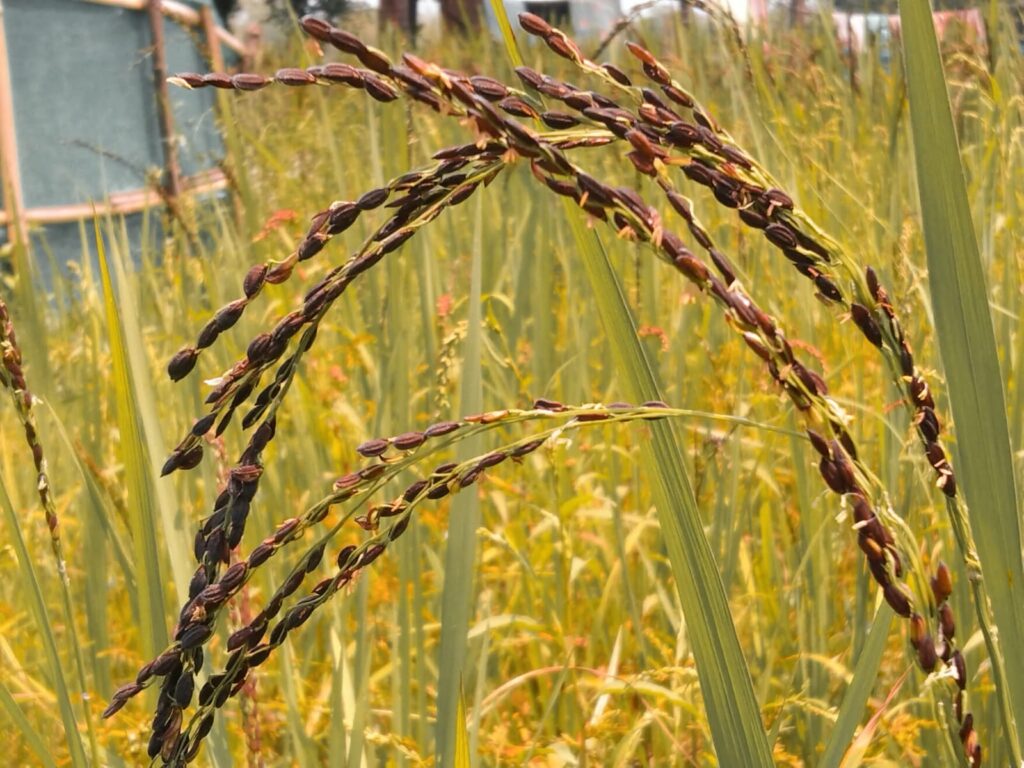
I did not scale it up after that. The reason was not doubt about the method. It was price. For years joha paddy in my area stayed around Rs 900 to Rs 1000 per maund. At that rate, even a successful boro joha crop was not worth the opportunity cost, the irrigation cost, or the risk. So the observation remained a note to self.
I did not arrive at this by reading research papers first. I arrived at it the old way, by failing with joha in the wrong season, then staring at the weather and trying a small patch. Only later did I realise that scientists had also been circling the same question.
That success also tells us something simple. Joha fails or performs poorly when the crop misses the short day trigger. It succeeds when transplanting is timed so that the plant reaches its reproductive stage while days are short and nights cool. In other words, boro joha is not impossible, but it has a narrow biological gate. ICAR-CRRI’s Gerua (Kamrup) trial made the same point sharply. When Kola joha nursery sowing slipped to 15 February, it missed the gate, stayed vegetative through spring and summer, and only flowered on 16 October. That is what photoperiod sensitivity looks like in real time.
This is not just a farmer’s story. Assam’s rice scientists have known for a long time that Kola joha is photoperiod sensitive, and that cool late winter and early spring conditions help the crop complete flowering and grain filling. They also know what happens when you push it into the boro season without respecting that biology. Trials and field experience across Assam show that if joha is timed too late in winter, the crop can remain green and vegetative well into summer, and farmers can lose everything because the crop refuses to flower within the boro cycle. Because of this risk, extension systems and services largely wrote off winter joha as impractical. They preferred the safer route, photoperiod neutral boro varieties that can be planted across a wider window and still mature.
Rice research followed the Green Revolution path. They searched for short duration, high yielding, nitrogen responsive rice that could be pushed into irrigation packages. Joha, which is long duration, low nitrogen, quality driven, and sensitive to day length, never fit that model. Even when joha was studied, the goal was often to breed it to behave like modern rice, not to understand how it could be placed correctly inside Assam’s changing seasonal ecology.
One way research addressed joha was by creating “improved” aromatic varieties that behave more like modern rice. Assam Agricultural University’s Keteki Joha, notified in 1999, is a good example. It is bred from Savitri and Badshabhog, neither of them is described as an Assam joha landrace, which already raises a basic question. When institutions say “joha,” are they naming an ecology and a cultural grain, or are they using the label for any small grained scented rice that can be made to fit the standard calendar. AAU recommends Keteki Joha for the Kharif season with sowing from June to mid July across multiple agro climatic zones of Assam, roughly the same window used for high yielding varieties like Ranjit. The plant is about a metre tall, matures in around 150 to 160 days, and AAU reports an average yield of about 12 to 13.5 maunds per bigha . The point is not that Keteki Joha is a bad variety. The point is that the institutional solution was to stabilise “joha” inside the dominant high yielding rice schedule, not to ask whether Kola joha could be re-timed into the boro window.
Yet the story has started changing inside the labs as well. Very recent genetic and mutation work on Assam’s aromatic joha rices has identified photoperiod insensitive lines that can flower even under long days. In plain terms, scientists have now found ways to remove the very barrier that made boro joha risky. That does not mean every farmer should suddenly jump into it. But it confirms the deeper point. The barrier was not winter. The barrier was flowering control.
Science catching up is one thing. Price signals are another. For years joha paddy stayed around Rs 900 to Rs 1000 per maund. Last year it moved to around Rs 1500. This year it has jumped to around Rs 2500. That is when the old calculation breaks and the boro joha idea becomes more than a curiosity. By April and May, if boro joha could come, fresh joha will be scarce. Traders and buyers will be looking for clean lots. Off season joha could cross Rs 3000 per maund if the grain looks and tastes right. At those prices even 5 or 6 maund per bigha becomes meaningful. What was once uneconomic becomes viable.
There is a wider shift behind this too. Since around 2023, paddy prices in general have been creeping up in our area, though still far below MSP. That slow rise has encouraged some enterprising peasants to look at HYV boro rice, using whatever water they can manage, partially irrigating from ponds, or using a shallow boring if available, and then hoping pre monsoon rains arrive early enough. It is a gamble, and everyone knows it is a gamble. In that context, boro joha becomes interesting for a different reason. If you are going to take winter rice risk anyway, a quality, low input crop with a strong price premium can make the risk calculation less brutal. And in my own tiny 2021 trial, Kola joha did not behave like a fragile crop. It behaved like a resilient crop that can hold itself, provided you hit the flowering window.
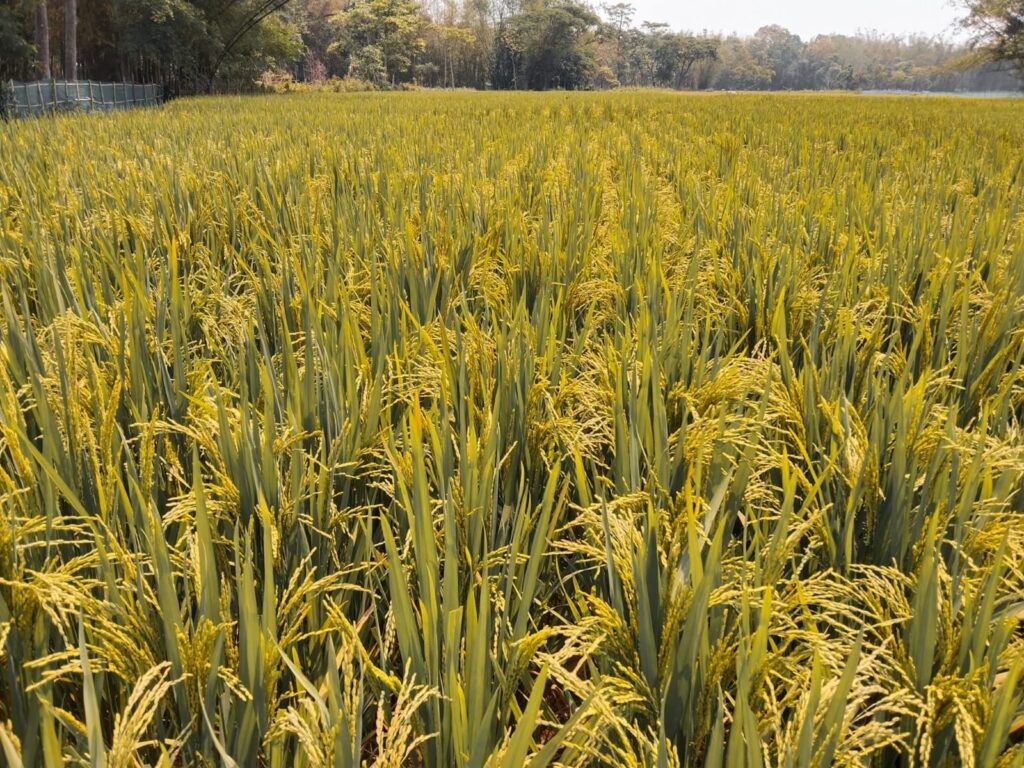
But price alone is not the whole story. The bigger question is what kind of rice rotation your land can carry year after year. This shift matters because it opens up a new pairing in our rice system. On my land the monsoon window belongs to Ranjit. It handles waterlogging, gives bulk grain and straw, and fits the newer village calendar. The winter window is open, but most of us fill it only with the standard HYV boro varieties and accept their price. With occasional but planned irrigation and the right temperature curve, Kola joha can fit there too, not as a replacement for food rice, but as a value crop.
There is another reason this pairing matters. A Ranjit kharif followed by a high yielding boro variety looks attractive on paper, but it often turns the farm into an input treadmill. Two HYV rice crops back to back mine nutrients fast and demands regular fertiliser correction. You can do it, but the soil and the pocket both start paying. Joha changes that equation. It is not a “no input” rice. Boro joha still needs occasional irrigation and basic fertility. But it does not want heavy nitrogen and it does not need the same chemical regime as a yield driven HYV. If the market is paying a premium, a lower input, quality led boro crop after Ranjit can be a smarter way to use the winter window than chasing another round of maximum yield.
This year I am planting only half a bigha to confirm yield, timing, and market response under the new price regime. A small trial is cheaper than a big mistake. But next year the direction is clear. Ranjit in kharif for volume. Kola joha in boro for value.
That is not a package from a university. It is a relationship between land, season, and market. And sometimes a farmer’s field sees what institutions miss.