Discourses From the East

There exists no such clear definition as to the notion of something called an absolute truth. We live in subjective realities, something that we form on our own. We chose to believe what we see and have with us, and what we often see or have with us is what we are just shown and given, and then, above all of this, lies a greater web, vision, that we are seldom able to see, or just choose to ignore. That is what grabs us so tight, that we forget to breathe.
Over more than five decades now, the state of Assam has been in turmoil, and has almost never had the time to rest. All that a complete generation has lived through is fear, torture, authoritarianism and devastation; dreams of a distant future in some forgotten bleak past, and still an entire community continues to live on, sometimes with some hope, sometimes hopelessly and sometimes being completely drained, the life, sucked out of them utterly.
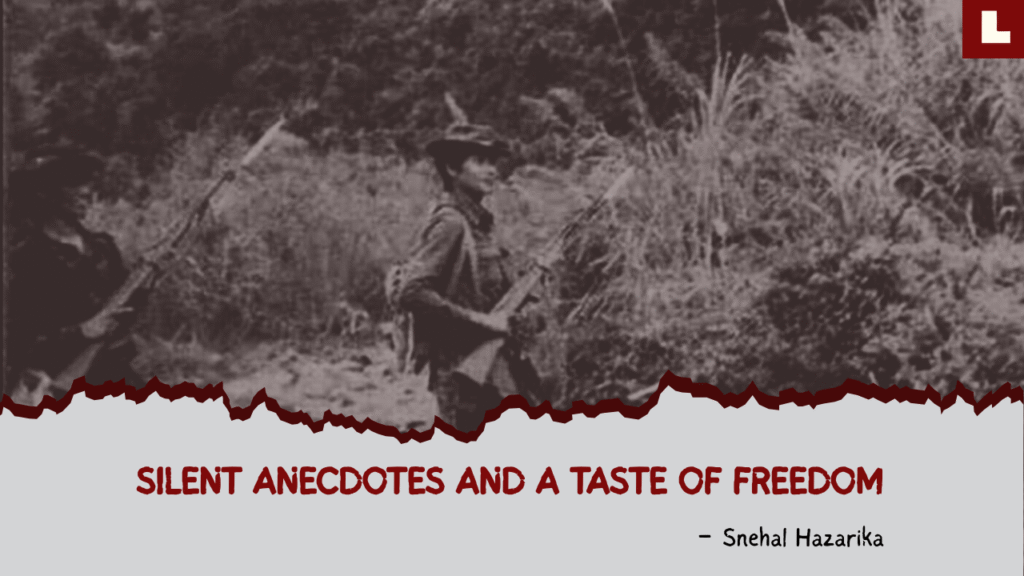
The ULFA emerged out as an extremist organization in the aftermath of the devastating and bloody Assam Agitation. Fueled by the notion of years of neglection by the authorities, self-establishment and a boiling sense of Assamese nationalism, they gained immense power after 1985, after starting their recruitment drive in 1984. The ULFA had their hay-days for a very short period of time in the mid to late 80s. In that period, the organization enjoyed very strong hold over the Assamese populace and massive power and support, so much so that they ran a parallel government running alongside the one in Dispur, and more surprisingly to the very knowledge of it.
The organization was almost everything that a populace could want. What the government would not do, ULFA would. They worked for this downtrodden section throughout the villages of Assam, whom the “greater Indian state” refused to. They built bridges, took up agro-economic initiatives and helped the people wherever needed, ultimately gaining their image of Robin Hood, so much so, that people worshipped them in these villages. But, along with these, one of the key aspects of their structure was, functioning as an “unofficial judiciary and police”.
The outfit used to resolve disputes, catch culprits for local crimes and punish them, and a part of this is what played a major role in their downfall. The punishments that they conferred upon the convicts were at times much more severe than the crime itself, which many times also meant execution after torture, and this came to light better when the “mass grave” at their Central Headquarters (CHQ) in Lakhipathar was found during Operation Bajrang in 1990, which had the bodily remains of around 50 people.
The concept of the mass grave was that, tall pillars (khuta) were laid as the borders of a specific area. The area consisted of muddy water, or swamp, high up till the waist. The tortured victims or the “convicts”, were put there, and given to stay there for days. Food was dropped in from above and due to not being able to move their bodies much, they would have to pick up and eat whatever falls on them or till their reach.
They were given to eat, sleep, eject and basically do whatever they wanted, there itself. Unable to sustain this, when the people, after sometime, would call out to “better kill them than this”, their confessions would be recorded and they would be executed, and the bodies would remain there.
When the bodies were unearthed in 1991, the details were so gruesome and the bodies so mutilated that many of them could not even be identified. Some bodies had no hands, some were without ears, some without fingers and some without their eyeballs. The most devastating part of it was that not all the killings there, were of crime-convicts, but were political killings too, which were equally gruesome and inhumane enough to not be imagined.
One such killing was of Dimbeswar Gogoi. Dimbeswar Gogoi was the founding secretary of All Tai Ahom Students’ Union (ATASU), and belonged to Lakhimpur. One day, in 1990, while having lunch, he was called and brought up to camp by some men whom he knew. What followed was a series of diabolic torture subjected to him which included severe beating and at one point, ripping up of his belly and stuffing a handful of salt into it.
The armed men then drank booze and cooked meat in front of it. The prime accused in this was Prafulla Baruah aka Sarbjeet Dhekial Phukan, who was also the Lakhimpur’s District Commander of the outfit at that time. He had surrendered in 1992 itself, and is now a ruling-party MLA.
Another case depicting the dumbfoundedness springs up from a village in Nagaon, from the year 1989-90. The brother of a college-going girl from Nowgong College, decided to inform ULFA men, instead of the police, that a guy named Zakir Hussain had eve-teased his sister while coming from college by pulling her dupatta. Zakir was taken up from his house that day, and his head was seen hanging on the bamboo-post at the entrance of the village the next morning.
Whenever the dreadful nature of the period of secret killings in Assam is talked about, of the names that turn up is one of Kushal Dowari. Kushal Dowari was a low level officer of the outfit, alias Jayanta Hazarika. He had even gone to Kachin for training, but surrendered in 1992. Even before the saga of state-atrocities began, being in the outfit itself, he had gained a very infamous reputation.
An account goes as such, that, once, Dowari and his platoon, after a late night operation were resting beside the river. This was before Operation Bajrang. An old farmer on passing by, was asked by them “O daidou bulu bhale ase?” (How’s it going uncle, all good?), upon which he replied that he wasn’t well and that a “scumbag named Jayanta Hazarika” had been creating trouble around. Dowari then called him closer, stabbed him, and then beheading him played football with his severed head for ten minutes.
What’s the perplexing part is, is that, incidents like this catered to the gradual deterioration of the outfit in the eyes of the masses, from the erstwhile status they had developed, and what’s more important is that these aspects played a large role as a whole to their perceived image on ground to be generically formed, a big question or cynicism started hovering the image and intentions of the organization in the eyes of the people.
The greater question that comes out is that, is the question of being human. How is it possible for a sane human being, or even someone wooed by the romanticized ideas of a far-away revolution, carry out such acts equivalent to the cruelest psychopaths in history in such ruthlessness, as to not even be able to be termed primal in nature? This puts a dent into the integrity of the organization as a whole.
The “surrender-drive” of CM Hiteswar Saikia promised re-establishment and renumeration for the militants but ultimately resulted in the same power-hungry, scum elements of the outfit to come out of it and exercise their diabolic powers as a ruling entity among the commonfolk, backed by the government itself and having most of the state assets in their hands.
The ones who were talking of revolution yesterday, were now extorting and murdering people under the open sky, in front of everybody, and each person had their hands tied. People like Kushal Dowari, Bhagya Kalita, Mridul Phukan, Shyamal Baruah, Saurav Gogoi and others, emerged as unofficial warlords, whom nobody could dare to even turn an eye up to.
Kushal Dowari built a mansion in his Dorikapar, Charaideo ( then Sivasagar) home. The unwritten rule of the area was such, that while passing through his house, you may not, under any circumstance, honk. An “AK47”, on doing the opposite, would turn up from above, and the bullets would be emptied out on you. Kushal Dowari is a BJP candidate and former MLA from Thowra constituency, Sivasagar.
Bhagya Kalita, at a time been made to kneel down the entire day as punishment for teasing girls infront of Nalbari College, Heerak Jyoti Mahanta (ex-commander in chief), once deliberately ran over the security guard in Fancy Bazaar in presence of all the people, because someone had parked in his self-designated-spot that day. He had become a powerful contractor after surrendering in 1992 and is counted as the second richest man in Assam.
Mridul Phukan and his apprentices, would be wait in their car at Sepon Tiniali, observing 16-18 year old high school girls, and pick up the one which they would find the most attractive.
The wheel spins around, reality spins like pictures in a bioscope, and we see just that. The state crumbles, agonizes, breaks down, but does not move forward and we are made to stick inside this loop with no end. The fact that the ones resulting in the dreaded and frightful perception of the outfit, and were used by the Congress and regional government to create the state of terror are in the now-ruling party of BJP.
Directions towards answers seem to fade down the line and yet we fail to look, actually understand, how reality has always been painted to us and made to be forgotten, and we spin in spirals. The question of being human will forever remain and we will be battling with it no matter what, despite the changes of contexts.