Discourses From the East
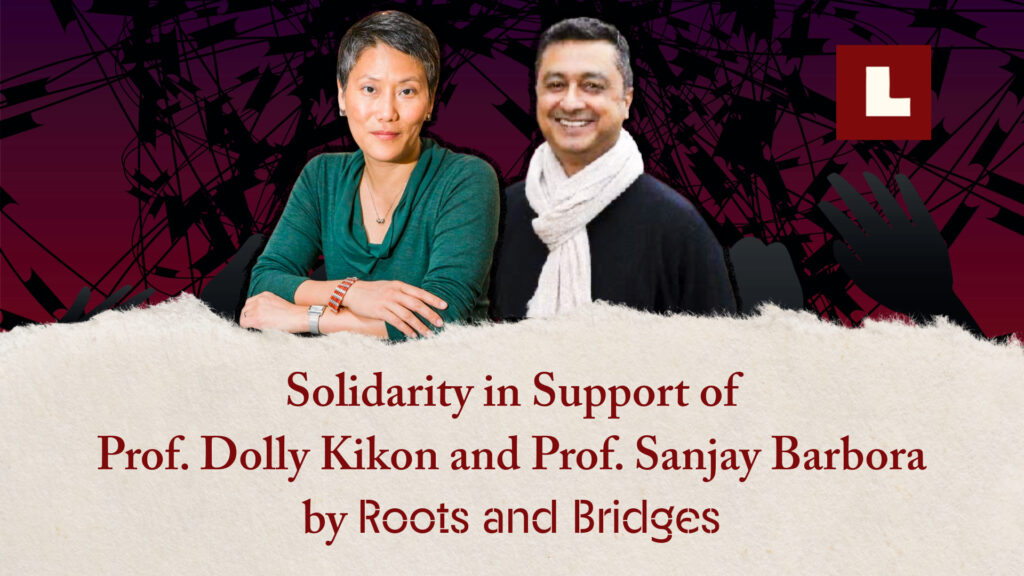

On 15 September 2026, after a screening of Prof. Dolly Kikon’s documentary A Sacred Place and a discussion with students and scholars at Nagaland House in RK Puram, New Delhi, attendees continued interacting near the reception area. A staff member allegedly ordered them to leave in an aggressive manner and, when Prof. Sanjay Barbora objected, challenged him to a physical confrontation. The manager of Nagaland House reportedly defended the staff member instead of intervening, while Prof. Kikon—despite explaining that she had been invited by the Naga Scholars’ Association—was repeatedly asked to leave and the gathering was described as a “nuisance” and “disruption.” The incident has been condemned as an act of humiliation and intimidation, prompting demands for a transparent inquiry, appropriate action against those responsible, and an unconditional apology from the Government of Nagaland.
A Letter by Roots and Bridges Collective
To,
The Resident Commissioner
Nagaland House, Delhi
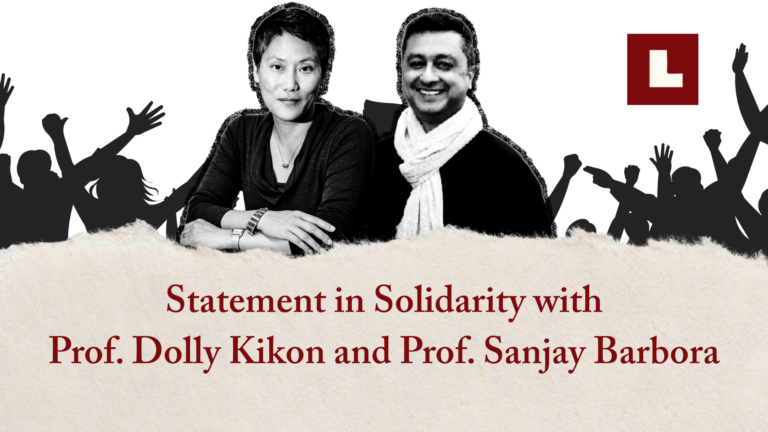
On behalf of the Roots & Bridges Collective which comprises of Social Science researchers and academics from across Northeast India and abroad, we are anguished to learn about the rude behaviour, public humiliation, and unprovoked threats meted to anthropologist Professor Dolly Kikon and sociologist Professor Sanjay Barbora by the staff members of Nagaland House, RK Puram, New Delhi. Professor Kikon and Professor Barbora hail from Nagaland and Assam, respectively and are currently teaching at the University of California, Santa Cruz. On 15 September 2026, they were invited guests and resource persons for an event hosted by the Naga Scholars Association (NSA).
It was the public screening of Professor Kikon’s documentary, A Sacred Place followed by an Interactive Session with the filmmaker. What seemed to be an opportunity for the young students and scholars in Delhi to interact with Professor Kikon and Professor Barbora turned out to be an extremely unfortunate experience for the renowned academics who stopped by Delhi for a night before flying back to the United States of America.
What happened?
In the words of Professor Dolly Kikon:
“It was a very unpleasant experience for me and Sanjay. The manager kept telling me the event was a nuisance and created disruption. She repeatedly said she [the manager] had no idea who NSA was when I said I was an invited resource person of NSA. She said I should leave the premises and stop being noisy. The event unfolded when the receptionist slammed hard on the desk behind me and asked me to get out. I was standing with students from Miranda House who were asking me to come to the college to give a talk. My husband Sanjay who was behind me turned around and told the reception guy that this was not the way to behave. The receptionist asked him to get out, and started speaking in Hindi with him aggressively. He said everyone was very loud and should all leave right away. Next, in front of my eyes he got up to challenge Sanjay for a fight and I heard him say, ‘You want to fight, come, hit me, hit me.’ I slammed the desk to ask him what the hell was wrong with him to behave this way.”
Apart from the receptionist, the manager, identified as Ms. Metha, humiliated both Professor Kikon and Professor Barbora by asking the receptionist for the paperwork and permission for the event, instead of de-escalating the situation.
We strongly condemn the shameful behaviour of the staff at Nagaland House who lack basic etiquette and orientation in engaging with guests, be it with the professors or the students.
Who are we?
Individually, we work as academics, writers, and researchers based in India and abroad. Many of us call Northeast India our home. Collectively, we come together for a writing workshop in Guwahati under the banner of Roots & Bridges Ethnographic Writing Workshop annually to support and mentor young students from Northeast India pursuing doctoral research in the region. The students are mostly from underrepresented colleges and universities from Northeast India. We are not funded by any organisation to run this workshop and have been doing this as our voluntary contribution for the past 13 years. We are sure the alumni of this workshop carry back with them the responsibility of writing about the region with care.
Founded by Professors Kikon and Barbora, this fellowship continues to be guided and inspired by their undeterred commitment to supporting students in the region and helping bridge divides between here and international academia. The most recent edition of the workshop was held in July 2026 in Guwahati, and like every year, students came together to sit and work in shared solidarity, finding themselves joining a community of scholars to draw support from and give back to.
Their Commitments this Summer
As academics in an American university, June to September are vacation months that Professors Kikon and Borbora normally spend in India, often turning their holidays into a chain of workshops and events every year. This is also a time when students, scholars and other interested organisations in India set dates and organise events to connect with the professors. The film screening held in Nagaland House was one such engagement that they had committed to on the second last day of their time in India this summer.
Professor Barbora travelled through Upper Assam meeting people and the communities in distress during the devastating Assam Floods. Together, they travelled through Nagaland and Manipur for community engagements. In August 2026, Professor Kikon participated in an international workshop, Ecologies of Care in Nagaland which emphasized on the need to revive connections between younger generations and Indigenous food systems. In September 2026, they released their book Pothar Pedagogy in collaboration with the Annapurna Seed Library, Jorhat, a testament to their deep engagement with rural schools and community initiatives. Over the past few decades, they have been closely working with the Forum for Naga Reconciliation (FNR) in facilitating peace dialogues with the Naga elders and community members. Over the past few years, they have been engaged with the initiative Recover, Restore and Decolonise (RRaD) to facilitate the repatriation of Naga ancestral human remains from the Pitts River Museum, Oxford. In September 2026, the University of Oxford, UK agreed to repatriate 39 sets of human remains belonging to Naga people. The news was also covered in The New York Times, BBC, Reuters amongst others in September 2026.
A day before flying from Guwahati, some of us had asked Professor Kikon why they were not directly flying to the United States. What was the need to halt by Delhi when they had spent their holidays working? Professor Kikon replied, ‘It is an opportunity to see our teachers in Delhi and meet people from the region.’ It is heartbreaking to think of the horrible way this decision turned out for the professors.
Although intended to be an opportunity to discuss the documentary and create an environment conducive to critical thinking, learning and sharing, the event at Nagaland House became a deeply disturbing memory for all involved.
We strongly condemn the incident
We acknowledge that the Naga Scholars Association (NSA) has taken the incident seriously and urge them to seek public apology from the staff who have humiliated Professor Kikon and Professor Barbora. If Nagaland House was not meant for events such as a movie screening on Naga cultural heritage or oriented with the academic conversations that follow post-events, it’s time we need to reconsider our choice in the selection of venues.
For the staff of Nagaland House who may not know Professor Kikon and Professor Barbora, we share their work with you:
- Living with Oil and Coal
- Homeland Insecurities
- Leaving the Land
- Ceasefire City
- Life and Dignity
- Seeds and Food Sovereignty
- Food Journeys
- Pothar Pedagogy
This letter is written with deep anguish and deeper commitment to stand in solidarity with our mentors who have selflessly nurtured generations of young scholars across the region.
In solidarity with Professor Dolly Kikon and Professor Sanjay Barbora,
The Roots & Bridges Collective
1. Dr. Dixita Deka, Assistant Professor, St. Joseph’s University, Bengaluru
2. Dr. Raile R. Ziipao, Associate Professor, IIT Bombay
3. Dr. Amrita P. Gogoi, Post-doctoral Fellow, IIAS, Leiden University; Assistant Professor,
Department of Political Science, Dibrugarh University
4. Dr. Pavei Kh, Assistant Professor, Assam Don Bosco University
5. Dr. Premshila Singh, Assistant Professor , Assam Don Bosco University, Tapesia Campus
6. Dejna Daulagupu, PhD Scholar, National University of Singapore
7. Joel Rodrigues, PhD student, Department of Social Anthropology, Stockholm University
8. Roluahpuia, IIT Roorkee
9. Repakaba Tzudir, PhD Scholar, Nagaland University
10. Shaokhai Mayirnao, PhD Scholar, Tata Institute of Social Sciences, Mumbai
11. Dr. Roshni Brahma, Independent Researcher
12. Dr. Bitopi Dutta, Academic, Assam
13. Dr. Ramachan A Shimray, Research Associate, Tata Institute of Social Sciences, Mumbai
14. Tenzin Nyima Bhutia, Guest Faculty, ICF AI University, Sikkim15. Swuduveyi Sapu, PhD Scholar, National Institute of Technology Nagaland
16. Ankita Dutta, PhD Candidate, Dibrugarh University
17. Dr. Newlandson Samuel Angam, St Joseph’s University, Bengaluru
18. Tage Umbrey, PhD Scholar, Rajiv Gandhi University, Arunachal Pradesh
19. Hrishi Raj Thakur, PhD Scholar, Dept. Of Geography, University of Delhi
20. Kelevil Neikha, PhD Scholar, National Institute of Technology, Nagaland
21. Dr. Mirza Zulfiqur Rahman, Visiting Associate Fellow, Institute of Chinese Studies, Delhi, India
22. Chiranjib Boruah, PhD Scholar, TISS, Guwahati
23. Smriti Rajiung, PhD Scholar, Assam University
24. Champha Wangsu, Assistant Professor, Dikhowmukh College, Sivsagar, Assam
25. Maisnam Arnapal, University of California, Santa Barbara
26. Mridugunjan Deka, PhD Candidate, Gauhati University.
27. Lahun Dashisha Rumnong, PhD Scholar, TISS, Guwahati
28. Libenthung Kikon, PhD Scholar, Nagaland University
29. Upatyaka Dutta, PhD Candidate, University of Toronto
30. Dr. Brishti Banerjee, Urban researcher and practitioner
31. Radhika Moral, PhD candidate, Brown University
32. Dr. Chandan Kumar Sarma, Professor , Department of History, Gauhati University
33. Chinggelniang. PhD Scholar, IIT Delhi
34. Dr. Pranab Kr. Pegu, Independent Researcher
35. Dr. Lamneithem Haokip, Independent Researcher
36. Dr. Rituparna Patgiri, Assistant Professor, IIT Guwahati
37. Manbor Singh Warjri, Associate Professor, Sankardev College, Shillong
38. Dr. Manta Wangsu, Postdoctoral Fellow, IIT Guwahati
39. Rachel Khrasi, PhD scholar, Jawaharlal Nehru University, New Delhi
40. Asin M S, PhD scholar, Jawaharlal Nehru University, New Delhi
41. Tanmoy Sharma, Researcher, Yale University
42. Karvileena Deka, PhD Scholar, Department of Anthropology, Gauhati University, Assam.
43. Kyamba Elangbam, PhD Scholar, University of California, Santa Cruz
44. Sheetal Shalini Pebam, PhD Scholar, IIT Roorkee
45. Yashika Subba, PhD Scholar, IIT Dhanbad
46. Kevino Krose, PhD Scholar, Nagaland University
47. Ringsmola Jigdung, PhD Scholar, Guwahati University
48. Rustom Kutum, PhD Scholar, Dibrugarh University
49. Dawa Lhamu Sherpa, PhD Scholar, Ambedkar University Delhi
50. Timothy Khongsai, PhD Scholar, Ashoka University
51. Neha Rai, PhD Scholar, IIT Dhanbad
52. Limatula Ozukum, PhD Scholar, Lovely Professional University
53. Dr. Snehashish Mitra, Independent Researcher
54. Prof. Bengt G. Karlsson, Department of Social Anthropology, Stockholm University
55. Dr. Walter Fernandes, Director, North Eastern Social Research Centre, Guwahati
56. Ng Sourav Singha, PhD Scholar, IIT Guwahati
57. Bikash Chetry, PhD Scholar, University of Cape Town
58. Ningthoujam Suresh Meitei, Phd Scholar, IIT Guwahati59. Ila Ananya, PhD Candidate, University of Cambridge
60. Sukrity Gogoi, PhD Candidate, TISS, Mumbai
61. Dr. Sammy, Assistant Professor, Tezpur University
62. Nohosanu Natalia Rhutso, PhD Candidate, St. Joseph’s University, Bengaluru
63. Kipa Yullo, PhD Scholar, Rajiv Gandhi University
64. Chandan Kumar Sharma, Professor, Dept. of Sociology, Tezpur University
65. L. Dipika Singha, PhD Scholar, Department of Anthropology, Gauhati University
66. Bonojit Hussain, Farmer and Independent Researcher, Assam
67. Porixita Kakoty, PhD Scholar, IIIT Guwahati
68. Lemila Kuireiwoshi, PhD Scholar, TISS Guwahati
69. Maithron Konyak S, PhD Scholar, Nagaland University
70. Uddipan Sarma, PhD Scholar, Department of Cultural Studies, Tezpur University
71. Vizokhole Ltu, NESRC
72. Sanskriti, Guest Faculty, The English and Foreign Languages University, Shillong
73. Sonia Kahmei, PhD Scholar, IIT Guwahati
74. Dr Vijay A. D’Souza, Director, North Eastern Institute of Language and Culture, Guwahati
75. Trinayan Kachari, PhD Scholar, Department of Anthropology, Gauhati University
76. P. Lalpekhlui, Tetso College, Chumoukedima, Nagaland
77. Somiwon A Shishak, PhD Scholar, IIT Guwahati
78. Dr. Jiangampou Kamei, Assistant Professor, Saint Claret College (Autonomous), Ziro
79. Tsukhumla Yimchunger, PhD Scholar, IIT Guwahati
80. Dimpy Talukdar , PhD Scholar , Nagaland University
81. Tana Anam, PhD Scholar, Arunachal Institute of Tribal Studies, Rajiv Gandhi University, Arunachal Pradesh.
82. K Inakali Sumi, PhD Scholar, SRM University AP
83. Richa Borthakur, PhD Scholar, NIT
84. Priyanky Bhuyan, PhD Scholar, Birangana Sati Sadhani Rajyik Vishwavidyalaya, Golaghat
85. Odity Barthakur, Doctoral Student, Department of Humanities and Social Sciences, IIT Delhi.
86. Kime Yallo, PhD Scholar, University of Hyderabad.
87. Dr. Matthew Wilkinson, Senior Research Advisor, University of New South Wales, Sydney, Australia
88. Ramengmawia Bawitlung, PhD Scholar, IIT Bombay
89. Dr Richard Kamei, Associate Professor, Royal Thimphu College, Bhutan
90. Raysha Alvir, Teaching Fellow, Ashoka University, India
91. Dr.Ilito H. Achumi, Assistant Professor, IIT Bombay