Discourses From the East
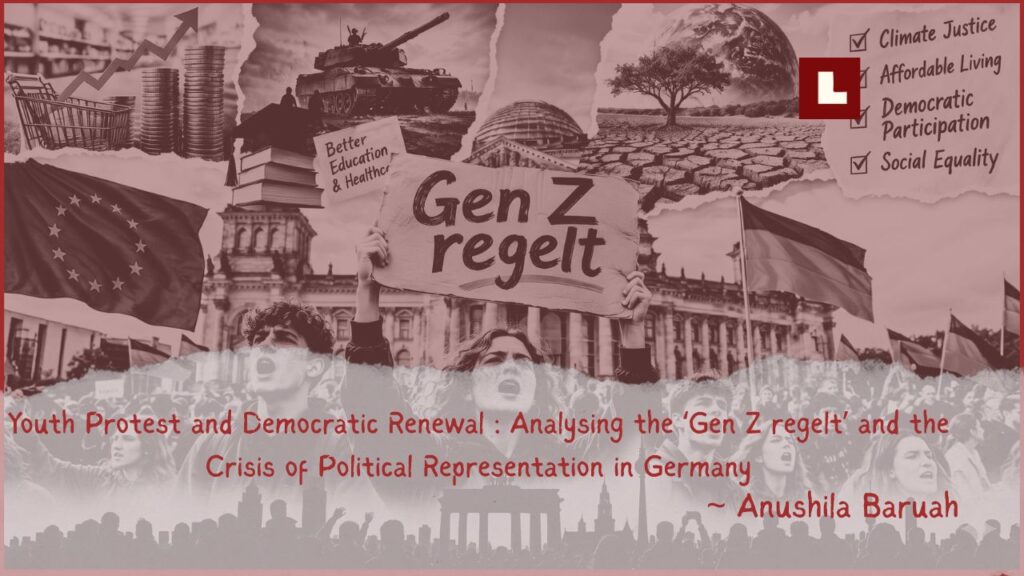

The changing nature of protest politics across the globe, in recent times has given new meaning to protest participants, protest content and protest outcome. From a heterogenous blend of participants, to focusing on new forms of systematic iconoclasm with social media utilisation being one of its biggest boons and finally to expeditiously reshaping the ruins of democracies despite constant repression from the people in power, these protests are changing political discourses across nations.Youth, students and specifically Gen Z ( the generation between late 1990s to early 2010s) have taken centre stage in these protests challenging fascist regimes, rising inflation,education and healthcare policies, cost of living, climate injustice, economic inequalities, gender inequalities and so on. The shared global political consciousness among these groups have helped in the overthrow of government or political figures in many countries across the world.
French Fiscal Crisis to Pan-European Contestation
With rapid economic, political and social unrest intensifying in Europe, students and youths are seen coming out and protesting for the ruling government’s failure in representing their rights and creating a sense of alienation and frustration. This youth mobilisation is largely a structural reaction to the systemic failures and institutional instabilities left behind by preceding generations. France served as the foundational locus for the protests that subsequently diffused to other parts of Europe. France’s public debt and fiscal constraints triggered the already deteriorating public services. On 17 September, 2026, students in Paris protested against inadequate public education where demonstrators advocated for expansion in teaching and administrative staffs, infrastructural enhancements and equitable educational access. Later the protest was joined by other groups and unions with additional demands focusing on rising living costs.
The expansion of the French protests into a broader Pan-European phenomenon reflects a collective crisis of youth representation, wherein young populations across southern and central Europe mobilized against structural state neglect and declining public service provisions that jeopardize their long term socio – economic security. This transnational crisis saw Italian students aligning with their French counterparts to critique educational expenditure and poor infrastructures. Further, the protests saw a convergence into a broader ideological debate questioning the authoritarianism and discriminatory social policies of its right wing government. In Spain too, student led activism took a dual character highlighting educational austerity and acute housing crisis. Housing inflation is a serious concern in Spain affecting working class households.
Macroeconomic Shifts and Demographic Pressure in Germany
Demonstrating cross border solidarity, students and youths also participated in nationwide protests in Germany. The trajectory of the German protests demonstrated a significant thematic shift, pivoting from critiques of educational underfunding to a systemic challenge against the state’s militarization agenda, specifically targeting defense budget expansion and compulsory national service policies.
After the financial crash of 2008, Germany had introduced a constitutional debt brake (Schuldenbremse) that enforced strict structural deficit caps to preserve fiscal discipline. Against the backdrop of the Russia-Ukraine War, and an increasingly unsteady cross-atlantic relationship; European countries were forced to re-evaluate their defence spending aiming to decrease their reliance on US security guarantees within NATO and move towards strategic autonomy. In response to these shifting geopolitical imperatives, Germany re-evaluated its historically conservative fiscal regime, and in 2025 the German parliament enacted constitutional amendments to finance critical public infrastructure and boost its national defense capabilities.
Adding to these fiscal changes is Germany’s severe demographic contraction. It is characterized by an aging populace that will soon outnumber the active workforce. This structural demographic transition will affect future spending and public amenity provision. Within this context, prioritizing military expenditure over social infrastructure creates a critical trade-off, placing the socio-economic security and future pension viability of younger generations in severe jeopardy.
The Mobilisation of ‘Gen Z regelt’ and its demands
Within these macroeconomic and demographic changes, German youth movements organized nationwide demonstrations on October 31 under the slogan ‘GenZ regelt’(‘Gen Z Takes Charge’). The mobilization manifested across major urban centers including Berlin, Frankfurt, Cologne, and Munich while simultaneously decentralized actions spanned over 30 other cities, illustrating a widespread geographic footprint and coordinated youth resistance. Around 100,000 people participated in the protest nationwide. The opposition Greens and the Left Party are also supporting the protest.
The ‘GenZ regelt’ in their website articulates a distinct, six-pillar critique of contemporary state policy, systematically addressing the distinct structural precarities facing youth across Germany. First, regarding institutional austerity, the movement opposes budget cuts to public education, social welfare, culture, and healthcare. It is critical towards the closure of youth addiction clinics and inaccessible mental health therapy while demanding direct state investment in schools and youth care. Second, addressing socio-economic insecurity, the platform highlights the financial strain caused by inflation, rising living costs, and high taxation on lower-income brackets. It demands an affordable life for all. Third, concerning fiscal burden-sharing, the manifesto exposes a structural imbalance where public austerity falls heavily on the younger generation while corporate profits remain sheltered. It calls for a fairer distribution of economic resources. Fourth, grounded in antimilitarism, the movement explicitly rejects mandatory military screening (Musterung) and compulsory conscription, asserting generational self-determination against being forced into military service for geopolitical conflicts in which youth have no democratic input. Fifth, regarding civil liberties, the platform contests the continuous expansion of the state security apparatus and digital monitoring, demanding the protection of fundamental constitutional rights and privacy over heightened state control. Sixth, addressing ecological precarity, the manifesto identifies climate change as an existential threat impacting youth most severely, condemning the ongoing postponement of structural environmental policy and demanding immediate, systemic climate action to secure their future.
The Bonn Case
As an associate site within this broader network, Bonn mobilized approximately 500 demonstrators who gathered at the historic Hofgarten before marching towards Bonn Central Station (Bonn Hauptbahnhof). This protest saw intersectional agenda encompassing opposition to state militarization, calls for climate action, the preservation of youth socio-economic security, and the advancement of LGBTQI+ rights. Demonstrating broad coalition-building, participation extended beyond Gen Z to encompass intergenerational solidarity, with placards highlighting systemic governance failures and contesting state policies that reduce political agency to mere economic necessity. People, irrespective of age, gender, class and nationality participated in the demonstrations.
State Response and Media Sensationalism
The state’s tactical management of these nationwide mobilizations has primarily manifested through periodic ignorance and utilising repressive State apparatuses to control and monitor protest sites. This state-level response is further reinforced by mainstream media narratives that disproportionately focus on instances of civil friction, thereby marginalizing the core structural grievances articulated by youth activists. By prioritizing sensationalized coverage of confrontation over substantive reporting on policy deficits, public discourse effectively sidelines the movement’s foundational demands.
Furthermore, despite the ‘GenZ regelt’ initiative explicitly framing itself as a non-partisan movement dedicated to civic welfare rather than electoral politics, political elites have instrumentally capitalised the protest for their own gain. Both ruling coalition ministers and opposition figures have engaged in partisan politics, weaponizing the narrative of civil unrest for electoral advantage. Notably, the far-right Alternative für Deutschland (AfD) has deployed exclusionary rhetoric, attributing the mobilizations to far-left extremism and migrant populations. This strategic politicization challenges the legitimacy of the protest movement, delegitimizing youth agency within the formal public sphere.
As the movement prepares for its upcoming national day of action on November 20, 2026, the structural implications of this state-society friction become increasingly critical. Youth-led mobilizations possess the capacity to catalyze latent public discontent and fundamentally reshape state-society relations. Institutional attempts to suppress youth political expression while reinforcing exclusionary narratives threaten to undermine the broader socio-economic and democratic foundations of the nation. To preserve democratic legitimacy, state apparatuses and civil society must engage constructively with the transformative potential of youth activism as a mechanism for democratic renewal amidst systemic instability.