
Discourses From the East


When I began learning Burmese in 2022, I never imagined I would one day use the language in a conversation in Assam. That changed last month, when I met Itika Bhikkhu, 85, one of the state’s most senior Buddhist monks and the abbot of the Borphakial Buddhist Monastery in Tinsukia district.
Born to Nocte parents in 1940 in Changlang, Itika Bhikkhu was raised by a Buddhist Tai Phake family and ordained as a novice in 1958, when U Tissa, a visiting Burmese monk, arrived in Borphakial village. Soon afterwards, he travelled to Burma to study the Dhamma, becoming fluent in Burmese and forging enduring ties with communities across the border.
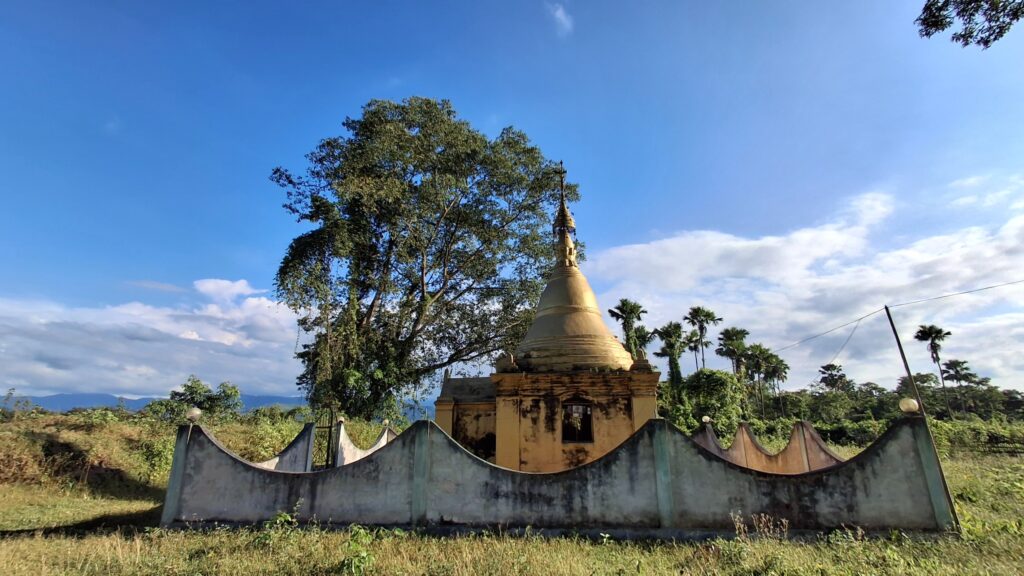
The Theravāda Buddhist tradition of eastern Assam and Arunachal Pradesh—among the Tai, Singpho, and Tikhak peoples—was introduced by itinerant Burmese monks in the 1880s, beginning with Ashin Narindabhidhaja (1847–1906), popularly known as Payen Dwin Sayadaw (ပယင်း တွင်း ဆရာတော်). When the Kingdom of Burma fell to the British in 1885 and Buddhist kingship was lost, Burmese monks responded by intensifying their missionary activities. They viewed the Patkai Hills and the regions beyond, such as eastern Assam, as mountain frontiers of the Buddhist Burmese world, much as British and Indian rulers saw the Northeast as a frontier of their own.
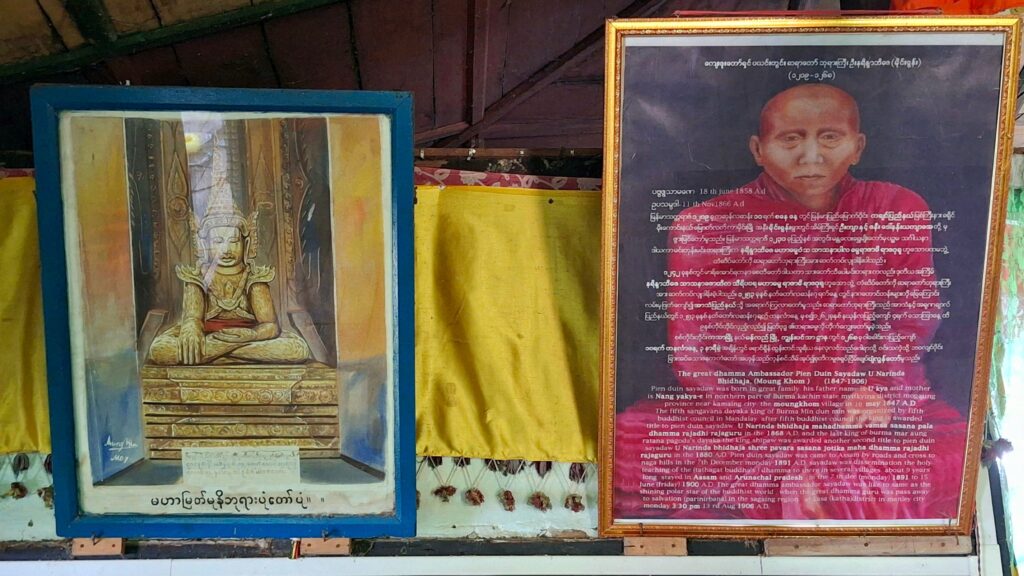
Known as taungtan sasanapyu (တောင်တန်းသာသနာပြု, “mountain missionaries”), the first of these roving Burmese monks to make a notable impact was Payen Dwin Sayadaw, an influential figure from Mogaung—a town itself on the periphery of the Burmese royal court at Mandalay.
The various trans-Patkai communities—Tai, Singpho, and Tikhak—were receptive to these Burmese monks, though their religious systems have continued to retain significant elements of their pre-Buddhist, animistic past. For centuries, monks, traders, and travelers from Upper Assam maintained regular contact with their counterparts in Burma through the Patkai passes. Singpho traders, Naga hunters, and Khamti elephant catchers crossed the border with ease, their movements reflecting a region defined more by shared culture than by political boundaries.
This association with Burmese Buddhism opened new pathways across the Patkai—routes that remained active until the passport regimes of modern India and Myanmar came into force. So close were these links that Tai monks from Assam even became entangled in Shan nationalist politics in Upper Burma. Amya Khang Gohain, in The Tai Buddhist Communities of Assam (p. 147), writes:
“This writer remembers a group of six Phake Buddhist sramaneras who went to Burma in 1936, of whom two lost their lives during the Japanese invasion of Burma in 1942 AD; two became Bhikkhus and remained in Burma; and two returned home to Namphake—one prior to the Japanese invasion in 1941, and the second later in 1951–52. Both were tattooed as per Tai (Shan) custom there. The second one was named Ngo Sakhu [Chaokhu]. He was called Lu-pii-Thapii, ‘immune to cutting and shooting.’ He demonstrated his invulnerability to the sword. He served as a soldier with the Shan Nationalist Army but left after the Japanese defeat and returned home. He has since passed away.”
The trans-Patkai exchanges continue even today, albeit often in a clandestine manner. While the movement of people is now restricted by the border regimes of the nation-state, the flow of ritual and secular objects continues. Most of the Buddha statues and other ritual paraphernalia used in the monasteries of Assam come from Burma through the Patkai passes. At times, the movement of objects creates openings for people to move as well, revealing how porous the borders still are.
A few years ago, as a large Buddha statue was being transferred to the Khamtis in Arunachal Pradesh, a Burmese woman of shared ethnicity crossed the border with it—an “illegal” passage that ended with her deportation. While her crossing into India was illegal in the eyes of the modern Indian state that had demarcated what was once a shared world, for her, it was simply following in the footsteps of her ancestors—a trans-Patkai movement that once felt entirely normal and part of everyday life.
The most important ritual text in the Theravāda Buddhist communities of Assam, the Kammavācā, is Burmese in origin. As crossings through the Patkai have grown more difficult and the circulation of knowledge in Burmese has diminished, Burmese literacy has declined. In many monasteries today, the original Burmese Kammavācā manuscripts are treated as potent ritual objects, while a version rendered in Assamese script by the late Sāsanavaṃsa Mahātherā (1926–2023) is read aloud during ceremonies.
Assamese, the easternmost Indo-Aryan language, has a considerably larger number of words borrowed from Tibeto-Burman languages, including Burmese, than is generally acknowledged. The Assamese word madoi (মাদৈ), meaning “queen,” is most likely borrowed from the Burmese word médaw (မယ်တော်). The Myanmar-English Dictionary commissioned by the Myanmar Language Commission glosses médaw as “royal mother.”
Some Assamese dictionaries incorrectly connect madoi to the Sanskrit word maha without offering any linguistic explanation. This likely stems from the tendency among certain Assamese literati to draw a filial connection between Sanskrit and modern Assamese. Their imagination is so circumscribed by this framework that they often fail to recognize that, although Assamese is an Indo-Aryan language, it draws extensively from sources beyond the Indic or Sanskritic world.
An example of the recognition of Assamese linguistic registers beyond the Sanskritic sphere can be found in Karunadhar Barua’s early twentieth-century Assamese translation of Kālidāsa’s Meghadūta, a masterpiece of Sanskrit poetry. Barua preferred to use the word kareng—a Tai-origin term naturalized in Assamese—instead of the Sanskrit tatsama word prasāda to denote “palace.”
One can cite numerous such examples attesting to the unique position of Assamese—an Indo-Aryan language situated within a social and linguistic landscape densely populated by Tibeto-Burman languages.
Certain shared commodities transcend linguistic barriers and attest to the cultural and culinary proximity of the trans-Patkai worlds. One evening in 2018, when I was sitting with a few local Burmese men in a tea stall in a small town in Myanmar’s Sagaing region, I inquired whether I could buy betel nut somewhere nearby. At that time, I didn’t speak Burmese, and they spoke little English. I used the different words for betel nut that I knew, such as tamul and kwai. One of the men recognized the word tamul because he had lived in Lahe, a town in Burma’s Naga Self-Administered Zone (SAZ), where he had picked it up from some Nagas who use the same word in Nagamese. Interestingly, betel plays as significant a role in Burma as it does in Assam—from dispute resolution to use in various ceremonies.
What made me reflect on my travels and interactions on both sides of the Patkai was a recent experience during a series of Indology and South Asia lectures at Oxford. While the whole series—focused on regional histories, geographies, and cultures of India—did not venture beyond Bengal, a prominent Indologist, speaking about the one-horned rhinoceros, pointed to a “blank spot” on an eighteenth-century map of India and remarked that the pachyderm’s endemic area is “somewhere in Bengal, perhaps near Chittagong.”
It’s worth pondering how much of “South Asia” we really are.
Bikash K Bhattacharya is a graduate student in the Faculty of Asian and Middle Eastern Studies (AMES) at the University of Oxford.



[…] Also Read: Speaking Burmese in Assam: Notes from the Trans-Patkai Borderlands […]
[…] Also Read: Speaking Burmese in Assam: Notes from the Trans-Patkai Borderlands […]