Discourses From the East
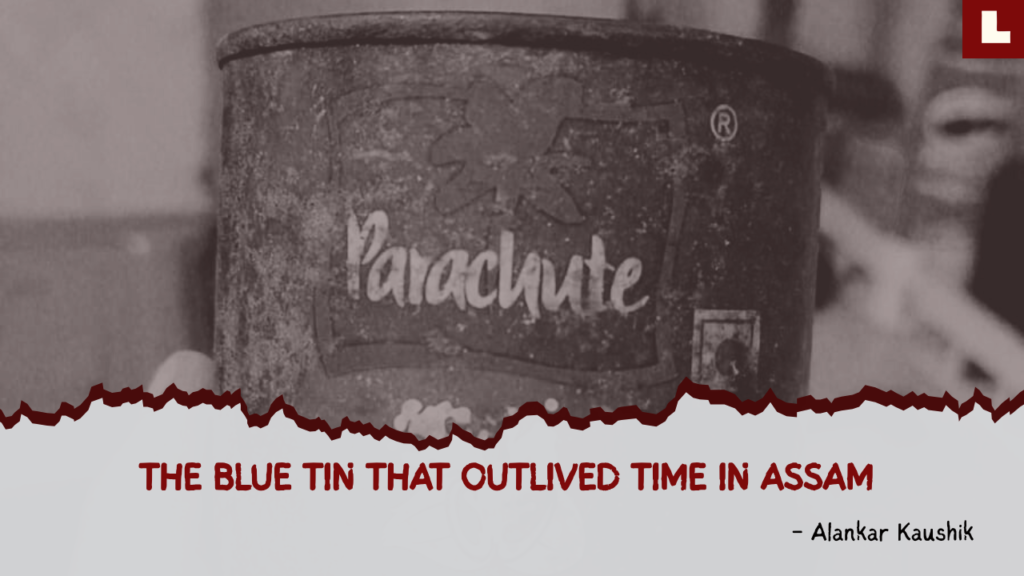

Ask anyone from Assam, and they will smile when they see that familiar blue tin. It evokes not just kitchens and meals, but an entire philosophy of using, reusing, and remembering. It stands as a quiet witness to the Assamese way of life, one that values simplicity, durability, and connection. Within its small circular frame, it holds the fragrance of home, the smell of steamed rice, coconut oil, and the warmth of hands that never let go of what still has purpose.
In almost every Assamese household, tucked quietly in a kitchen corner or sitting on a verandah shelf, rests a humble relic, the blue Parachute tin dabba, in local parlance they call it tema. Once filled with the sweet scent of coconut oil, it has long emptied itself of that purpose, yet found a second life far more meaningful. Some now cradle rice, some guard mustard seeds, others hold the soft white powder of washing soda. Weathered and dented, this blue tin is not just a container; it is a chapter from our collective memory.
The Parachute tin’s journey into Assamese homes began decades ago, carried on the waves of India’s consumer evolution. The brand itself dates back to the 1970s after Harsh Mariwala joined his family’s business. In 1990, it became the flagship product of Marico Limited, a newly formed Indian company that soon grew into one of the country’s most trusted names in hair care. But before it became a plastic bottle on a supermarket shelf, Parachute was a blue metal tin strong, practical, and meant to last. In Assam, that tin became more than packaging; it became part of life itself.
In the 1980s and 90s, Parachute coconut oil arrived as a small luxury amid everyday simplicity. Its sturdy tin gleamed in blue, promising purity “100% coconut oil,” it declared. In the smoky, cool kitchens of Assam, where rice simmered in blackened iron pots and the air smelled faintly of firewood, the blue tin quickly found its place. It sat beside earthen jars of fermented bamboo shoot, glass bottles of homemade pickles, and brass containers of salt and turmeric. The tin represented a quiet meeting of worlds, a symbol of modernity merging with tradition, an industrial product that somehow became utterly local.
When the oil was gone, the tin stayed. And that’s where Assamese ingenuity took over. It became the bhaat-or tema (the rice holder). Every home had one. The sound of its lid being tapped open sounds like tok tok tok was as familiar as the clinking of ladles against pots. It held the first scoop of new rice after the harvest, the precious sali or ahu rice grains brought home from the fields.
Rice (bhaat) in Assam is not just food; it is the measure of life itself. A house without rice is an empty one. Festivals begin with it, marriages are blessed with it, and even in grief, rice offers quiet solace. To understand the blue tema is to understand the Assamese household, its thrift, tenderness, and continuity.
In Assam, nothing is ever discarded too quickly. Every object earns its second life. Tin boxes become storage tins; glass jars preserve pickles or dry fish; old sarees turn into quilts stitched with affection. The Parachute tin, with its faded palm-tree logo and rust along the rim, became more than a remnant of consumerism , it became memory cast in metal. It tells stories of mothers warming coconut oil for their children’s hair before school, of grandmothers who saved every tin “for later use,” of homes that believed beauty lies in utility.
Long before “recycling” became a global slogan, Assamese households practiced it instinctively. A broken mug found life as a flowerpot, a plastic jar became a seed holder, and the blue Parachute tin stood as a symbol of endurance. Its continued presence in homes is not just about habit; it’s about a worldview, one that resists waste, honours the old, and finds meaning in the everyday.
The history of this tin also mirrors the story of changing India. The early Parachute tins were made of solid metal, built to endure. But as the economy liberalised in the 1990s, metal slowly gave way to plastic. Lighter, cheaper, and disposable. For many, it marked progress; for others, it signalled a quiet loss. Yet, the old blue tins refused to fade away. Like the elders of the house, they stayed on bearing dents, rust, and the mark of years. Their survival was a kind of defiance against forgetfulness.
In many Assamese homes, the tin travelled through generations, from the smoky kitchen of a wooden stilt house to a tiled urban flat. It carried rice to the paddy fields during harvests, measured grain during Bohag Bihu in the month of April every year, and sometimes sat beside the chulha (hearth), its lid blackened by soot. The tin absorbed time itself, the rhythm of seasons, the rituals of food, the warmth of families gathered around a meal.
Today, in a world obsessed with sleek packaging and fast consumption, the old Parachute tin stands quietly dignified. It doesn’t glitter; it doesn’t shout. It simply endures. It is, in a way, an accidental heirloom, a reminder of a slower, steadier Assam that knew how to hold on.
Even in urban apartments, far from the open paddy fields, one can still find a Parachute tin tucked away, perhaps holding rice, coins, or bits of household memory. For those who have moved away from home, the sight of that faded blue evokes something visceral: the hum of a mother’s kitchen, the aroma of fresh rice, the sound of rain against tin roofs.
The tin’s endurance also speaks of a culture that values the practical and the poetic in equal measure. For Assamese families, reusing is not an economic compulsion; it is an act of care. Every reused tin or bottle holds the invisible touch of hands that refused to waste, refused to forget.
The Parachute company itself has transformed with time from a family-run venture into a multinational brand exporting to over 25 countries. Yet, in Assam, its legacy is not in market reports but in memory. It exists not in the plastic bottles of supermarket aisles, but in the old blue tins resting on wooden shelves, holding grains and stories.
Somewhere today, in a kitchen in Jorhat or Lakhimpur district of Assam, a hand still opens that old blue tema (holder/dabba) to take out a scoop of rice. The familiar tok tok tok echoes across generations. Steam rises from the pot; the family gathers. Outside, the paddy fields stretch golden under the afternoon sun. Inside, under the soft kitchen light, the tin gleams faintly, like a relic that has refused to die. In that blue tin lives an entire philosophy of thrift and tenderness, of rice and remembrance, of a home that endures through its smallest things. It reminds us that time may move on, brands may change, and markets may modernise, but the essence of a home, its warmth, its memory, its quiet resilience remains timeless.