Discourses From the East
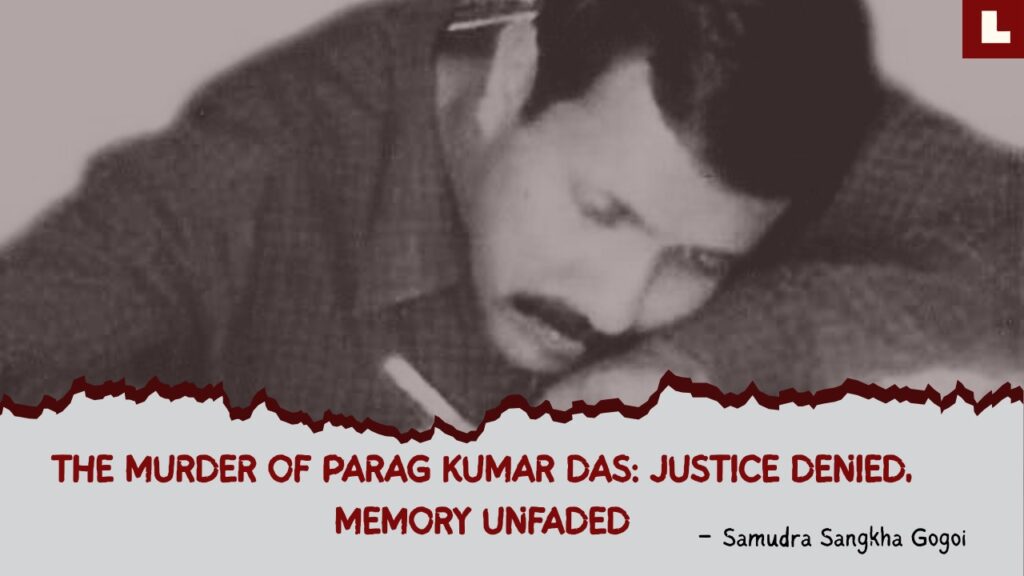

Parag Kumar Das was more than a journalist. He was a public intellectual who dared to articulate what most people in Assam only whispered in fear. His assassination on May 17, 1996, in broad daylight while he was picking up his son from school, was one of the darkest moments in Assam’s contemporary political history. For many, his death symbolized not only the silencing of a dissenting voice but also the tightening grip of impunity and intimidation that marked the state’s political climate in the 1990s.
Nearly three decades later, the questions surrounding his killing and the state’s failure to deliver justice remain as relevant as ever. To understand why, we must revisit the life, context, and contradictions that defined Parag’s struggle.
The Making of a Rebel Journalist
An alumnus of St. Stephen’s College and the Delhi School of Economics, Parag began his professional life in the Stock Exchange Department in Guwahati. But his calling was elsewhere. Through his weekly Budhbar and later as Executive Editor of Asomiya Pratidin, Parag wielded his pen as an instrument of dissent. He also served as General Secretary of the Manab Adhikar Sangram Samiti (MASS), highlighting human rights violations in a state marred by militancy and militarization.
Manorom Gogoi, in Reminiscences of Parag Kumar Das, captured his uncompromising spirit, a journalist who refused to dilute the truth, no matter the consequences. In a time when many remained silent, Parag Das’s words challenged the political elite, exposed excesses of security forces, and questioned the co-option of surrendered militants into state structures.
Also Read: Not Yours to Wear, Not Yours to Mourn
Assam in Turmoil: The 1990s and the Politics of Fear
To understand Parag Das’s death, one must situate it within Assam’s fraught political landscape. The 1979 Assam Movement, initially a popular upsurge against illegal immigration, had birthed both hope and disillusionment. While the 1985 Assam Accord promised a way forward, its implementation faltered. The United Liberation Front of Asom (ULFA) emerged that same year, channelling Assamese aspirations into an armed struggle for sovereignty.
By the early 1990s, ULFA had lost its ideological mooring. What began as a people’s movement turned into a violent insurgency. The government’s response, in turn, grew more repressive. Army operations intensified, and thousands were detained, tortured, or disappeared. The surrender of a section of ULFA cadres, later known as SULFA, was promoted as a peace measure but effectively transformed them into an armed adjunct of the state.
Parag Das’s writings cut through this haze of violence and propaganda. He sympathized with the ideological core of ULFA’s demand for dignity and self-determination but rejected its resort to terror and violence. Likewise, he was equally scathing in his criticism of state excesses, the arbitrary arrests, fake encounters, and the sinister phenomenon of “secret killings” that targeted family members of militants and sympathizers.
Mrinal Talukdar’s book Secret Killings of Assam and subsequent testimonies revealed the systematic collusion between the police, SULFA cadres, and political leadership during this period. Parag Das’s columns in Asomiya Pratidin consistently denounced this state-sponsored terror, making him a marked man in the eyes of both the establishment and surrendered militants.
Also Read: Justice for Zubeen: When BJP Takes to the Streets Against Itself
The Day the Pen Was Silenced
On May 17, 1996, at around 2:45 p.m., Parag Kumar Das was shot dead in front of the Asom Jatiya Vidyalaya in Guwahati. He had just picked up his young son, who was also injured in the attack. The murder shocked Assam. For days, the state came to a standstill, protests, strikes, and memorials erupted across towns and villages. People who had never met Parag Das felt a personal loss, as if a collective voice had been abruptly muted.
Under public pressure, Chief Minister Prafulla Kumar Mahanta, himself a product of the Assam Movement, promised to catch the culprits within 48 hours. The police named surrendered ULFA members as suspects, but no real progress followed. The case was soon transferred to the Central Bureau of Investigation (CBI), a move that initially inspired hope but later came to symbolize bureaucratic lethargy and institutional indifference.
A Trial of Delays and Disappearances
The CBI took over the case in 1997 but did not submit its chargesheet until 2001. It named four surrendered ULFA members: Tapan Dutta (alias Biswajit Saikia), Diganta Baruah, Mridul Phukan, and Nayan Das. By then, two were already dead, and one was lynched by a mob. Only Mridul Phukan faced trial.
In 2009, thirteen years after the murder, the District and Sessions Court acquitted Mridul Phukan for lack of evidence. The court criticized the CBI for its “shoddy investigation” and noted glaring procedural lapses: delayed submissions, inconsistent witness testimonies, and mishandled evidence. The agency’s own charge sheet had established motive and connection, yet crucial forensic and eyewitness links were missing.
Parag Das’ brother, Pallab Das, filed a petition in the Gauhati High Court seeking reconsideration of the trial. The petition alleged bias, intimidation of witnesses, and foul play by both the Assam police and the CBI. The High Court, however, upheld the lower court’s verdict in 2012, stating that “a retrial is not possible after a judgment has been passed.” It added, somewhat paradoxically, that “justice though being avowed objective, it cannot be vied for in supersession of law.”
The statement revealed the deep irony of India’s criminal justice system, its commitment to procedure often outpaces its commitment to justice.
Also Read: Liberty and Law in Assam: Fear, Dissent, and the Fragile Balance of Democracy
Anatomy of a Failed Investigation
Multiple layers of failure defined the Parag Kumar Das trial. First, the witnesses were left vulnerable. No protection was offered despite threats. Several witnesses later recanted or hesitated to testify out of fear. The state, having handed over the investigation to the CBI, abdicated its moral responsibility to ensure a safe environment for truth to emerge.
Second, the inordinate delay itself eroded the case. The CBI’s slowness, nearly five years to file a charge sheet, was never adequately explained. During this time, key evidence vanished, suspects died, and memories faded. The trial proceedings dragged on for another eight years, marked by frequent adjournments and lack of prosecutorial urgency.
Third, the public prosecutor’s role came under scrutiny. In 2006, Parag’s family petitioned for a special prosecutor, citing the incumbent’s indifference and poor cross-examination of witnesses. The request was ignored. In the end, the case was technically complete but substantively hollow.
The case exemplified systemic failure at every level. Witnesses received no protection despite threats. The CBI’s charge sheet came 12 years after the murder. Crucial testimonies were ignored. And procedural loopholes, anticipatory bails, delayed submissions, missing judges, ensured that the trial moved at a glacial pace.
When the State Speaks Through Silence
The verdict was not merely a judicial outcome; it was a political signal. It reinforced what many human rights activists had long feared that the state could tolerate, even orchestrate, the elimination of dissenters under the guise of counterinsurgency. Parag’s killing was not an isolated event but part of a pattern where journalists, lawyers, and activists challenging state narratives were systematically silenced. Arunabh Saikia in his article, In Assam, families of 32 slain journalists await justice – and closure, captures some of the stories of those families. To add to that, India is ranked 159 out of the 180 nations considered in the 2024 edition of the press freedom index, published by the organisation Reporters Without Borders.
Scholars such as Jeffrey Sluka and Arthur D. Brenner have analysed how modern states, while claiming monopoly over legitimate violence, often delegate it informally to paramilitary groups or “death squads.” In Assam, the SULFA phenomenon represented precisely this dynamic, a convenient outsourcing of coercion that allowed the state to deny direct involvement while reaping the benefits of repression.
As Brenner wrote in his essay “Feme Murder: Paramilitary ‘Self-Justice’ in Weimar Germany”, the horizontal dispersion of state power enables plausible deniability. In Assam, this structural ambiguity gave rise to a culture of impunity, where violence was not an aberration but a mechanism of governance.
Also Read: Unburying Nellie: What the Tiwari Report Means for Assam’s Unhealed Wounds
The Moral Afterlife of Parag Kumar Das
While the courts failed to convict his killers, Parag Das’ moral victory endures. His writings continue to sell briskly in book fairs across Assam, drawing readers who were not even born when he was killed. His essays on democracy, ethnicity, and state power are cited in academic research and reprinted in journals. University students and young activists often recall him as the face of ethical journalism in Assam.
Parag Das enduring relevance lies in his refusal to conform. He believed that journalism was not about neutrality but about moral clarity. “To write,” he once said, “is to take a side.” In that sense, his pen was revolutionary not in the militant sense, but as an act of resistance against erasure.
Today, when independent journalism faces renewed threats, Parag Das’ story serves as both a cautionary tale and a source of courage. It reminds us that truth-telling has always been a dangerous profession in regions caught between state violence and insurgent retaliation.
Lessons and the Enduring Legacies
The murder of Parag Kumar Das represents a microcosm of India’s broader struggles with justice, accountability, and state violence. It exposes how the legal system often collapses under political pressure, how institutions meant to uphold the law become complicit in its subversion, and how memory becomes the last refuge when justice fails.
Nearly three decades later, Parag Das words continue to resonate. His collected works remain bestsellers in Assam’s book fairs. Younger generations, many born after his death, read him to understand a time when journalism in the Northeast meant courage under siege. His legacy endures not in legal archives, but in the collective memory of a society that still grapples with the meaning of justice.
Parag Kumar Das’s life and death remind us that truth, even when silenced, finds its way into history. The state may have failed him, but his pen continues to bear witness. For every year that passes without closure, His absence becomes more present, a haunting reminder of what it means to live in a democracy that cannot protect its truth-tellers.
As Assam continues to navigate questions of identity, autonomy, and state power, the spirit of Parag Kumar Das remains a touchstone. His pen, once silenced, continues to write through the words of those who still dare to question, still dare to remember, and still dare to hope that justice, though delayed, is never entirely denied.
Also Read: অসমৰ “মামা” ৰাজনীতি: মৰমৰ নামত নিয়ন্ত্ৰণ