Discourses From the East
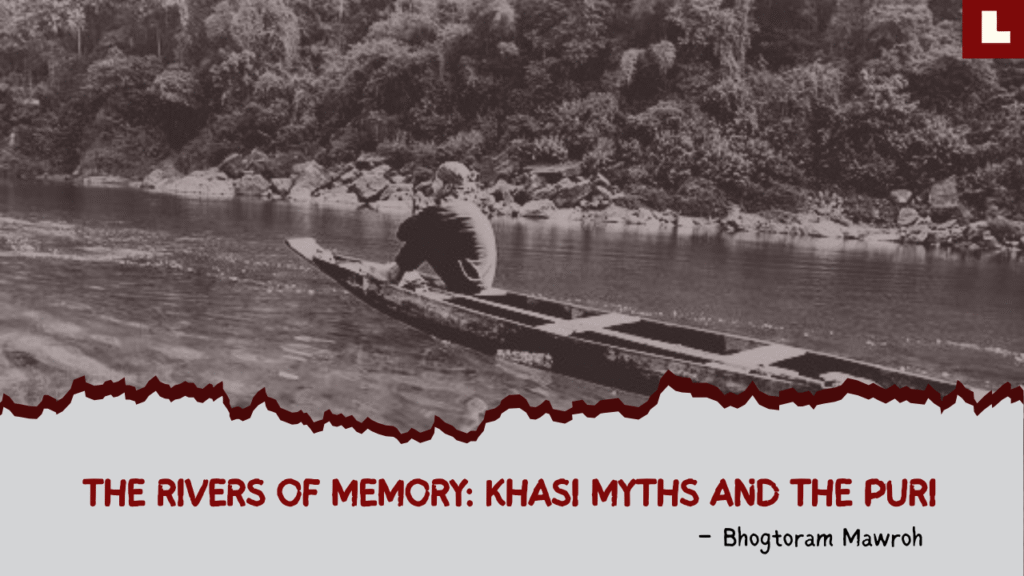

The Khasis, like many indigenous communities around the world, have imbued their landscape with stories and the presence of mythical creatures. Some are benevolent, while others can bring great harm if their domain is intruded upon. These stories are a way for the indigenous people to assert their belonging to the land in the absence of maps or documents—a connection that goes back thousands of years. Some of these stories have been verified through recent archaeological discoveries—for example, the 4,000-year-old sites in Lum Sohpetbneng and Myrkhan—while stories connected to some of the mythical creatures can be understood as attempts by the Khasis to ascribe a divine origin to the founding of the early states on the Meghalaya Plateau, especially Hima Shillong and Hima Sutnga, two of the most powerful and earliest Khasi kingdoms. It is believed that these two kingdoms were founded by mythical women who married mortal men, one of them being a Puri.
Recently, Sonal Jain, a highly acclaimed artist and author based in Shillong, gifted me her book Puri. The book, which was the outcome of a project supported by Heinrich Böll Stiftung and took over four years to complete—interrupted by the pandemic—has as its setting the landscape around Lum Shyllong. On a splash page, there is a map of the nine mythical springs that emerge from it, revealing the beginning of their journey. As they flow downstream, they are joined by smaller streams like Umliew, transforming them into great rivers such as the Umngot and the Umiam. Not long ago, as I was cycling towards Nongjrong village (famous for its viewpoint), I saw how the confluence of these streams created the mesmerizingly beautiful Umngot Valley, which further downstream gives rise to the crystal-clear waters that flow through Shnongpdeng village, attracting tourists from all over the world. It is along these rivers and streams that the Puri, or water nymphs, resides—and they are the focus of Sonal’s work. I remember my mother telling us stories about the Puri and other mythical creatures in the past, which included the Boit, Kshuid Tynjang, and many more. In fact, the house in which I grew up stood along the bank of Wah Umkhrah, which also originates from Um Demthring (one of the nine mythical springs) in Lum Shyllong.
For long-time residents of Shillong, Wah Umkhrah holds a special connection. It has been mentioned in many literary works, including the 2017 book by Esther Syiem, a highly accomplished scholar and retired Professor of English at North-Eastern Hill University, Memoir in Water: Speaks the Wah Umkhrah. In an interview with Jobet Warjri, a respected writer and scholar, while talking about the book, she reminisced that the water body in the past “had beauty and power and the ability to make itself heard through its raging waters or clear translucence in autumn or winter.” In his famous poem “Sundori” from The Yearning of Seeds (2011), Kynpham Sing Nongkynrih, the most celebrated modern Khasi writer, also mentions the river. Recently, at a workshop, I listened to Desmond Kharmawphlang, a well-known folklorist, talk about the river and recite a poem. Wah Umkhrah has powerfully impacted everyone who lived around it, finding mention in their creative works. And its transformation—from a pristine river to a drain—has likewise deeply affected them. Staying along its bank, I witnessed the entire transformation.
When I was young, going to Wah Umkhrah (known as Umkaliar in our section) to wash clothes and bathe was a regular weekend affair. There were a couple of waterfalls, including the Spread Eagle Falls, close to which were deep pools where the most adventurous among us would go diving. I preferred shallow water where I could submerge myself without drowning. On the other side of the river, there was a path that led to Nongrim Hills, which I used to take on my way to college. However, during the pre-monsoon and monsoon months, the river would transform into a torrential swell carrying mud and debris while giving off a frightful roar that could be heard from far away. We avoided going to the river during this time.
But when the river was gentle, it was full of people washing, swimming, and picnicking. Some would catch fish using fishing rods, while others used a khoh (conical basket). People would walk along the edge of the water and thrust the khoh into the sand. Then they would lift the basket out of the water and inspect it for dohthli. Sometimes, the catch also included crabs. But I never saw people catching frogs for food—or perhaps I simply missed it. Along its banks were many fruit trees, especially Sohpyriam (guava). The trees belonged to people staying on the other side of the river. My friends and I would throw stones at them to bring the fruit down. When some fell into the water below, we would rush to collect them and escape before the owners found out. Fruits were not the only things we would steal.
There was also a bamboo grove planted as a fence along the bank. Whenever we needed stumps for our cricket matches, we would cut some with a wait (Khasi machete). During winter, we would cut down long bamboo poles to make small bamboo houses to be burned later. This was part of the Nepali festival called Mera Meri, and once, I even made my own bamboo house and stayed in it for the night. Our house was one of the first in the area, which was then mostly farmland where farmers grew radishes and sweet potatoes. Just before harvest, we would steal sweet potatoes from the field and eat them with our friends. Come to think of it, we did a lot of stealing back in those days.
This was a time when the river was very clean, and dragonflies darting around in search of prey were a common sight. The image of dragonflies stayed with me for a long time, and I was truly saddened when they were gone. In time, the fireflies we once caught in the fading light of dusk disappeared as well. Their disappearance began when the river started becoming dirty.
It all started with the establishment of a small abattoir near the riverbank, close to where I lived. Every day, I would see a cow being killed and drained of its blood, which, along with other waste, would flow into a nearby stream that joined Wah Umkhrah. Initially, there was no discernible impact on the river. But slowly, changes began to unfold.
The first sign of the river becoming dirty was the appearance of red worms swimming in the water. The fish had already disappeared. Then plastic, discarded clothes, and all kinds of debris started appearing, clogging the flow of water. Slimy brown moss began to grow on the rocks we had previously used for crossing the stream. Downstream, the pool once used for diving was now awash with floating plastic and garbage. It had become so dirty that I was hesitant even to let my feet touch the water, which had once been full of shimmering pebbles. The once-beautiful Wah Umkhrah had become a nullah.
Sonal Jain expertly presents the transformation of our water bodies in her book, displaying pictures of pristine forest streams, millennia-old caves, and the pollution that is slowly destroying many of them. One of the caves featured in the book is from Mawmluh, which has many caves, including the one that led to the discovery of a global climate shift 4,000 years ago—an event that defines the latest age in the geological time scale, known as the Meghalayan Age. Caves also feature in the stories told in the book, including one where a protagonist, rejected by both the human and spirit worlds, sits at the entrance of a cave where he meets his Puri. The book itself feels melancholic and grounded, giving a very earthly vibe as you turn its pages. Since the book is about the Puri, it contains many stories about people being possessed by them—encounters that turn out to be both a blessing and a curse.
It always begins with a Puri falling in love with a human, who then falls violently ill. The person carries the mark of this encounter throughout their life, which may give rise to the impression that the price of being loved is a curse. However, the person also gains abilities such as healing and clairvoyance, which they use to help others. The story of the well-known sculptor and painter Raphael Warjri’s great-granduncle, who was enchanted by a Puri, is especially fascinating and worthy of a feature film. In fact, the book contains shots that are going to be part of a feature film in the future.
The book reveals many things I did not know about the Puris. For example, I always thought that Puris were only women, but the book also contains stories of women being possessed by male Puris, who then asked them to marry. Similarly, the story of Thlen (a mythical serpent that requires human sacrifice) gives the impression that these stories are deeply connected to the Khasis. Yet in one of the stories, it was a visit to a Pir Baba that finally ended the trance into which those possessed had fallen. Such cross-cultural elements hint that these stories, though they arose among the Khasis, were never isolated or confined to them alone. A good example of this is the adaptation of the story of Woh Ryndi, who married a Puri whose progeny founded Hima Sutnga, by the Brahmins of the Hindu kingdom of Jaintiapur. After the War Awmi (linguistically the oldest group among the Khasis) from Hima Sutnga captured the kingdom and created Hima Jaintiapur—combining both the uplands and the newly conquered plains—the story was modified to incorporate Hindu elements, giving rise to the myth of the goddess Jayantia Devi founding the kingdom. This was a familiar tactic used by Brahmins to incorporate indigenous cultures into the Hindu fold, something seen not only in South Asia but also across Southeast Asia.
Perhaps the most important contribution of this book, however, is the insight it offers into the cosmogony of the Khasis—how they viewed their place in the universe. There is a very clear message being conveyed: the need to reconnect with nature and recognize the value of environmental stewardship. The Puris can only live in clean water bodies. Naturally, as Wah Umkhrah began losing its unspoiled character, the stories also disappeared. When I was young, near our house, there was a small shyngiar (spring) used for collecting water. It dried out as soon as houses began being built in the area. I remember being told to stay away from it at night because of a spirit said to dwell there. It was not a Puri but a malevolent one. As soon as the shyngiar disappeared, so did the fear, and we started playing football and cricket around it. With it, the mystery was gone.
Sonal’s book is a timely reminder that it is the stories that give identity to our community. These are not just folk tales about magical beings told as bedtime stories. No—they carry the imprint of our history and shape the way we view the world around us. It’s what makes a Khasi a Khasi. When we lose them, we lose a part of our identity. And in reviving them, we acknowledge who we are—a people of long history and rich traditions.
Let’s bring them back.
Let’s bring back our rivers.
Let’s bring back Wah Umkhrah.
Let’s bring back the Puri.
Let’s bring back our stories.