Discourses From the East

Star Trek, the science fiction world that began on American television in 1966, imagines a future where Earth is one among many equal worlds in the United Federation of Planets. It is a cooperative experiment in survival, not conquest, colonization, or extraction. For nearly sixty years the series has changed faces and settings, but one belief stays the same: curiosity and decency carry a species forward.
On a quiet outpost in that imagined future, a man keeps a flag folded. He is the last Starfleet liaison of a vanished Federation, a title that now means tending to dust and listening to the hollow hiss of dead subspace channels. His daily ritual is not exploration, but maintenance: running diagnostics on crumbling systems, logging non-existent traffic, and transmitting a standard greeting into an indifferent static. “If there is even a chance the Federation still exists,” he says to the silence, a soft incantation against despair, “I have to keep trying.”
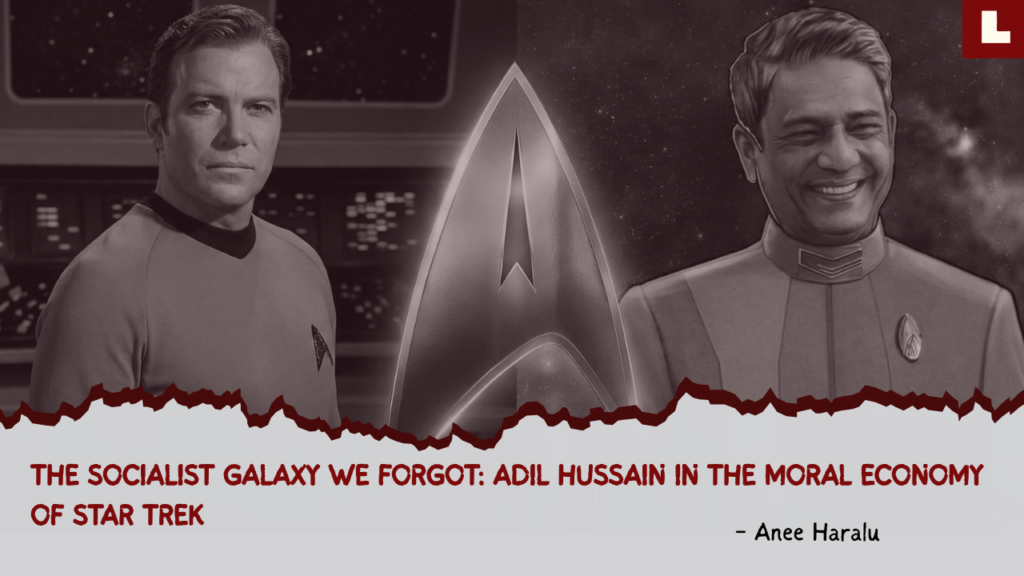
That man is Aditya Sahil, played by Adil Hussain in Star Trek: Discovery (2020). For viewers familiar with Hussain’s calm, deliberate presence, it was quietly moving to see him appear in this old utopia. His role is small but unforgettable, a solitary believer holding on after the system has fallen apart. When Michael Burnham, played by Sonequa Martin-Green, arrives almost a thousand years in the future, in the 32nd century, she does not find a hero or a rebel. She finds a clerk. The Federation has faded into legend. Starfleet is only a memory. Sahil is its archivist, praying over its ghost.
He has been the custodian of an empty office for forty years. His vigil is not one of dramatic suffering, but of bureaucratic fidelity. He opens the station at the appointed hour, polishes the console, and waits for a visitor who never comes. When Burnham finally stumbles through his door, the first living Federation officer he has ever seen, his pent-up faith does not erupt in joy, but spills out as a quiet, devastating testimony: “I watched this office every day, as I have for 40 years, believing one day, others like me would walk through that door; that my hope was not in vain. Today is that day. And that hope is you, Commander Burnham.” The line lands not as melodrama, but as the earned dividend of a lifetime’s emotional investment.
Sahil’s story is deceptively simple. His grandfather had served as a commissioned officer in Starfleet, making his fidelity a familial inheritance. Sahil could not join because no senior officer remained to swear him in; the institution had vanished, leaving behind only its rules. His was a faith without a church, a devotion to a sacrament that could no longer be performed. When Burnham appears, she is not a savior, but a function, the missing component required to complete a circuit of belief he has kept live for decades. He asks her not for rescue, but for protocol: to commission him, to make official the service he has already rendered. When the flag rises, it is not a victory, but a validation. It restores meaning to an oath that never died, performed in a ritual that finally has a witness.
There was something crushingly familiar in that moment. Sahil’s lonely watch did not feel like science fiction at all. It felt closer to home, to the kind of patience found in teachers with broken chalkboards, nurses in understocked clinics, and keepers of archives no one visits, people who rebuild without reward and tend to broken systems because someone must. I first watched this during the long lockdown months, and something in his voice, quiet but steady, resonated deeply. The way he held the flag as if it were a living thing mirrored those who keep working long after certainty is gone. His forty-year vigil, his declaration that “that hope is you,” this is the Federation’s creed stripped of starships and starbases, reduced to its barest, most human essence: one person waiting for another, believing that a shared idea demands a shared presence, and that presence alone can re-enchant a hollow world. The Federation, for all its stars, does not ultimately run on dilithium, the fictional crystal that powers its starships, or diplomacy. It runs on that same stubborn, mundane, and indispensable hope.
The Custodian of the Dream
Since its first broadcast, Star Trek has pictured a civilization that left capitalism behind. There is no money, no hunger, no private factories chasing profit. People work out of curiosity and duty, not desperation. The stories are not about wealth. They are about cooperation and the effort of living well together.
By any reasonable measure, that is socialism, or something close enough that the name hardly matters.
People have argued for years about what to call this world. Some fans say it is “post scarcity” or “luxury communism”. Some writers, including those in Jacobin, see it as a straightforward socialist future. I think it is simpler. What matters is the labour, the daily moral work needed to keep such a society alive once greed and fear lose their force. Star Trek’s socialism is not a doctrine. It is a habit. It is a discipline people practice.
The Federation is the institutional form of that dream, a galactic alliance of equals. Its starships are not battleships. They are travelling communities of scientists, engineers, and diplomats. Captain Jean Luc Picard, commanding the Enterprise D in the 24th century, once said, “The acquisition of wealth is no longer the driving force in our lives. We work to better ourselves and the rest of humanity.” That line captures the ethic clearly. Labour is redirected from accumulation to growth.
Technology makes that ethic possible. Machines called replicators can produce almost anything from energy. When needs are freely met, property loses meaning. Competition fades. Power shifts to makers, not owners. Star Trek asks what happens when invention and decency finally pull in the same direction. It is not a perfect world, but it feels like one humanity could earn.
The Long Road to the Stars
This future did not arrive at once. The road was uneven. Before the Federation’s birth, Earth went through wars and learned, through first contact, to change or perish. The prequel series Star Trek: Enterprise, set in the 22nd century, tells that story. It follows Captain Jonathan Archer and humanity’s first deep space crew as they stumble through diplomacy, suspicion, and fragile alliances. The world they leave behind has not yet shed its fears. Xenophobia still lingers on Earth. The Federation’s birth is not a clean break from history but a slow unlearning of arrogance. Their voyages are clumsy but honest, less conquest than learning how to live with others.
At the end, Archer addresses the delegates who will soon form the Federation. He asks what they have really discovered and answers that the most important discoveries are within. Exploration, he says, begins with learning to see each other. That speech is the Federation’s moral beginning, exploration as solidarity and progress as self knowledge.
The 1960s Original Series unfolds in the 23rd century, when Earth’s reach for the stars feels confident and full of purpose. The Next Generation, Deep Space Nine, and Voyager, all set in the 24th century, show a more mature Federation facing its own contradictions. Discovery pushes that future into the 32nd century, where the dream has thinned to memory.
And it is there that Adil Hussain’s Aditya Sahil reappears, a single man tending the ruins of a socialist federation, believing in it long after the banners have faded. The story that began with hope ends in endurance.
The Discipline of Care
Star Trek did not imagine a humanity purged of its darker impulses. Instead, it quarantined them —into the Klingons’ culture of war, the Cardassians’ logic of empire, the Ferengi’s obsession with profit. These species became narrative vessels for the very forces the Federation claimed to have transcended: conquest, hierarchy, extraction. The Federation’s utopia was not built on human perfection, but on a sustained refusal to let those old impulses define its politics.
This is why the space ventures of today’s billionaires feel like a genre violation. Musk, Bezos, Branson, they have taken Star Trek’s aesthetic, the rockets and the rhetoric of frontier, and fused it not with the Federation’s ethos, but with the drives of its antagonists. Their rockets are not instruments of shared discovery but assets in a portfolio; their vision is not open exploration but enclosure extended into the cosmos. They are not building a Federation. They are resurrecting, with sleek technology, the very empires Star Trek’s writers had exiled to the margins of the galaxy.
The difference is not technological. It is moral. Star Trek’s universe runs on cooperation and curiosity. Ours runs on ownership and branding. Gene Roddenberry’s vision was not prophecy. It was faith, that humanity could mature as much as it could invent.
Watching those old series now feels almost radical. In an age of privatized exploration and shrinking welfare, the Federation’s quiet socialism reads less like fantasy and more like a memory we lost along the way.
And so we return to Adil Hussain’s small scene, the folded flag, the calm persistence. In it, the whole project of Star Trek comes into focus. Socialism here is not ideology. It is staying power. It is the daily act of keeping faith; and care, when you think about it, is a discipline too.
Maybe utopia was never a destination among the stars. Maybe it is a practice we forgot to keep alive here on Earth.