Discourses From the East
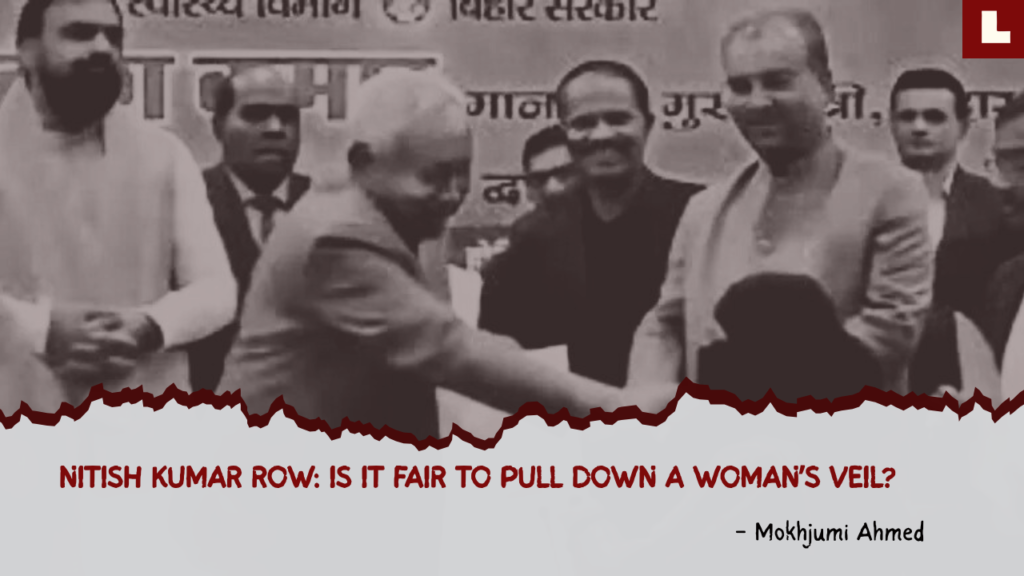
Recently, a video went viral in which Nitish Kumar, the Chief Minister of Bihar, is seen forcefully pulling down a Muslim woman’s hijab. The video is reportedly from an official event where appointment letters were being distributed to doctors. It has generated strong reactions across sections of society, with some criticizing the act and others supporting it, largely for political mileage. The opposition seeks to project the Bihar Chief Minister as Islamophobic, while his supporters attempt to gain political brownie points by flexing cultural chauvinism.
In both cases, what goes unnoticed is the woman. Both sides generalize the event by giving it a religious colour and harness group sentiments to play to the gallery. It has become commonplace to generalize individual acts in order to communalize them. After all, there is little more electorally rewarding than polarizing communities along religious lines. In such circumstances, the agency of the individual, in this case a woman, goes unheard. Throughout the row, her agency has been submerged in the cacophony of politics. While some are busy portraying Nitish Kumar as a religious fanatic or a Sanghi, others justify the act by claiming that India has no place for Islamic hijab, turning it into a taunt against religious identity.
In any case, religion and politics are at play. However, the central question is neither political nor religious. It is about individual agency. Has anyone asked the woman for her opinion? Has anyone considered the humiliation she may have felt? Has anyone reflected on whether the veil was imposed on her or chosen by her?
Nitish Kumar pulling down the veil must be seen through the lens of essential human dignity. As Chief Minister, he may believe that the veil is regressive, but he has no right to pull it down without the consent of the woman wearing it. A human being, irrespective of gender or religion, is free to wear what they choose, whether a veil, scarf, or stole. This freedom of agency must be respected, whether the Chief Minister approves of it or not. He has the right to generate awareness against the veil if he believes it to be wrong, or to campaign for freeing women from purdah. It is not his right to pull it down in public.
Giriraj Singh, a Union Minister from Bihar, commented on X: “If someone is going to collect an appointment letter, should they not show their face? Is this some Islamic country? Nitish Kumar acted as a guardian.”
Giriraj Singh’s argument lacks substance. The veil does not belong exclusively to Islam. Many religions and cultures practice veiling. Women in Rajasthan still observe purdah and they are Hindus. Christian nuns do the same. Although supported by religion, the veil is more a cultural practice than a strictly religious one. Giriraj Singh is also mistaken in his understanding of guardianship. While the Chief Minister is a guardian of the state, he is not a custodian of all women in it. No one elects a Chief Minister to touch a woman or pull her veil. He is elected to govern, not to regulate people’s lives, choices, or ways of life.
A secular state grants freedom to all religions. It does not curb religious practices arbitrarily. The state neither favours nor restricts religio-cultural practices unless they are morally degrading. In this case, no morality was harmed. The woman followed her own dress code, which she is entitled to do. No government has the right to dictate what one wears, eats, or practices unless the rule of law is violated or harm is caused.
Even if there had been a prescribed dress code for the event, the Chief Minister still could not have acted in this manner. At most, he could have refused to hand over the appointment letter. Under no circumstances does he have the right to touch a woman who has consciously veiled herself, whether for modesty or personal belief.
This incident raises a larger question about the direction in which society is heading. Chauvinism, in its ugliest form, erodes basic public decency. In the larger narrative of a supposed religious wrong, a woman was harmede harmed. By focusing excessively on one identity, another is often erased. While people shout about her Muslim identity and Nitish Kumar’s Hindu identity, the core issue is ignored: a woman’s dignity was violated by a man.
In a charged atmosphere of majority and minority politics, the most vulnerable often suffer the most. She is both a Muslim and a woman, and therefore doubly victimized. Chauvinistic politics works by ruthlessly trampling the powerless, whether defined by religion, language, caste, or economic position. Those who belong to more than one marginalized group are doubly oppressed. This is the very foundation of majoritarianism. It recalls Gayatri Spivak’s famous question: “Can the subaltern speak?”
The question is left to the readers to ponder.