Discourses From the East
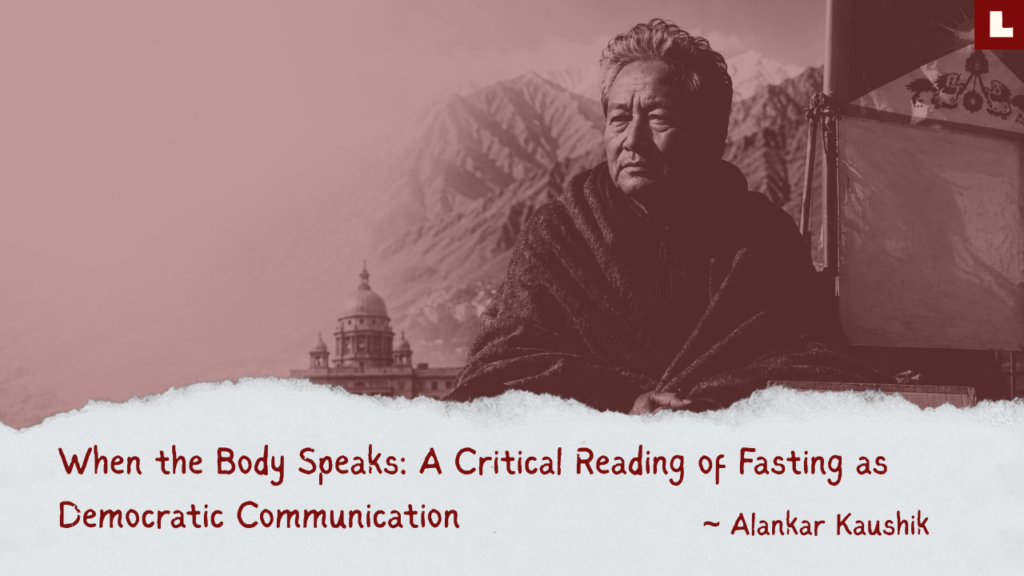

Democracy is often understood as a system built on communication. Citizens express their views, governments listen, institutions respond, and disagreements are addressed through dialogue rather than force. At least, this is how democracy is supposed to function. Yet history repeatedly shows that many voices remain unheard despite the existence of democratic institutions. It is in such moments that unusual forms of political expression emerge. One of the most powerful among them is fasting.
The recent fast undertaken by Sonam Wangchuk in Ladakh once again brought national attention to a form of protest that has a long history in democratic politics. From Mahatma Gandhi’s fasts during India’s freedom struggle to Bobby Sands’ hunger strike in Northern Ireland, fasting has often been used when conventional channels of communication appear ineffective. These acts are frequently celebrated as examples of moral courage and self-sacrifice. While such interpretations have merit, fasting deserves a more critical examination. It is not merely a personal act of sacrifice; it is a powerful form of political communication. At the same time, its effectiveness and ethical implications raise important questions about the health of democratic systems themselves.
The Body as a Medium of Communication
The Canadian media theorist Marshall McLuhan famously argued that “the medium is the message.” His insight becomes particularly relevant when we think about fasting as a political act. In most forms of protest, the medium is external to the protester. It may be a speech, a banner, a newspaper article, a television interview, or a social media post. In a hunger strike, however, the medium and the message become one. The protester’s own body becomes the site of communication.
As the body weakens, it sends a message that cannot easily be ignored. The gradual physical decline of the fasting individual becomes a visible argument. Governments may ignore petitions, dismiss speeches, or overlook public demonstrations. A fasting body, however, creates a moral and political challenge that is difficult to filter out. It demands attention in a way that ordinary communication often cannot.
In this sense, fasting is not a form of silence. Rather, it is an intensified form of speech. The body speaks when words fail to produce a response. Yet this is also where the ethical complexity of fasting begins. Its power does not come solely from rational persuasion. It derives much of its force from visible suffering. Observers are moved not only by arguments but also by the emotional impact of witnessing a person willingly endure pain. This does not make fasting illegitimate, but it reminds us that its effectiveness rests partly on moral pressure rather than on reasoned debate alone.
Democracy and the Limits of Being Heard
The German philosopher Jürgen Habermas argued that democratic legitimacy emerges through open and rational discussion among citizens. In theory, everyone should have an equal opportunity to participate in public debate and influence political decisions.
The hunger strike both supports and challenges this vision of democracy. On one hand, the fasting individual is still appealing to conscience rather than using violence. The protest remains within the realm of democratic engagement. On the other hand, the very need to undertake a fast reveals a deeper problem. It suggests that formal equality of voice does not necessarily translate into actual equality of hearing.
Many communities, particularly those located at geographical, economic, or political margins, often struggle to attract attention through conventional democratic channels. Their concerns may be ignored despite repeated efforts to communicate them. In such circumstances, fasting becomes a strategy for forcing visibility. The body becomes a means of overcoming political invisibility.
This observation is important because it points to a limitation of contemporary democracy. If people must endanger their health before institutions take notice, then democratic communication is already failing in some significant way. The hunger strike should not simply be viewed as evidence that democracy eventually listens. It may equally be understood as evidence that democracy often listens only after suffering becomes impossible to ignore.
Politics, Power, and the Meaning of Self-Deprivation
Scholars such as Michel Foucault and Giorgio Agamben provide another way of understanding fasting. Their work focuses on the relationship between political power and human life. Modern states exercise power not only through laws and institutions but also through the management of bodies, health, and populations.
From this perspective, the hunger strike can be seen as an attempt to reclaim control over one’s own body. By refusing food, the protester asserts a form of autonomy that the state cannot fully regulate. The body becomes a site of resistance.
While this interpretation is intellectually attractive, it should be approached with caution. Not every hunger strike is a grand philosophical challenge to state power. In many cases, fasting is a practical political tactic aimed at achieving a specific objective. Protesters often choose fasting because they believe it is more likely to attract attention than petitions, meetings, or demonstrations.
Overly philosophical interpretations sometimes obscure this practical dimension. They can transform a concrete political strategy into an abstract drama about sovereignty and existence. A more grounded analysis requires us to ask simpler but equally important questions. Did the fast achieve its objectives? Were meaningful policy changes introduced? What was the human cost involved?
Vulnerability, Moral Pressure, and Democratic Ethics
The philosopher Judith Butler argues that human vulnerability can become a source of political strength. Visible vulnerability can generate empathy, solidarity, and public concern. This insight helps explain why fasting often resonates so deeply with observers.
A fasting individual exposes their vulnerability before society. The weakening body creates a moral appeal that asks others to respond. Yet this raises a difficult ethical question. What happens when suffering itself becomes a source of political legitimacy?
In democratic societies, arguments ideally succeed because they are persuasive and reasonable. Fasting introduces another factor into the equation. The willingness to suffer becomes part of the political claim. This creates an uncomfortable tension. Governments are not merely responding to arguments; they are also responding to the possibility of physical harm or death.
In this sense, fasting can function as a form of pressure. The pressure is unusual because it is self-directed rather than imposed on others. Nevertheless, it remains a powerful means of influencing political outcomes. This does not invalidate the practice, but it does complicate efforts to celebrate it uncritically. A democratic society must consider whether public attention should depend on the intensity of suffering rather than the strength of an argument.
There is also another issue that deserves attention. Fasting is not equally available to everyone. It requires a body capable of enduring prolonged deprivation. Factors such as age, illness, disability, and social expectations shape who can realistically undertake such a protest. Some individuals can use fasting effectively, while others cannot. Consequently, fasting is not a universally accessible form of democratic expression.
Attention Versus Change
A further question concerns effectiveness. Hunger strikes often succeed in generating public attention. They can dominate news cycles, mobilize supporters, and compel governments to respond. Yet attention and change are not the same thing.
Many fasts result in temporary assurances, symbolic gestures, or short-term concessions. Once public attention fades, implementation frequently becomes uncertain. The deeper structural issues that motivated the protest may remain unresolved.
This distinction is important because democratic communication should ultimately be judged not only by whether it produces visibility but also by whether it produces meaningful change. If fasting succeeds mainly in generating public sympathy without securing lasting reforms, its democratic impact may be more limited than supporters assume.
There is also a broader institutional concern. If hunger strikes repeatedly become successful, they may gradually be incorporated into the routine repertoire of democratic politics. What begins as an extraordinary act of desperation can become an expected method of negotiation. In such situations, fasting risks losing its disruptive force and becoming just another recognized pathway through which citizens seek attention from the state.
Fasting remains one of the most powerful forms of political communication available to citizens. It reveals important inequalities in democratic life and exposes the gaps between formal rights and actual recognition. By placing the body at the centre of political expression, fasting forces institutions and societies to confront voices they might otherwise ignore.
Yet a critical understanding of fasting requires more than admiration. It requires difficult questions. Is it ethically acceptable for democratic systems to respond only when suffering becomes visible? Is fasting a form of communication equally available to all citizens? Do the concessions won through fasting lead to lasting change, or do they merely provide temporary recognition? Ultimately, the hunger strike raises a troubling question about democracy itself. The central issue is not simply why people choose to suffer in order to be heard. The deeper issue is why democratic societies so often wait for suffering before they begin listening. If pain becomes the most effective language of citizenship, then democracy must reflect on the limits of its own capacity to hear ordinary voices before they are pushed to extraordinary acts.