Discourses From the East
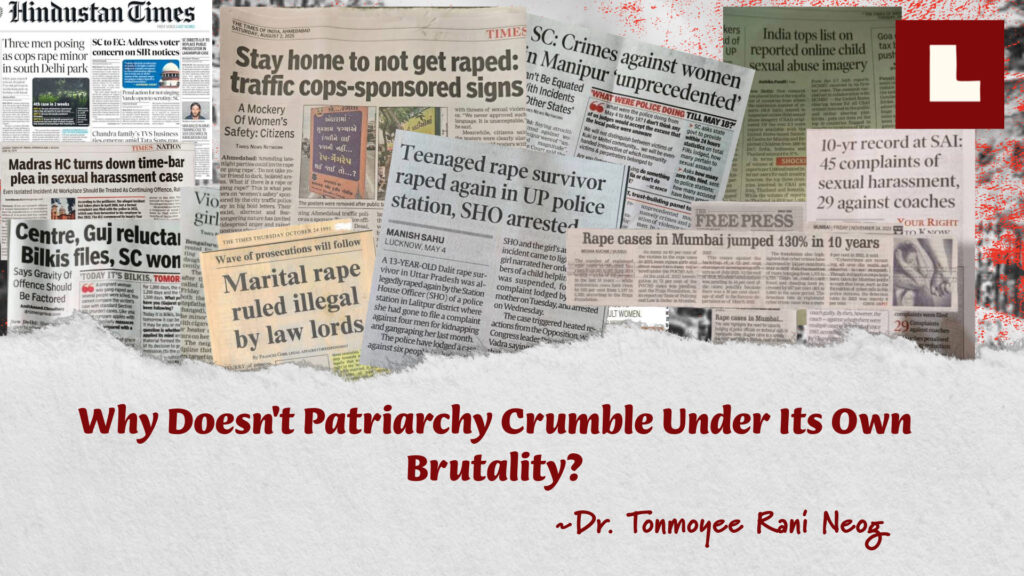

In Jamui, Bihar, a teenage girl was stopped and sexually assaulted by a group of men, while her male friend was beaten. In Delhi, a 17-year-old was allegedly gang raped in a public park. In Assam, a wife was beheaded by her husband; another young woman was allegedly raped and killed. After each of these cases, it is women who end up paying through restrictions and curfew as care and surveillance as protection. This raises some uncomfortable questions. Why are women expected to guard honour at all? Why are nights, parks, buses, trains and hotels never fully for women? And why does patriarchy- the root cause of such violence not collapse under the weight of its own violence?
Honour is a social technology, a mechanism through which patriarchal families turn women’s behaviour into collective reputation. Whom a woman loves, where she goes, what she wears and when she comes home are never only her business, because they become part of the family’s honour, and her body becomes a public ledger in which the community reads the family’s standing. In the old logic of patriarchy, a woman’s body is not her own but the vessel of family reputation, community standing, caste purity and religious identity. To violate her is to dishonour her father, husband, brothers and community. She is the medium through which their honour is passed on, contested and lost.
That is why violence against a woman is rarely treated as a crime against her alone. It is read as damage to the family’s social capital, and so the response tends to be damage control rather than justice. The family must recover its reputation; the community must redraw its boundaries, and the women must be contained. This works in three ways.
The Honour Machine: Silence, Discipline, Erasure
The first is silence. A family’s ability to arrange marriages and command respect is tied to the perceived purity of its women, so when a woman is violated, the family is often seen as compromised. Her sisters become “risky”, and her brothers are maligned. Under that pressure, families are pushed to silence the victim, settle the issue quietly and avoid scandal. And this is how justice becomes a distant dream.
The second is discipline. Girls grow up knowing that a single rumour, single photograph or late return to home could come to define them and damage them and everyone around them. This is the ordinary social reality in small towns and big cities alike, where the gossiping aunts, watchful neighbours and judging uncles make surveillance and moral policing as much an intimate affair as an institutional one.
The third is eraser. Once a woman has been violated, the conversation moves away from her pain towards the loss of the family, and she is reduced from a person to a symbol. She is expected to suffer, and if she doesn’t, she risks being accused of bringing further dishonour to the family. So, the violence towards the women is effectively doubled, first by the attacker and then by the family that demands her silence.
Together, these three mechanisms make women responsible for the family’s reputation and then punish them when it is threatened. Society makes a woman protect ‘honour’, but that same ends up hurting them.
This is why the first question after an attack is rarely about what the perpetrator did. It is so often about “What was she doing there? Who she was with? What she was wearing, and Why she left the house so late?” The inquiry targets her for the breach of an unwritten contract or a code that entrusted her as the guardian of honour, which she failed to guard. As a result, her movement becomes the real ‘trouble’, and the violence becomes secondary.
Moral Policing: Then, Now, Forever
Do you really think men in Jamui or in the public park in Delhi see themselves as criminals? Probably not! They may well see themselves as moral arbiters. They found a girl out with a boy at an hour they disapproved of and wanted to know who had given her the right. Their violence was sexual, but it was also disciplinary, meant to teach her and every girl who would watch the video what happens when you forget your place. It is simply the common sense of patriarchy that the presence of women in public needs justifying and their freedom is provocation.
The result is a public space that is empty for women, not physically but existentially. Women are present without being fully present, because they are always calculating: whether this bus is safe, whether this hotel is reputable, whether the family will ask questions, whether they can walk home alone. More than a space of possibility, a public space is a maze of risk assessments for a woman.
The moral police cast themselves as saviours, but the rescue is conditional. Women are protected only as long as they remain victims and accept protection as a form of control. To demand freedom is to refuse the role of the rescued, which is exactly what a patriarchal society does not tolerate.
None of this is new. Controlling the bodies of women in public is as old as patriarchy. Its forms have shifted over time while the underlying logic has stayed largely the same.
Under colonial rule, control over the mobility of women was bound up with cast and community. Upper caste women were kept at home, where their purity signaled cast superiority. The lower caste women worked in public and were exposed to exploitation and violence. The public sphere was therefore never neutral, and the rights of a woman depended on her social position.
After independence, the Indian state promised equality, and the women gained constitutional rights and entered Universities, workplaces and politics. Even so, a woman in public remained a suspect figure. The eve-teaser, the moral policeman and the protective father or brother – all enforced the same boundary that the mobility of women comes with conditions.
The women’s movement of the 1970s and 90s turned cases such as Mathura, Bhanwari Devi and custodial rape cases into the sights of struggle. Women marched, ran campaigns, held candlelit vigils and occupied the streets to demand the right to move without fear. The state answered with stricter and anti-rape laws (such as the 1983 amendment), faster trials and new committees. In the 1990s, the gang rape of Bhanwari Devi, a Rajasthan government worker who had tried to stop a child marriage, led to the Vishaka guidelines on workplace harassment. But the culture barely shifted, and the laws remained largely on paper while the streets still remained hostile to women.
Liberalisation in the 1990s and 2000s brought expanding cities, malls, multiplexes, call centres and IT parks. Women then entered the night economy, working late nights and travelling alone. The backlash came in the form of intensified moral policing. There were attacks on women in pubs (such as the 2009 Mangalore pub attack), harassment in workplaces and constant questioning of their character. The message was that economic participation did not amount to full citizenship. A woman remained a woman first and a worker second.
The 2012 Delhi Gang Rape was a turning point. Women filled public places in unprecedented numbers to demand justice, safety and freedom. The state responded with fast-track courts, tougher laws (including the 2013 criminal law amendment) and more surveillance. But after every high-profile case since, however, the advice to women has stayed the same: be careful, come home early, don’t provoke. The burden of safety still falls on women. In 2026, the cycle is repeating itself. Jamui, Delhi, Assam – each set of the same set of outrage, arrest and committees and then the restrictions on women quietly follow. Girls are told not to go out, to dress properly, to travel only with guardian, families tighten their hold and the public places shrinks until the night closes again.
Seen this way, the history of moral policing is a cycle of expansion and contraction. Women push forward, and patriarchy pushes back so that women gain ground, lose it and gain it again.
Patriarchal Bargain: freedom, fear, survival
Why, then, does patriarchy not crumble under its own brutality? Partly because it is a system of benefits as well as a system of ideas. Men gain authority from women’s fear and from her restricted mobility. The father who insists her daughter come home early may be protecting her, but he is also preserving his authority. The husband who questions his wife’s late return, may be worried, but he is also asserting control. Women are often complicit to, tragically not because they love oppression but they were taught to behave. Women were taught that a good woman is a contained one. So, women end up policing each other by shaming the one who stays out late and questioning the one who travels alone, who doesn’t marry, who doesn’t bear a child. As a result, women become enforcers and enablers of the system that harms the women. Scholars call this a “patriarchal bargain”: women accept restrictions in exchange for a measure of security and standing.
Women’s complicity is, in the end, a survival story. When violence is common, restriction feels like protection. But that feeling is false. Restriction does not stop violence, it only pushes it indoors, into the private spaces, where it is even harder to challenge. Data from the National Crime Records Bureau consistently show that in more than 90 per cent of rape cases the offender is known to the victim.
In such a situation, freedom is expensive. It means risking violence, accepting judgements and living with the exhaustion of constant calculation. However, unfreedom costs more, because it means the slow death of the self, the acceptance that our body is not our own, that movement is a privilege and that our life is a permanent negotiation. Here the question arises: if restriction is supposed to be the price of safety, why do the restrictions never fall on those who commit the violence, and why does the burden of safety always land on women? Because it is easier to control women than to confront men, and easier to tell girls to dress properly than to tell boys not to rape.
A New Slogan: Die Honour Die!
A different way of speaking and thinking might help. It would begin with a different grammar: replacing women’s safety with women’s freedom, protecting women with granting rights and honour with dignity, since honour is granted by others while dignity belongs to the self.
It would then change policy. It would favour accountability over restrictions, justice over surveillance and an end to impunity over more moral policing. In practice, that means better street lighting and safe, reliable public transport, police who register complaints without questioning where a woman was and what she wore; swift and certain convictions, and consent and gender education for boys, starting in schools. The men accused in Jamui, in Delhi and in Assam must be tried and if found guilty, punished, but so must the culture that produces them.
Finally, it would require a change of imagination. A world in which women are the guardians of dignity where nights, parks, buses, trains and hotels are fully open and where their presence does not mean provocation. That is not a utopia; it is a long overdue right to the women.
The real question is not why women must pay but why women have been paying for so long. That debt belongs to the men who assault, the families who control, the states that do not deliver justice and the patriarchy that treats women as property. Women have already paid enough in silence and fear. It is high time to call the debt in from those who owe it. Somewhere tonight, a girl is checking the clock, the road and her own reflection, and none of them is the thing she should have to fear. The day she stops counting the minutes between the bus stop and her door is the day she can finally call herself free. Let the nights belong to the women, let the parks, buses and trains belong to the women. Let their bodies be their own. Let honour die, and dignity live.