Discourses From the East
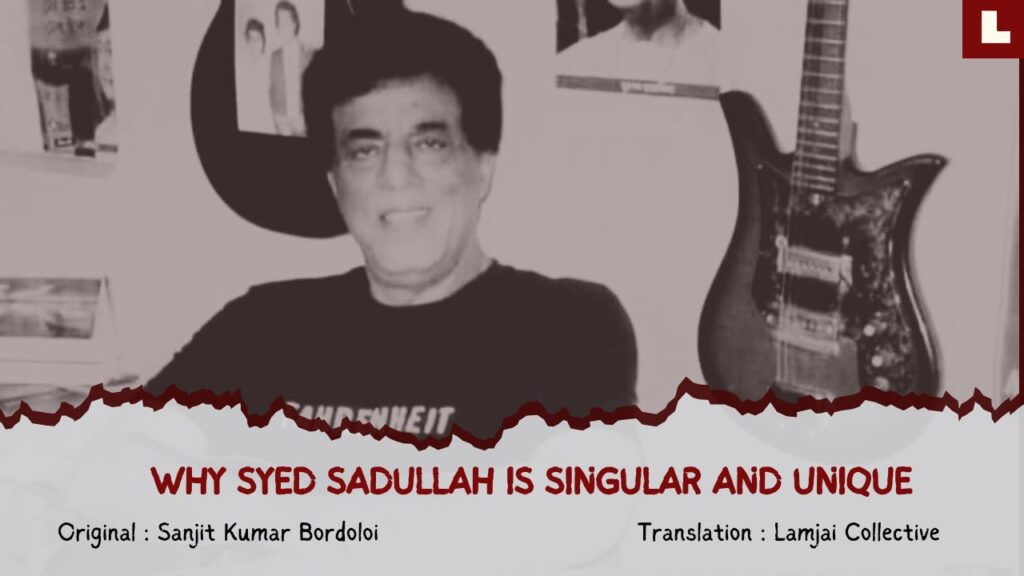

Original piece by Sanjit Kumar Bordoloi (Translated From Assamese to English by Lamjai Collective)
“When I was young
I’d listen to the radio
Waiting for my favorite songs
When they played, I’d sing along
It made me smile.”
—The Carpenters
Syed Sadullah was born a few months after India’s independence (1st February 1948). His father was a police officer. He began school in Dibrugarh and completed it in Shillong. He studied at Kanoi College, Dibrugarh. A science graduate, he was drawn to music from his student days. As a boy he wanted to learn the guitar, but his father did not allow it and asked him to focus on studies. He learned anyway and soon became known as an instrumentalist, quick and skillful on the guitar.
During his college years, Syed Sadullah, Bhavesh Goswami, Biju Phukan, Charu Gohain, and others formed a band called Quivers, likely influenced by The Beatles and the rising wave of rock and roll. As a guitarist, he spent some time in the mesmerizing ‘City of Illusion,’ Mumbai, and drew attention for his distinctive style. He accompanied well-known singers such as Bhupinder Singh, Anup Jalota, and Usha Mangeshkar. Even so, All India Radio seemed destined for him, as if waiting for his golden voice.
When passion and profession align, the work shines. That was true of Syed Sadullah. He found the perfect medium to give his all. His role in popularising the Akashvani Dibrugarh station needs no elaboration. His voice, presentation, and creative energy helped define an entire era of radio in Assam.
Those of us in our fifties are fortunate. We saw the golden age of radio, the age of television, and now the digital and social media era. FM is a later evolution of radio and is now very popular in big cities. Still, the inescapable nostalgia of our childhood and youth is the radio. The Carpenters’ Yesterday Once More captures that feeling perfectly, echoing the warmth of a simpler time.
As children, radio plays such as Dr. Bhupendra Nath Saikia’s Shantashishta Hrishtapushta Aru Maha Dusto, Indra Bania and Chetana Das’s Gowardhan Charit, and Ghan Hazarika’s Surongor Xeshot drew us to the set. Programs like Akanir Mel, Yuvavani, Aideur Buloni, Ghar Jeuti, and Geetimalika became part of daily life. So did Lily Das Malik’s news from Delhi, the afternoon Vividh Bharati, and the nightly Binaca Geetmala. To that list of beloved programs was added Bornali, hosted by Syed Sadullah. “Namaskar, priya srota bandhu” (“Hello, dear listener friends”), he began in a rich, golden voice, and Bornali soon became hugely popular. The voice was memorable, the presentation compelling, and the connection with listeners deeply personal.
I once read a story about a young man who fell for the honeyed voice of a radio announcer. He visited the station to meet her, only to feel disappointed because the person he saw did not match the image formed in his mind from her voice. I recall that story for a reason. Around 1994–95, at a Bihu event at the Kenduguri Kala Kendra in Jorhat, I first saw one of my adolescent heroes, Syed Sadullah. Tall, well built, smart, and handsome, he matched exactly the image his radio voice had created. I did not feel like the protagonist in that story. He had a regal voice and a regal presence. On that stage, he spoke with the singer Utpal Sharma, radiating warmth and grace.
As a musician, Syed Sadullah made many valuable contributions. He recorded and broadcast the songs of Jyotish Bhattacharjee. He composed the tune for Bhattacharjee’s well-known Jowar Porot Xora Sewali Butoli and arranged the music. He also composed many timeless songs, including Mandira Lahiri’s Ahar Dore Ubhoti Atori Gola and Charu Gohain’s Barakha Tumi Aha. Dr. Bhupen Hazarika lent his voice to Sadullah’s compositions. While at Akashvani Dibrugarh, he undertook several important projects that expanded the creative range of Assamese radio.
In the 1960s, under the leadership of actors like Balraj Sahni, the Indian People’s Theatre Association (IPTA) sparked a cultural awakening across India, including Assam. In this context, Dr. Bhupen Hazarika brought the folk artist Maghai Oja to wider public attention. In 1977, Syed Sadullah produced a long radio feature on Maghai Oja that included a conversation with him and a dhol performance. For his service to radio, Akashvani honoured Syed Sadullah more than ten times. He narrated or dubbed nearly one hundred documentaries for the BBC, National Geographic, and others.
Syed Sadullah mastered several languages. Besides Assamese and English, he spoke Hindi, Urdu, and Arabic. He could also recite and sing Sanskrit shlokas. His pronunciation in any language was precise. His linguistic ability deserves praise and emulation. Syed Sadullah was at once an instrumentalist, singer, lyricist, composer, star announcer, producer, playwright, and recordist. Along with this range of talent and skill, he was honest, generous, modern, and scientifically minded. That is why he is singular and unique. His name will always shine in Assamese music and radio.