Discourses From the East

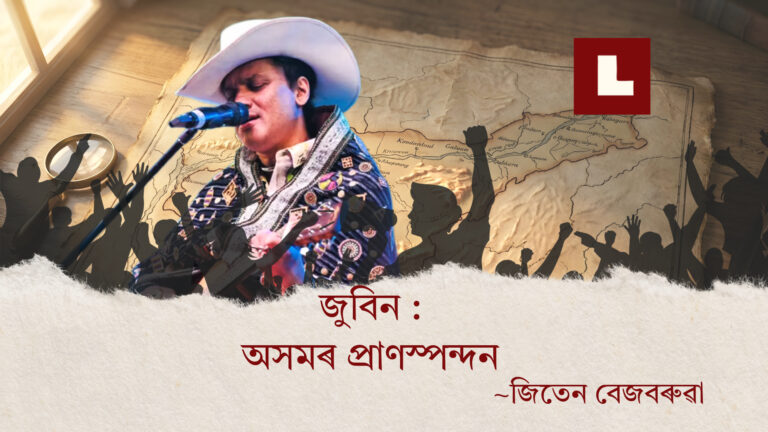
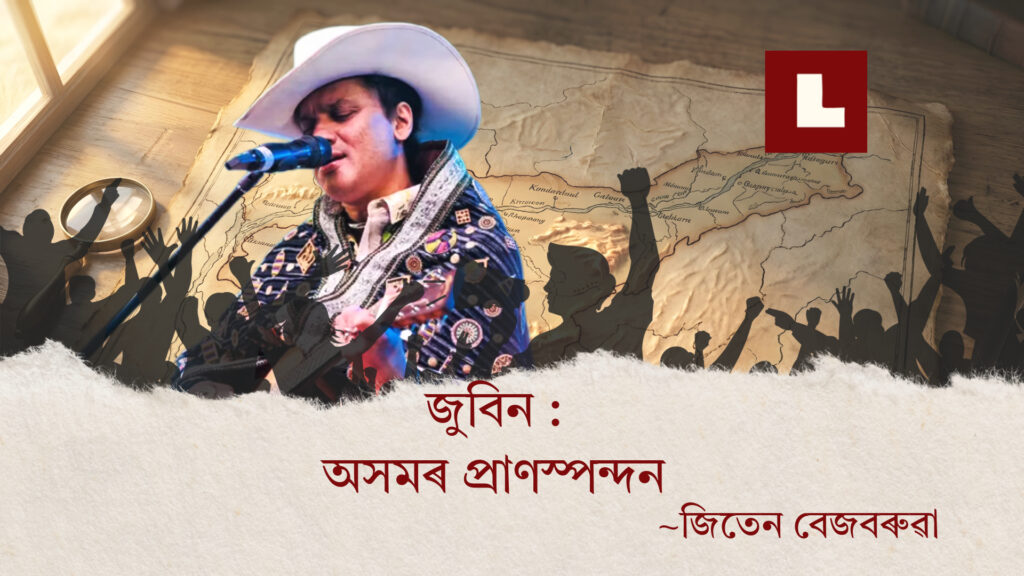
Rongali Cassette House — a small cassette shop at the heart of Nazira, a quiet town by the banks of the Dikhow River in Sivasagar district — was more than a shop. It was a gathering place for young girls and boys drawn not merely by music, but by the dreams those cassettes carried. Arranged neatly on wooden shelves, the tapes invited us to linger before them, pretending to choose, while in truth we were intoxicated by the tunes, lyrics, and melodies that promised worlds beyond our reach. Along with those songs, our minds sprouted wings — eager to explore every window of curiosity. The voice that animated those melodies gave rhythm to the changing seasons of our small town. That voice was Zubeen Garg.
Of course, we had heard him long before, on the old cassette player at home. Anamika, Mukti, Shishu, Jatra — we would flip between Side A and Side B again and again. My younger uncle had carefully preserved his collection of cassettes in a small blue suitcase, treating it as a priceless treasure. When he was away, we would tread lightly, ensuring no tape was damaged. Yet sometimes the reels tangled, and patience became a test — untangling the thin magnetic tape and rewinding it carefully.
For lower-middle-class rural families of the 1990s, that patience extended far beyond cassette reels. These families, already burdened by poverty and fatigue, had weathered the turbulence of Operation Rhino and Operation Bajrang, and the wider unrest that defined Assam’s frontier towns. Life moved under an unspoken fear: What next? What remains to lose or gain? Beyond dreams, there seemed little left — yet dreams persisted, fragile but alive. Every community, after all, requires a voice, a rhythm, a sound to turn abstraction into something tangible — or more simply, into hope.
Perhaps that hope lived inside that blue suitcase — in those cassettes, in that voice that played through our humble cassette player:
Asha mur asha, ekhoni xarab noi,
Sei asha mur asha, ahise rongali hoi,
Mur gaanor, bohu jogar, sukh-dukhar chinaki loi.
(My hope, my dearest hope, is a dancing river.
That hope arrives glowing in crimson hues,
Carrying with it memories of many ages —
Joy and sorrow woven into song.)
In Zubeen Garg’s voice, words, and music, we discovered a reason — a reason to fall in love with life, to remain human among humans. Amid words like secret killings, ULFA, and Assam Bandh, we began to hum other words instead:
Mur gaanot ase Anamika Maya,
Meghar boron, rodor boron,
Bedona bedona mor bhalpowa, tomak heruwai pathor hua,
Tumi chulei je bosonto, dhumuhao je proshanto,
Bohudin hol, xoru bupar mukh dekha nai.
Through rain dripping from our tin roofs, while scrubbing school uniforms beside the well, during power cuts that lasted weeks after storms — we kept humming those tunes.
The young men from our village, unable to bribe their way through the APSC mains opened tuition centres, and there too, Zubeen da’s songs played.
Another opened a poultry farm; his voice echoed there. A grocery shopkeeper, an auto driver, a night-school teacher, all found solace in Zubeen’s songs before sleeping.
His voice became the soundtrack of ordinary Assamese lives.
These young men did not join ULFA; they chose instead to fight for life itself and that choice became their quiet form of resistance.
Zubeen Garg’s songs, with lyrics penned by Manas Robin, often reflect the emotional crossroads faced by Assam’s youth—where education raises hopes for opportunity, yet socio-economic realities lead to disappointment.
Their music captures the inner conflict between rural roots and urban aspirations, portraying not just frustration, but also the quiet dignity and resilience found in returning to one’s land.
Pohilou xunilou, sakori napalu,
Etiya ki koro ko?
Gaonot pori ase kheti tini pura,
Khetite dhoro ne ka?
(I studied, I learned, but found no job.
Now what should I do?
Back in the village lie three fields —
Should I take up the plough?)
The early 1990s also marked the rise of globalization. Through cable TV, MTV reached the upper-middle-class Assamese homes. The growing dominance of English-medium education and Hindi pop culture posed subtle threats to Assam’s cultural identity. Yet, Zubeen da bridged this divide infusing the pulse of rock, jazz, and reggae into Assamese music while keeping his heart rooted in home. His art was both global and local: a connection to the world, yet a reaffirmation of belonging.
Years later, in the Delhi University hostel, I listened to those same songs again and realized they were not just melodies — they had shaped our youth, tracing the blurred boundaries between emotion and nostalgia. During Bihu or Puja vacations, when homesickness and scarcity weighed heavily, we turned to Zubeen da’s songs. They became family — sometimes a lover, sometimes a loyal friend, sometimes a guardian.
Also Read: Roi Roi Binale: A Fiiting Swansong Of A Great Artist
In some of his songs, one senses as much emptiness as hope — a nothingness, as Friedrich Nietzsche called it. Some carry subtle protests against tradition and oppression — melodic protests, not loud rebellions. It is no surprise that in his last interview, Zubeen da asked novelist Rita Chowdhury if she had read Nietzsche’s Nothingness. He never rejected emptiness; he embraced it, understanding that even after achievement, a sense of void lingers. Yet his songs revealed that emptiness is essential for creativity — that breaking and remaking oneself is vital for liberation.
Zubeen Garg and the Democratic Heterotopia
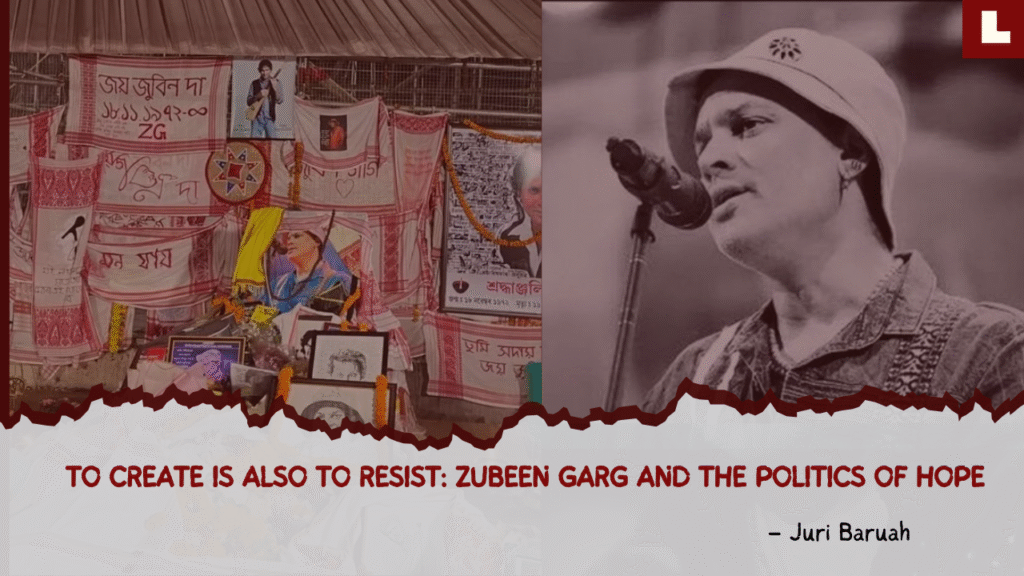
The cremation site of Zubeen Garg has evolved from a space of ritual mourning into what may be described as a democratic heterotopia — a living arena where alienation, love, and the demand for justice coexist within the same ground. This transformation converts fleeting grief into a durable democratic temporality within Assam’s contemporary political climate. The collective acts of offering prayers, singing, lighting candles or diyas, and chanting slogans have become both civic duties and symbolic performances, turning the site into a heterotopia of memory. Here, ordinary citizens enact belonging and dissent, embodying democracy through emotional participation rather than institutional procedure.
Drawing on Michel Foucault’s notion of heterotopia, this site mirrors society’s contradictions — it is sacred yet secular, personal yet political, ritualistic yet radical. Heterotopias, as Foucault posits, are “counter-sites” where the real and the imagined converge, producing spaces of resistance that challenge social norms from within. Zubeen da’s cremation site at Sonapur thus reflects how democracy in Assam is not merely legislated but lived — through bodies, songs, civic rituals, and collective memory. It becomes a counter-space of resistance, where ordinary citizens reclaim voice and agency beyond the reach of formal politics or state authority.
Also Read: Not Yours to Wear, Not Yours to Mourn
The resonance of this site can also be understood through Yi-Fu Tuan’s humanistic geography. For Tuan, space becomes place when it is invested with meaning and emotion. The cremation site exemplifies this transformation — what was once a site of loss has become a place of belonging and moral action. Through ritual, music, and collective performance, people have inscribed emotional value onto the landscape, transforming it into a democratic place that anchors identity while propelling political imagination.
Zubeen da’s sudden demise has ignited not only collective mourning but also a broader critique of injustice and the communal tensions deepened by the Hindutva regime in Assam. The growing wave of social media engagement particularly on Instagram and Facebook demonstrates how narratives around khilangia Axomiya (indigenous Assamese identity) have been rearticulated as democratic sentiment in the wake of his death. These digital expressions, though sometimes marked by emotional excess or communal fault lines, increasingly reinterpret Zubeen da’s own ethos: “Be a socialist, be a rebel.”
Zubeen da’s public persona and art deeply echo the ideological spirit of Che Guevara, whom he often cited as inspiration. Che’s philosophy of revolutionary humanism, his belief in moral integrity, egalitarianism, and revolutionary love finds cultural resonance in Garg’s music and activism. Through his songs, Garg transcended class and ethnic boundaries, creating a form of cultural socialism rooted in empathy and shared emotion. His ability to give voice to diverse communities transformed popular culture into a medium of resistance and solidarity much like Guevara’s vision of art as a moral weapon of the people.
In this light, Zubeen da personified Che’s ideal of the “new human being” (el hombre nuevo): an individual who resists systems of domination not merely through ideology, but through compassion, creativity, and moral courage. His inclusiveness offered marginalized and minority groups a sense of belonging within the broader Assamese civil sphere, bridging divides through emotional intelligence and artistic sincerity.
Art, Resistance, and the Moral Imagination
At the convergence of Foucault’s resistance, Tuan’s sense of place, and Guevara’s revolutionary humanism, Zubeen da’s cremation site becomes a space where collective emotion, embodied ritual, and artistic memory redefine democracy. Through these practices, the people of Assam reclaim public space as moral territory, transforming grief into solidarity, remembrance into rebellion, and mourning into an act of living democracy.
Also Read: Ode to the Immortal
Zubeen da’s declaration — “I have no caste, no religion, no god. I am free. I am Kanchenjunga.” — encapsulates his vision of liberation from the rigidities of identity and orthodoxy. By equating the self with Kanchenjunga, the towering Himalayan peak, Zubeen suggests that Assamese aspirations must rise to similar heights rooted in the soil yet striving toward transcendence. The mountain thus becomes an emblem of moral and cultural elevation, symbolizing collective striving beyond sectarian boundaries. In this articulation, Zubeen redefines Assamese identity as a universal and emancipatory consciousness grounded not in religion or caste, but in freedom, creativity, and moral courage.
When a young Brahmin man at Zubeen’s burial ground tore off his sacred thread and threw it into a dustbin, declaring, “I have no caste. I have no religion. We must live as humans,” he enacted Zubeen da’s philosophy in lived form. In an era where hate has become a tool of political control, such gestures reassert humanity against division. Zubeen Garg had always envisioned a society of human beings, free from caste, religion, and hate. His death proved that his art was not merely expression but philosophy a creative humanism rooted in faith in humanity.
This democratic heterotopia resists the monopoly of state or political parties in defining mourning and justice. It aligns with Foucault’s insight that heterotopias are not utopias but spaces of resistance — challenging domination from within. The site performs democracy in its raw, embodied form: citizens reclaim public space, express grief as dissent, and mirror the moral pulse of society.
In the Key of Hope: To Create is also to Resist
Zubeen Garg’s legacy transforms art into activism and mourning into a collective reawakening of democratic consciousness in Assam. His moral and aesthetic vision imbues music with emotional depth and a politics of inclusion, turning melody into moral discourse making art a vessel of compassion and collective resistance. His songs stand as the living continuation of a tradition where song and struggle, emotion and ethics, art and revolution remain inseparable. Yet beneath every melody runs a quiet, persistent current — a politics of hope.
This politics is neither ideological nor utopian; it is ethical and humanistic. It resides in the conviction that beauty, compassion, and creativity can outlast fear and fragmentation. In times when democracy risks shrinking into procedure, Zubeen da’s art restores it as an affective practice — a living, breathing exchange between the artist and the people. His poetic assertion, “I want to be as tall as a eucalyptus tree,” captures this philosophy-the aspiration to transcend limitation, to stand upright against injustice while remaining deeply rooted in one’s soil.
Also Read: Justice for Zubeen: When BJP Takes to the Streets Against Itself
In his last film, Roi Roi Binale, Zubeen da declared, “There is only one politics of an artist, and that is to stay with the raij (the people).” This simple yet profound statement encapsulates his lifelong faith in the moral intelligence of ordinary people. For Zubeen da, the artist’s political duty was not to serve power or ideology, but to become the conscience of the collective, a bridge between private emotion and public ethics. His art transformed the everyday struggles of ordinary Assamese lives into the very grammar of democracy, demonstrating that to create is also to resist.
Through this ethos, Zubeen daa reaffirmed Assam’s socially conscious artistic lineage from Jyotiprasad Agarwala to Bishnu Prasad Rabha and Bhupen Hazarika where melody becomes a mode of resistance and performance becomes public memory. In this continuum, hope is not passive optimism but moral endurance.
In times of polarization and fear, Zubeen da’s voice remains a reminder that art is the last refuge of freedom, a space where the moral imagination of a society continues to breathe. Indeed, beyond politics and controversy, he became more than a singer; he became an artist of the people and for the people. His untimely death warns us that while ideologies may rise and fade, a society without a living philosophy of art and creation risks spiritual decay. To endure, it must cultivate imagination, courage, and above all — the politics of hope.