Discourses From the East
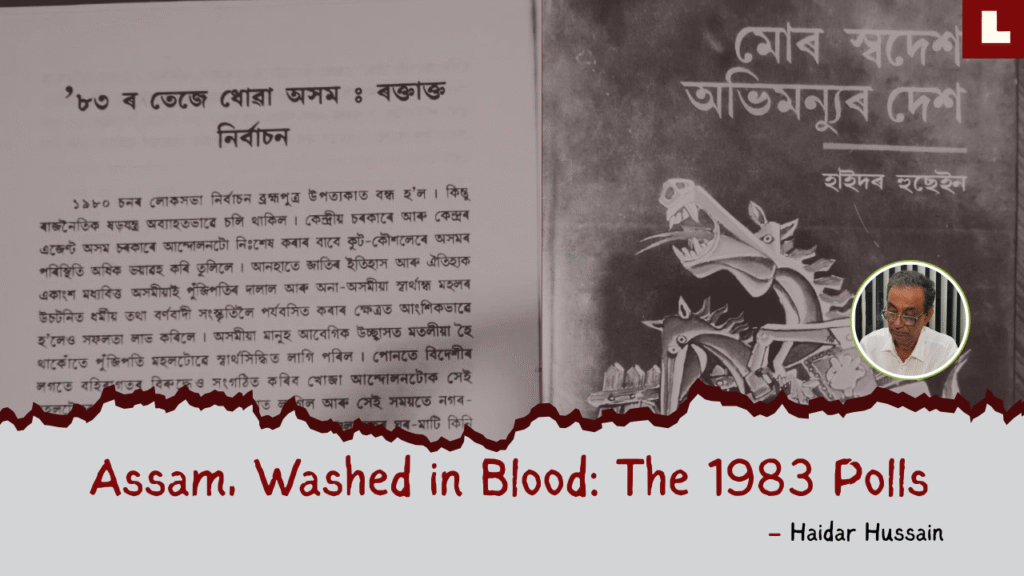

Editors’ Note: Translated from Assamese to English by Lamjai Collective, Haidar Hussain’s essay Assam, Washed in Blood: The 1983 Polls remains one of the most powerful firsthand reflections on the violence that accompanied the 1983 elections in Assam. Written in the immediacy of that moment, it lays bare how state power, communal division, and moral collapse turned a democratic process into a bloody tragedy.
The piece reads today as both witness and warning. It reminds us that the wounds of that time are not only historical but structural, shaping how democracy and belonging continue to be contested in Assam.
The Lok Sabha election of 1980 was suspended in the Brahmaputra Valley, but political conspiracies continued unabated. Through deceit and manipulation, the central government and its agent, the Assam state government, exacerbated the situation with the aim of crushing the Movement. Meanwhile, a section of the Assamese middle class, incited by brokers for capitalist interests and non-Assamese vested commercial interests, met with partial success in reducing the history and heritage of the Assamese nation into a religious and casteist culture. While the Assamese people remained intoxicated with emotional fervour, capitalist circles became engrossed in securing their own interests. Ironically, these very forces began to lend support to the Movement, which had initially sought to organise against both foreigners and outsiders. Simultaneously, they focused their plans on buying up houses and land in key Assamese-majority areas of towns and cities—particularly in Guwahati—to establish colonies.
Also Read: ‘৮৩ ৰ তেজে ধোৱা অসম : ৰক্তাক্ত নির্বাচন
The government, too, was actively engaged in a conspiracy against the nation, busy dividing the people of Assam on the basis of language and religion to weaken the Assam Movement. In mid-1980, the Governor of Assam’s adviser, Harish Chandra Sarin, advised the Governor to consolidate the anti-Movement forces. With the government’s cooperation, the All Assam Minority Students’ Union (AAMSU) was born in Jaleswar towards the end of 1980. At its inception, Congress leaders from the minority community of that time—Afzalur Rahman, M.F. Golam Osmani, Anwara Taimur, among others—provided significant assistance. Just as the All Assam Students’ Union (AASU) had become the symbol of the hopes and aspirations of the larger Assamese community by leading school and college closures, the stature of the Minority Students’ Union was similarly strengthened in minority-dominated areas. The agitating leadership remained mesmerized by the clear surface of the wave the Movement had created, failing to notice the thorns hidden beneath. They made no effort to understand the sentiments of the religious and linguistic minorities, the Bodo-Kacharis, the Tea Tribes, the Karbis, the people of Cachar, and others. The government, on the other hand, began to build its politics around these very groups. As a consequence of the government’s conspiracies and the Movement leaders’ failure to attempt to understand the concerns of all sections new problems continue to be born even today.
Flush with the self-satisfaction of having organized the anti-Movement forces, the government began clandestine preparations for elections under the pretext of a constitutional crisis. After the fall of Morarji Desai’s government at the Centre, the interim government led by Chaudhary Charan Singh sought to hold talks with the agitation’s leaders, but the frontline leaders refused to participate. In 1980, after Indira Gandhi returned to power, she expressed interest in discussions with the agitation leaders. Accordingly, a meeting was convened between the Prime Minister and the Movement’s leaders at Guest House No. 1 in Jawahar Nagar, Guwahati. During these talks, the Prime Minister proposed commencing the process of identifying and deporting foreigners who had entered after 1971. After the Movement’s leadership rejected this proposal, the Centre began to adopt a harsher stance. Meanwhile, the Movement itself grew more intense.
On 6 January 1983, the Chief Election Commissioner announced the dates for that controversial and ignominious election. The so-called indigenous people of the Brahmaputra Valley declared their firm resolve to resist it, and the Movement’s leaders devised new strategies. By then, a pall of fire, smoke, and shadow had fallen over the whole of Assam. News of student and youth supporters being killed in police and CRPF firing inflamed public anger. The sound of wailing rose everywhere. Assam’s sky was shrouded by the blood-red flames of funeral pyres. Village after village, roads, bridges, and other infrastructure were extensively damaged. Government employees resolutely pledged their non-cooperation. The government, however, remained obstinately determined to stage a farce in the name of an election. As the Movement’s supporters grew more resolute in stopping the polls, the anti-Movement sections were gripped by the fear that a failure to vote would see them branded as foreigners and their status permanently demoted to that of second-class citizens. The elections were scheduled for 14, 17, and 20 February. As a result, the month of February witnessed the highest number of deaths in electoral clashes.
Also Read: Unburying Nellie: What the Tiwari Report Means for Assam’s Unhealed Wounds
On February 10, Prime Minister Indira Gandhi began her election campaign in Assam. And within two days, that is, 12 February, the orgy of violence and counter-violence had already begun. The election in Gohpur was scheduled for February 20. The Plains Tribal Council of Assam (PTCA) was formed in 1967. Its principal demand was the creation of a separate state called Udayachal for the Bodo people. The PTCA wanted the election to be held. A suspicion had taken root among the Bodo populace that the Assamese-speaking people were unwilling to understand the profound sense of hurt surrounding their language, culture, and identity as sons of the soil. The PTCA, driven by political self-interest, contributed to the growth of this sentiment, and the Congress (I) party was quick to seize the opportunity. The consequence was the outbreak of clashes in Gohpur. Five people were killed on February 12 alone. The flames of violence and counter-violence between the anti-election and pro-election camps, once ignited continued to fester. On February 14, this violence, now clothed in the garb of communalism, spread to the districts of Darrang, Kamrup, Nagaon, Sonitpur, Dhubri, Goalpara, and several others. In the western part of Goalpara district, jawans deserted a camp of the Assam Battalion and took refuge in the hills of North Salmara. The sound of gunfire could be heard all around. It is true that the vultures circling in the skies of Assam failed in their attempt to obscure the sun—but the violence they left behind sowed the seeds of a new element – ethnic unrest.
February 19 witnessed the scripting of a new chapter of savagery in Nellie and Borbori, within the jurisdiction of the Jagiroad police station. In Nellie alone, nearly six hundred people fell victim to the violence, ruthlessly sacrificed at the altar of politics. In the role of political conspirators, the rulers looked on with cruel amusement. The minorities froze with terror. A conviction hardened among the minority populace that, regardless of who was involved in the conspiracies, only the Congress (I)—with the support of the CRPF and police—possessed the ability to save the lives of survivors. Conducted by force amidst this bloodshed, the election made a mockery of established democracy and scripted history in blood.
In that farcical election, the Congress (I) won by an overwhelming majority and formed the government. The vast majority of Assamese-speaking indigenous people abstained from voting. The people of Cachar voted at a normal rate. In Karbi Anglong and North Cachar, although the voter turnout in 1983 was about 10 percent lower than in 1978, the polled percentage still exceeded forty percent. In Kokrajhar, Dhubri, and Goalpara, constituencies where elections could be held, voting was nearly normal. However, it was impossible to conduct polls in Bijni in Kokrajhar district; in Bongaigaon and Abhayapuri (North and South) in Goalpara. Although a major section of the minority population voted in the districts where polling took place, in the majority-dominated constituencies the minority population also largely abstained. Tea garden workers also did not participate in voting on a large scale.
This is why the election could not be held in constituencies like Bijni. In Morigaon, a mere 1.94 percent of people voted. Elections could not be held in Lahorighat either. From the voter turnout of 2.56% in Bokakhat, 1.53% in Khumtai, 5.3% in Thowra, and a paltry 0.69% in Bihpuria, it can be inferred that the tea labour community also effectively boycotted the polls. In essence, the Congress (I) party placed paramount importance on capturing Dispur by pitting minorities, Bodos, and so-called indigenous Assamese-speaking people against one another, creating a blood-soaked environment. Therefore, the election was a blot on the name of democracy, and the government it established was utterly illegitimate.
In the Dharmapur constituency of Nalbari district, Dr. Bhumidhar Barman secured a mere 266 votes. The other two candidates failed to secure a single vote. One can assume that these votes were cast by CRPF personnel and their family members at the polling station set up in his own house; these votes constituted a mere 0.30 percent of the electorate. In East Guwahati, Munin Sharma received 0.93 percent of the vote; in Bihpuria, Borgoram Deuri received 0.66 percent. And yet, after the government led by Hiteswar Saikia was established, arguments were presented to defend it as a constitutionally elected, legitimate regime.
The framers of the Indian Constitution certainly never imagined that a situation could arise in independent India, even in the distant future, where an election would be forced through by trampling over the blood of voters and ignoring mass resistance. Had they envisioned such a possibility, they would undoubtedly have incorporated a provision to annul such an election. The Constitution itself had provisions for its own amendment, laid down with the foresight of changing times and for the interest of the country and its people. So why did a government—which, just before the Emergency, had not hesitated to amend the Constitution to place the Prime Minister above the court after Indira Gandhi’s election was annulled— show no interest in amending the constitutional principle that necessitated holding an election at the cost of thousands of lives?
The political strategy of exploiting the constitutional provisions for political conspiracies has today eroded the people’s faith in the ‘sacred’ Constitution itself. So-called democracy has become a hollow pretence. Therefore, the bloody election of 1983 will remain on record as a precedent. Everyone evaded the responsibility of putting the murderers of democracy on trial, relegating that duty to future, and immersed themselves in electoral politics once again. In that sense, this election will also endure as a symbol of the political deception perpetrated upon the people.