Discourses From the East
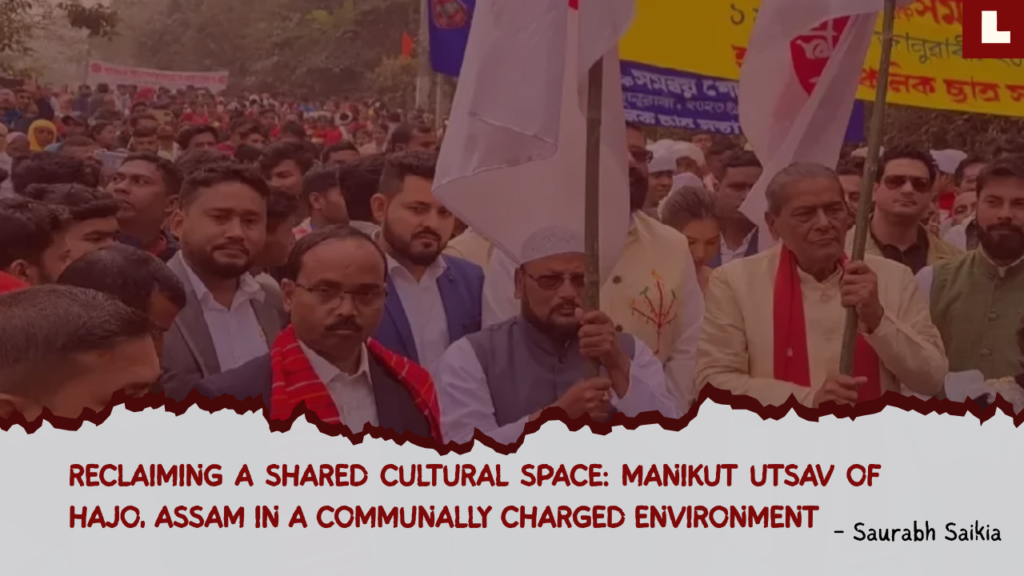

The Manikut Utsav, held annually on the first day of Magh (January-February), is a symbolic procession that originates from Poa-Mecca Dargah on Garurachal Hill and concludes at the Hayagriva Madhava Temple on Manikut Hill. Led jointly by the Khadim of Poa-Mecca and the Doloi of Panchatirtha, the event brings together thousands of devotees, irrespective of religious affiliations. This festival, featuring performances of Jikirs, Naam-Prasangas, Borgeet, Bihu songs, and other folkloric expressions, articulates a deliberate assertion of interfaith harmony in Assam’s socio-cultural fabric.
Against the backdrop of rising religious polarization in India and locally emerged communal forces’ attempt to polarise the harmony rally, the civil society of Hajo continues to stand as an exemplar of syncretic culture. The Manikut Utsav, in this context, is not just a festival but a counter-narrative to sectarianism, offering a model for peaceful coexistence of civil society. While organizers emphasize keeping the event apolitical, its very existence asserts the resilience to polarization and communal divide. While communal forces are reinterpreting the festival as an example of so-called secularism, a historical understanding of the festival and the syncretic traditions of Hajo has become the need of the hour. This article analyses how Manikut Utsav functions as both a reaffirmation of historical religious synthesis and a strategic response to contemporary socio-political anxieties.
As widely held and reported by newspapers and media, The Manikut Utsav came into being in the year 1992.The genesis of the Manikut Utsav in 1992 coincided with the broader national crisis triggered by the destruction of the Babri Masjid. Assam, historically known for its communal amity, faced localized tensions that threatened its pluralistic traditions. In response, civil society organizations, most notably the All Assam Students’ Union (AASU), took a proactive role in instituting this festival. AASU has since been actively engaged in the organization of the festival each year.
According to Mr. Bichitra Narayan Thakuria, one of the founding organizers of the Manikut Utsav and the first secretary of the Manikut Sahitya Samaj, the Manikut Sahitya Samaj was formed in 1989 with Dr. Prabin Chandra Das as its first president. Their shared vision was to promote Hajo’s cultural richness at a national level—its monuments, traditions like the Bulbul fight, and the peaceful coexistence among religious communities. In 1992, this vision materialized as the first Manikut Festival, held from January 15–17, several months before the demolition of the Babri Masjid.
In the wake of the Babri Masjid’s demolition later in December 1992, the festival assumed an even deeper relevance. As communal tensions rose across the country, the peaceful celebration in Hajo stood as a quiet but powerful testament to Assam’s long-standing ethos of harmony. Contrary to many reports, the Manikut Utsav was not born from crisis, but it gained renewed significance in its aftermath. Assam, historically known for its communal amity, faced localized tensions that threatened its pluralistic traditions. In response, civil society organizations like the Manikut Sahitya Samaj and the All Assam Students’ Union (AASU), took a proactive role in instituting this festival.
Hajo, in Assam, India, is a remarkable confluence of diverse religious and cultural traditions, nestled on the northern bank of the Brahmaputra River, about 25 kilometers from Guwahati. A revered pilgrimage site for Hindus, Muslims, and Buddhists, its history is deeply intertwined with religious syncretism. Known by names like Apunarbhav and Manikuta, Hajo is featured in ancient texts such as the Kalikapurana and Yoginitantra, highlighting its longstanding spiritual significance.
Historically, Hajo has been a political crossroads for the Koches, Mughals, and Ahoms. The Hayagriva Madhava Mandir, atop Manikut Hill, is a key Hindu temple dating to the 6th or 7th century CE, often linked to Buddhist traditions. Nearby, the Powa Mecca, a revered Sufi shrine, is said to contain soil from Mecca, making it a pilgrimage site akin to the holy city itself. This shrine, dedicated to the Sufi saint Ghiyasuddin Auliya, embodies the region’s rich religious diversity, with its upkeep supported by a grant from Ahom king Lakshmi Singha.
Hajo’s significance extends beyond its temples and shrines. The peaceful coexistence of Hindus, Muslims, and Buddhists has fostered a unique space for cultural exchange. The region’s rulers—Koch, Ahom, and Mughal—recognized Hajo as a center of spiritual and political importance, contributing to the preservation of its religious institutions.
The town’s syncretic history is most evident in its religious practices. The Panchatirtha, five prominent Hindu temples, include the Hayagriva Madhava Mandir, while the Poa Mecca houses the tomb of Ghiyasuddin Awliya, a revered Sufi. Buddhists from across South Asia revere the Hayagriva idol, believing it to represent Gautam Buddha, and make annual pilgrimages to Hajo. These overlapping traditions create a tapestry of shared faiths.
Festivals like Ashokastami exemplify this unity, as local Muslims known as “Saukadhara” escort the Hayagriva idol in procession. Similarly, during the Shivaratri festival at Kedar Temple, representatives from Poa Mecca would offer “Sidha” (an offering of uncooked food ingredients and other items), continuing the cycle of interfaith exchange. Another representation from the Kedar temple would do the same on the day of the “final Urus” ( a Muslim religious ceremony) at the Poa-Mecca. These local Muslims have voting rights in the election of the Doloi of the Panchatirtha (five Hindu shrines). The Moria Muslim community in the Muslimpatti in Hajo also has also right to vote in the Doloi election. Significantly, the Moria Muslims of Hajo, do not possess any land patta, but they have a historical settlement in the land of the Hayagriva Madhavaa temple, where their ancestors were brought to prepare utensils used in the temple.
Also Read: September in January: Rethinking Joha Rice Timing in Assam
In medieval Assam, Hajo stood at the heart of the political and cultural interplay between the Ahoms, Muslims, and Kochs. Despite occasional tensions, these interactions reflect a similarity with what Richard Eaton describes as ‘negotiated accommodations’ between religious communities, ensuring coexistence despite theological distinctions, and the consequent political ramifications of such negotiations.
In recent years, the festival has grown in both scale and symbolism. The 35th Manikut Utsav in January 2026 saw wide participation across religious lines, with community members, youth groups, and cultural troupes walking together in solidarity. Events ranged from devotional singing (Jikir and Naam-Prasanga) to folk performances like Bihu and exhibitions of traditional crafts. These elements echo earlier celebrations while resonating deeply with present-day concerns of division and disharmony.
The long-standing traditions of religious interdependence in Hajo, now reimagined through the Manikut Utsav, resonate deeply with scholarly reflections on the lived reality of cohabitation. It offers a richer understanding of coexistence—not as mere ideological tolerance, but as a shared experience that nurtures mutual respect and interconnection. This coexistence, rooted in local institutions, trade, and shared civic life, offers a model of harmonious living that transcends broader national tensions.