
Discourses From the East
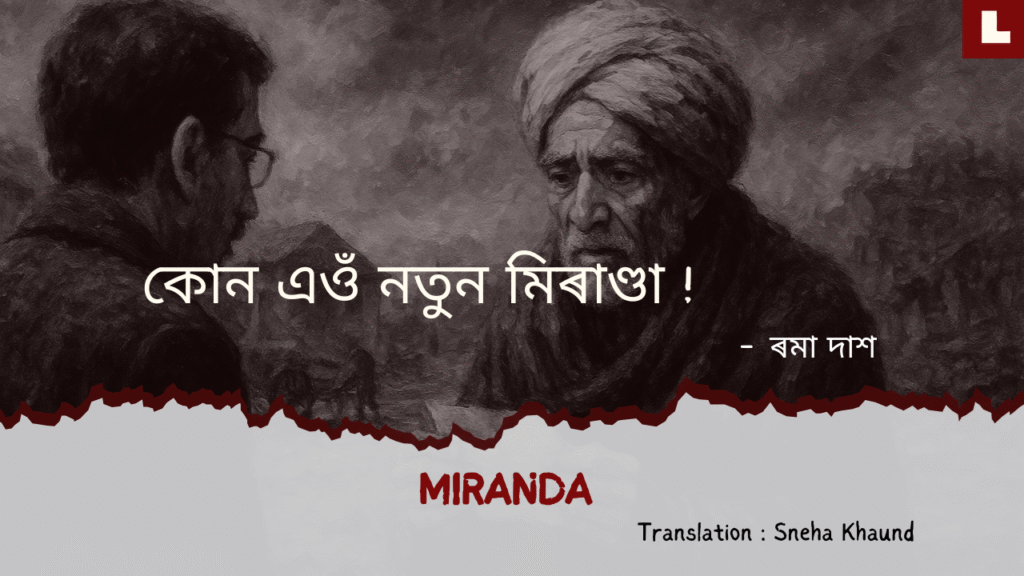

কোন এওঁ নতুন মিৰাণ্ডা!
– Roma Das, 1960
Translated From Assamese by Sneha Khaund
It was after the war.
After finishing my first cup of tea in the morning, with my eri shawl draped all around my body and my head, I was thinking of this and that, looking up at the sky.
July in Shillong. The sky looked as if the sun and the rain laden clouds would soon have a sporting match. The bit of clouds floated towards each other and scattered away again. As if they could not decide where to pitch themselves. As soon as they fix a spot to gather, they will pour down and drench all of earth.
I don’t know why, looking at the clouds suddenly reminded me of the war. I thought, just like the clouds, one day the war rushed in from nowhere, and just like that, it rushed away.
There were many different kinds of people here, from so many different countries. Regiments of soldiers, military equipment, and much else. The messiness of so much mess, the flush of money. Where did it come from, and where did it all go? It feels like the play of the clouds, when I think about it.
Forget about everything else, just take the case of my neighbour, Amulya’s store. Before the war, it wasn’t much more than a rundown hole-in-the-wall tea-shop. All it had was some half-broken wooden benches, a photo of Jawaharlal, a dozen or so cups with their handles missing, and a few stale and molding biscuits. But when the winds of the war blew through it, what a big ‘restaurant’ it became! Alcohol, meat, you could get whatever you desired. Day and night it was filled with soldiers of various countries, shouting and creating a ruckus, and getting into brawls.
But now it has become quiet again.
I was thinking of these things and sitting outside.
That is when I saw him standing in front of me–Gomar Singh.
Gomar Singh is just a Nepali dāju who sells firewood, but I have known him for a long time. When I first came here in search of a job, I stayed in the Assamese Mess at Laban. He lived in a small tin-roofed hut in a corner of the Mess’s backyard. His kañchī wife used to work as a part-time maid in the neighbouring houses. He used to supply us with firewood–either buying it from the store and carrying it back on his head, or secretly cutting some from the woods nearby.
But when the war arrived, the same Gomar Singh became a bigshot timber supplier. He left behind the shanty in Laban and moved to Rilbong. Right next to the cantonment. He built a large depot stocked with firewood, coal, and ‘coke’ in front of his house too. A signboard with large letters announced: Gomar Singh and Co. Military fuel contractor and supplier.
There were crowds of people who flocked to his depot to buy firewood. Countless cars, lorries, and trucks. Even though ten to twelve people worked there they could not fulfill all the orders.
But now there is no sign of that. His depot is gone, and so are the horse-carts, lorries, and trucks. The signboard has disappeared too.
To put it rather bluntly, Gomar Singh is completely bankrupt now. He puts on his old military overcoat and boots, wraps that red scarf around his neck, and hurriedly walks around the streets with some papers looking busy. But I have heard that his kañchī has removed her high heels and gone back to working part-time at the neighbors’ houses. Despite knowing everything, I feigned ignorance and called out to him.
Hey there, Gomar Singh! How are you these days? How is work?
What can I say, huzoor? It’s a big mess. I am barely managing to stay afloat. What even is left anymore to call my business? It all went away with the war. My only consolation now is the money I am owed. But things are so bad all around, I am losing hope whether I can ever recover my debts. Everyone I go to says the same thing. This month is very difficult. The wife is unwell. It’s the son’s exams. Come back next month. I will try to see what I can do. But if this happens every month. Tell me, how do I make ends meet, huzoor? Do I too not have a family, a son and a wife, debts of my own?
You probably don’t know, but during the war I took out a loan of just two hundred rupees from the Marwari trader, Badridas, in order to expand my business. Apparently now with fees and interest it has become seven hundred rupees. When the war was going on and I had a lot of money, I did not worry about paying off the loan. I used to think, who knows who will take off with whose money? Perhaps if I got out of the war alive, then I would think about paying back the money at some point. But before I knew it, the war ended, and I was out of cash. So how do I pay off the loan? A few days ago Badridas came to my house and snatched away the jewelry that my kañchī wore on her neck and wrists. Yesterday he came to take my horse and my cart. I did not let him. I told him that if you take these too, how will I eat, and how will I pay back your loan? Leave them, you don’t need to take my horse and cart. I still have about two hundred rupees left to get back from my old customers. As soon as I recover that money, I will go to you and return your money.
I said this to Badridas keñā and showed him my papers. He looked at them carefully, let out a laugh, gave the papers back to me, and said, “I understand that you are in a terrible rut. Who told you though that you will get back two hundred rupees? If you can recover even ten rupees, know that it is more than what you should be getting. Because even if these papers had any value in the past, they do not anymore. They are useless. Okay, since you have requested more time, I will give you another month. Keep in mind that I will certainly come back after a month. After that I will not listen to your excuses. I will take your horse, and your cart.
Huzoor, I have not had a moment’s peace since I heard those words come out of Badridas’s mouth. I feel as if my brain is melting. Where did all the wealth I created with so much hard work and struggle go? Who cheated me and stole my money? It is true that I am an uneducated man. But even so, did I not have my instincts and some sense of how things are? I can tell you how much business I did, how much money I made, and how much credit I extended. I didn’t give firewood to anyone without payment. I charged whoever took firewood from me. Otherwise I took a slip of paper from them. There is a heap of those slips still lying in my bag. Look at how many there are! I always go through the pile and open the folded slips of paper. I calculate the sums in my mind, and then put the slips back in the bag. They are my only source of consolation now. All the cash is gone. Now I have to recover my debts, and live off of them.
Even so, can you believe it, that that keñā, that wretched keñā, told me that I do not have money due from anyone? I may be illiterate but do I not have a sense of my own accounts? I can tell you that according to my calculations I am due back at least two hundred rupees. Where will that money go? It can’t possibly disappear, can it?
Huzoor, this is why I don’t entirely believe Badridas keñā. He is a wicked man. Who knows what tricks he is using to scam me? So here I am, huzoor. This is why I came running to see you. You are an old friend of mine. You are more educated and far wiser than Badrinath keñā. You are a bigshot in an office. So you will understand the value of these papers better. I request you to please go through them. Please tell me whether my calculations are correct or not. If you tell me I will have some peace. I can rest assured.”
Without waiting for my response, Gomar Singh frantically rummaged through the pockets of his overcoat. He took out hundreds of bits of paper, and poured them onto the table in front of me.
Not one of the pieces of paper matched any of the others. Each of them looked different, in shape, font, and colour. But each of them was folded exactly the same along the middle and kept carefully. Each of them appeared to be stained by dirty smoke and the pile reeked of strong chewing tobacco. When I opened them up, I could see that the corners were starting to fray and that some of the writing was starting to fade.
I carefully opened up the pieces of paper one by one and read them.
I saw that the first one was a corner torn out of an old, yellow office purchase form. It was written out very clearly, with a fountain pen, in English: Received from Gomor Singh fuel ten mounds. Signed below by some khasiẏani from Mawkhar. Name: Monimai Wallang. Dated from the war days. I had no way of knowing whether this person was still alive.
The second, a red handbill, published by ARP. On its back, in poor handwriting, written in Bengali: I have received fifteen mounds of firewood from Gomar Singh. The signature below was illegible. But beside it, the rubber stamp of Rilbong’s Shreebhumi Stores, which had closed shutters a long time ago, was clearly visible.
The next one was probably written in Assamese, it was hard to tell. The writing on the brown paper that is used to pack up stuff in grocery stores had completely faded. The only word you could somewhat read, next to the next to the signature, was “Barua.”
In this way, looking through the slips one by one, I reached the end of the pile.
Along with the receipts, I also found several cinema tickets. An ‘enclosure’ pass to visit the race course. An influenza prescription from a doctor at Laban hospital. A cash memo from Bata. And countless other miscellaneous things. I could see that Gomar Singh had folded them like his slips and kept them all together.
I quietly thought about what I could say. Just then my eyes fell upon the last couple of pieces of paper from Gomar Singh’s bag. I could tell that they were bigger in size than the other papers. Possibly pages from an exercise notebook and cut up into pieces. They had been kept neatly folded into squares.
When I opened them, I was stunned for a moment.
There wasn’t anything written on the top or bottom. No date, no signature. In the middle of the piece of paper, in beautiful English letters, arranged in a schoolgirl’s neat cursive, was written:
Looking at the sinking ship, Miranda told her father, “Oh father! Why have you raised this cruel storm? I cannot bear to see these people suffer. Please stop this.”
The absurdity of the situation made me smile. Gomar Singh seemed thrilled at my reaction.
“Huzoor, do you see, do you understand, what a wicked man that wretched Badridas is? How he wanted to trick me into giving up these papers? He says these letters have no value. That they are useless scraps. If these had indeed lost their value, would you have smiled like this? I knew that you would smile just like you did. Because you are an educated, knowledgeable, and wise man. You know the value of things. This is why I have not gone to anyone else but you. Please smile, laugh! I will be happy to see you laugh.
Saying this, he started clearing up the pieces of paper scattered across the table. I helped too and, handing over the papers, said to him,
“Gomar Singh, you are right. You should not believe Badridas keñā. These papers that you have may look useless to him, but they contain great value to you even now. So do not lose them, and do not give them to anyone. You can slowly collect one or two rupees and live off them for a while.
Your papers are not damaged. I see that the names and other details seem okay. Only this particular piece of paper bothers me. I can’t make out the name or anything else on it. There isn’t anything about firewood written here either.”
Gomar Singh looked at the piece of paper I was talking about and turned it over many times in his hands. He quietly said the name Miranda many times. Then suddenly he became excited like before.
“Huzoor, don’t worry! You may not be able to place it but I certainly can. Miranda–I never had a client called Miranda. I realized right away, it’s not Miranda’s–Narendra–it’s Narendra the compounder’s, it is his slip. You probably don’t remember, but in the old days there used to be a compounder called Narendra in Rilbong. He went to Manipur during the war and made a lot of money. He owns a large pharmacy in Laimukhrah now.
That’s right! I remember it exactly now. Before the war he had taken twelve mounds of wood from me. He has not paid me yet. Even though I am owed that money, it’s not gone, because I know that he is a good man. Besides, now he has a lot of money.
Let me go right away, I will go to him right now.
See you then, huzoor! Namaskār!”
Saying this, Gomar Singh left as quickly as he had arrived.
The dark clouds roared in all directions.
But Gomar Singh did not seem to care. He kept walking at the same pace.
I could not stop thinking about the page from the exercise notebook.
Whose daughter had read Shakespeare’s Tempest so earnestly in school? And had written–with such beautiful letters, Miranda’s inner thoughts? How had it reached Gomar Singh’s bag as one of his firewood slips?
Did someone really convince him that it was a credit note when they bought firewood? If so, in exchange for how many mounds of wood?
He has not seen Miranda’s words written on that piece of paper all these years. All he has seen is the cost of twelve or fifteen mounds of firewood.
Seeing that the ship was sinking, Miranda weeped and cried out to her father,
Oh father! Why did you conjure a storm for no reason and wish to drown the passengers of the ship? I cannot bear to see these helpless people suffer anymore. I beg you, please make the storm stop.
Who is that compassionate Miranda?
These tears are not only for Gomar Singh–they are for all of mankind.
Indeed, where is Gomar Singh going now?
Will he really show up at Narendra Compounder’s door? And ask money for twelve mounds of firewood, showing those scraps of paper?

[…] Also Read: Miranda […]