Discourses From the East

The Anthem of a Shattered Dream
“Who can build it today again?” This question, sung by Zubeen Garg in the 1990s, summed up the despair of a generation in Assam. The sentimental chorus of “Xunere xojua poja” touched the conscience of every conflict-torn Assamese.
Gold-garnished haven crumbles and wanes,
Who can build it today again
(Xunere xojua poja johi khohi jaai
Kune aaji xajibohi paribo dunai)
“Xunere xojua poja” was a metaphor for Assam itself. The 80s Assam Movement promised a ‘Xunor Axom’ (Assam of gold), but that dream was shattered by violence between ULFA and the Indian State. Zubeen not only lamented this loss but posed a direct, painful question: “Kune aaji xajibohi paribo dunai?” (Who can build it today again?). The song, a modern free-form ballad with simple yet powerful language, became a classic hit, its enduring relevance proven by its constant presence in his live performances.
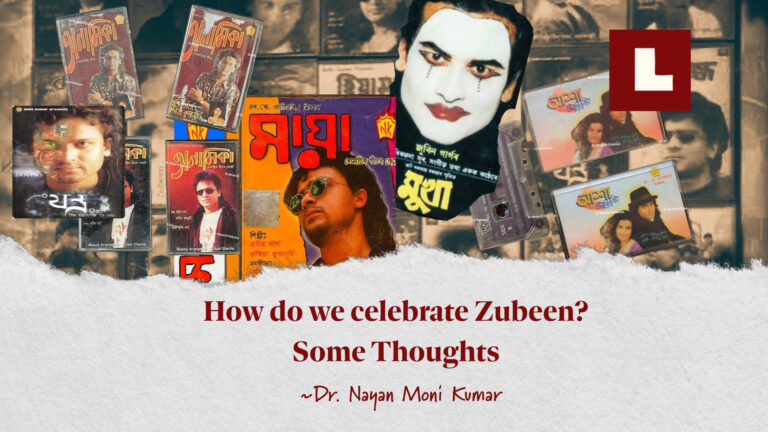
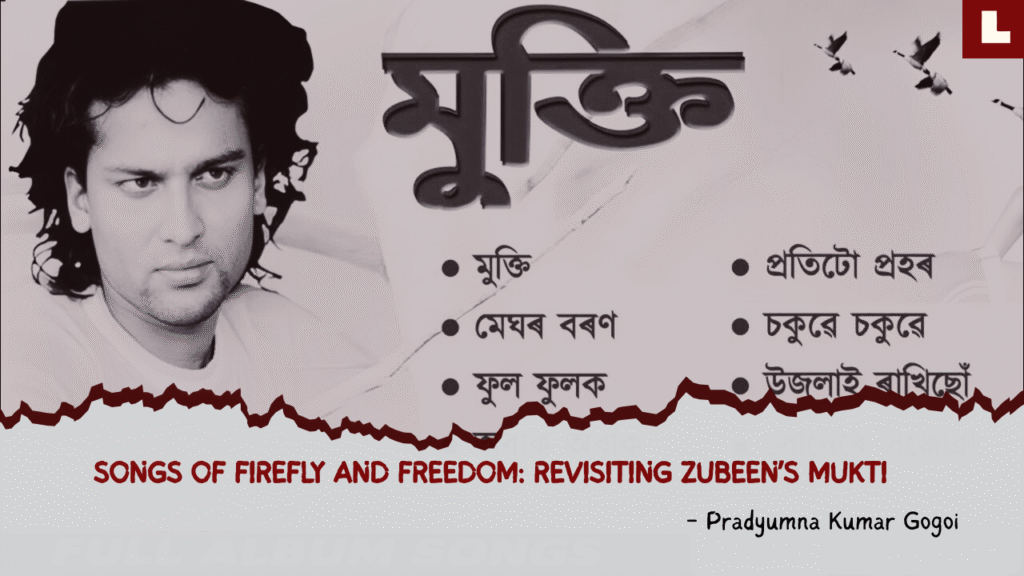
In 1997, at the peak of the Assam insurgency, Zubeen released his album Mukti. For the first time, he emerged as a vocal critic of both terrorism and the state. Before this, in albums like Anamika (1992) and Maya (1994), he sang of love and life, while Zubeenor Gaan (1995) explored philosophy. With Mukti, Zubeen portrayed an artist in social conflict, marking a milestone for him and the entire Assamese music scene. Interestingly, it wasn’t a hard-rock album, defying his typical depiction at the time. Its impact was huge, cementing his position as a bold, socially conscious artist. He once bluntly declared in his signature “colonel” attitude that “Xunere xojua poja” should be the state anthem of Assam instead of “O’ mur apunar desh”—a candid sentiment that sparked controversy and revealed his deep connection to the song.
The verses of “Xunere xojua poja” paint a vivid picture of the “crumbling haven”:
Old mom’s tears stream dry at the hearth
Same plight of dad too, gazing into the yard
For so long a time, haven’t seen little son’s eyes
Today in the sweetheart’s sky, no moon no stars
Plough’s cows just in the barn, paddy fields too dry
Just as night falls, sound of bullet bomb-blasts
(Burhi aair juhalote sokulu xukai…)
This verse captures the harsh reality of a conflict zone, where violence escalates at night and youth leave home—’habile gol’ (gone to the forest). Zubeen doesn’t sing of the youths’ dreams but laments their parents’ suffering—the sleepless nights and the impact on livelihoods, captured in lines like “Halor goru guhalite, potharu xukai” (Plough’s cows just in the barn, paddy fields too dry).
The final verse is a powerful critique of the state of insurgency and the very concept of independence:
Just grasping at independence, a hundred years gone
Bishnu-Jyoti’s Firefly Country hasn’t come into being till now
Among humans today, monsters are howling
Culture, reading, studying, just hopeless everything
Was this truly our twentieth century’s dream
Everywhere, only questions, anarchy and screams
(Swadhinotar buj lowtei exo bosor gol…)
“Swadhinotar buj lowtei exo bosor gol” (Just grasping at independence, a hundred years gone) highlights the long, layered struggle for independence in Assam. The “Bishnu-Jyotir jonaki desh” refers to the visionary “ideal kingdom” dreamed of by cultural icons Bishnuprasad Rabha and Jyotiprasad Agarwala, a dream that remained unfulfilled. Zubeen’s despair is palpable as he asks, “Eyai janu xopun asil kuri xotikar?” (Was this our dream for the twentieth century?). His questions—”Who can build it today again?” and “Was this truly our twentieth century’s dream?”—are infused with a raw anger and frustration that shook the core of Assamese society.
Andha Akash: The Anatomy of Violence
Another masterpiece on Mukti was “Andha Akash, ruddha botah”. Poetically, Zubeen plumbed the depths. The song begins with an ominous scream, evoking a bleak, oppressive atmosphere:
Blind sky, trapped air
Afraid night’s halted moonlight
In the blind mind’s shut corner
Bestial love’s untamed downpour
See today, liberation remains pathless
Path by path, only death’s chariot triumphs
(Andho akash, ruddha botah…)
Zubeen questions how death and violence were becoming normalized: “Mrityu atiya xohoj” (Now, death is so easy). In a powerful moment, he engages with his favorite poet, Hiren Bhattacharya (Hiruda), who once wrote, “Mrityu u tu eti xilpo” (Death is also an art). Zubeen asks, “Mrityu jodi xilpo hoi, mrityu kidore xulobh?” (If death is an art, why does it become cheaper?).
In the third verse, he taunts ULFA while reflecting on the paradox of life and death:
In the dream of becoming independent
How much is left of being human today…
The meaning of every birth is infinite hope
Meaning did not stay, turned into fatal havoc
(Mukto huar sapun dekhi…)
He asks, “Mukto huar xopun dekhi, poxu huat kiman baki?” (In the dream of becoming independent, how much is left of being human?) and articulates a profound truth with “Janma luar artho bixal” (the meaning of every birth is vast).
The song ends with a philosophical turn. A wistful flute enters as Zubeen sings his philosophy of freedom:
Free sky, calm air
Poetry night’s serene moonlight
Liberation is now in hand
Liberation is now in soul
Liberation is now in inner self
(Mukta akash, shanto botah…)
He declares liberation an internal, personal transformation. The musical conversation with his sister Jonkey symbolizes unity, and the song transforms from a primal scream into a spiritual anthem, ending with a Sanskrit Shanti Mantra (Om Sarve Bhavantu Sukhinah), echoing ideals of non-violent resistance.
Protitu Prohor: A Collective Elegy
“Protitu Prohor” echoes the pain and despair of the era. Every line starts with “Protitu” (every single), making the trauma a collective experience:
Every single hour
Every single minute
Every single second screams today…
(Protitu prohor
Protitu samay…)
The use of repetition and anaphora emphasizes the omnipresence of anguish. Zubeen’s voice is raw and emotive, oscillating between somber tones and intense anguish, especially in lines like:
Of every single eye
Every single teardrop
Every single day’s history today…
(Protitu sokur
Protitu tupal…)
The imagery of “Protitu premor xemeka saki” (pale candle of every single love) suggests a flickering hope. The song builds to a cathartic climax, with a haunting guitar solo and overdubbed vocals, painting a picture of communal grief and solidarity. This makes “Protitu Prohor” a timeless elegy, transcending its specific context to speak for every place and time scarred by conflict.
Obak Obak and the Streams of Life
Yet, Mukti was not solely an album of protest; it was also a testament to the enduring human spirit, with its second half exploring the flows and streams of life, love, and intuition.
“Obak Obak” is a poignant and mesmerizing ode to the human experience:
Speechless speechless
Dream dream
Light light
I am today
(Obak obak
Xopun xopun
Puhor puhor
Aji moi)
Among the tracks on Mukti, this is where Zubeen most vigorously turns inward, declaring “Puhor puhor aji moi” (Light light, I am today). This became a vigorous manifestation of personal liberty for his listeners, reminiscent of, yet distinct from, Bhupen Hazarika’s poetic “I.” The repetition creates a hypnotic rhythm, and the poignant last line, “Dudin pisot ekei kandun” (After two days, just that same weeping), underscores the cyclical nature of our emotional landscapes.
Tracks like “Meghor Boron” capture the essence of love as a transcendent force. It is a breathtakingly beautiful masterpiece:
You be mine, as if this moment
Yet you be distant distant…
(Atiya jen tumi mur mur
Tothapitu tumi dur dur…)
With its soothing music and Zubeen’s fluctuating yet tranquil voice, the song deifies the beloved, rendering them an unattainable ideal with phrases like “Meghor boron, junor boron, tumi kun jur…” (Clouds’ hue, sunlight’s hue, moon’s hue, who serene be you).
Similarly, “Phool Phoolok” is a vibrant, sensual celebration of love and nature. Its evocative wishes, using nature imagery to convey deep emotion, can be seen as a yearning for peace and normalcy amidst the turmoil:
Stay the bygone path covered
A mist-kissed dry fallen leaf…
In this heart of mine
Bloom the flower, sunflower
(Eri oha baat dhaki tho…
Mur ei hiyat ful fulok, suryamukhi ful) The Mukti album, therefore, stands as a complete artistic statement. It is a poignant portrayal of a society scarred by violence, a scathing critique of power, and a timeless celebration of the heart’s will to persevere, love, and find liberation within. Zubeen Garg, through this work, cemented his legacy as the voice of his generation, an artist who spoke straight to, and from, the soul.